How Much Super Do You Need to Retire in Australia - and How Spending Changes With Age

Figures current from 20 September 2026. How this is made
Key takeaways
- ASFA's comfortable lump sums are $630,000 for a single person and $730,000 for a couple. They're for retiring at 67, and they assume you own your home outright, receive a part Age Pension and draw down all your savings.
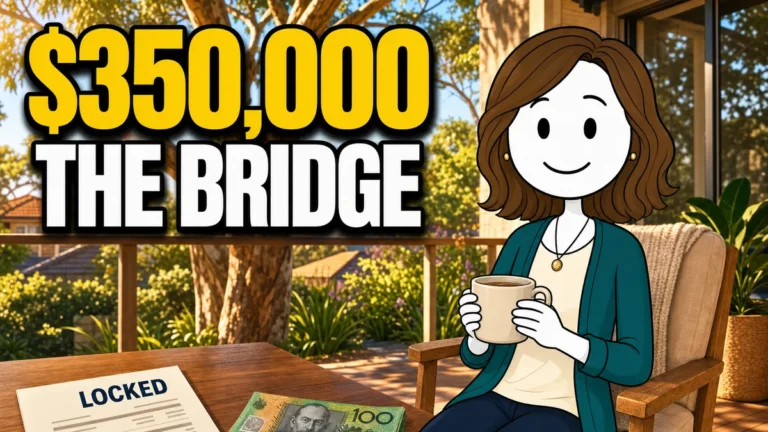
- Stop work at 60 and that's seven years with no Age Pension - about $393,000 of ASFA's comfortable single budget at today's prices, before returns. And if you were born from 1 July 1964, your super generally stays locked until at least 60.
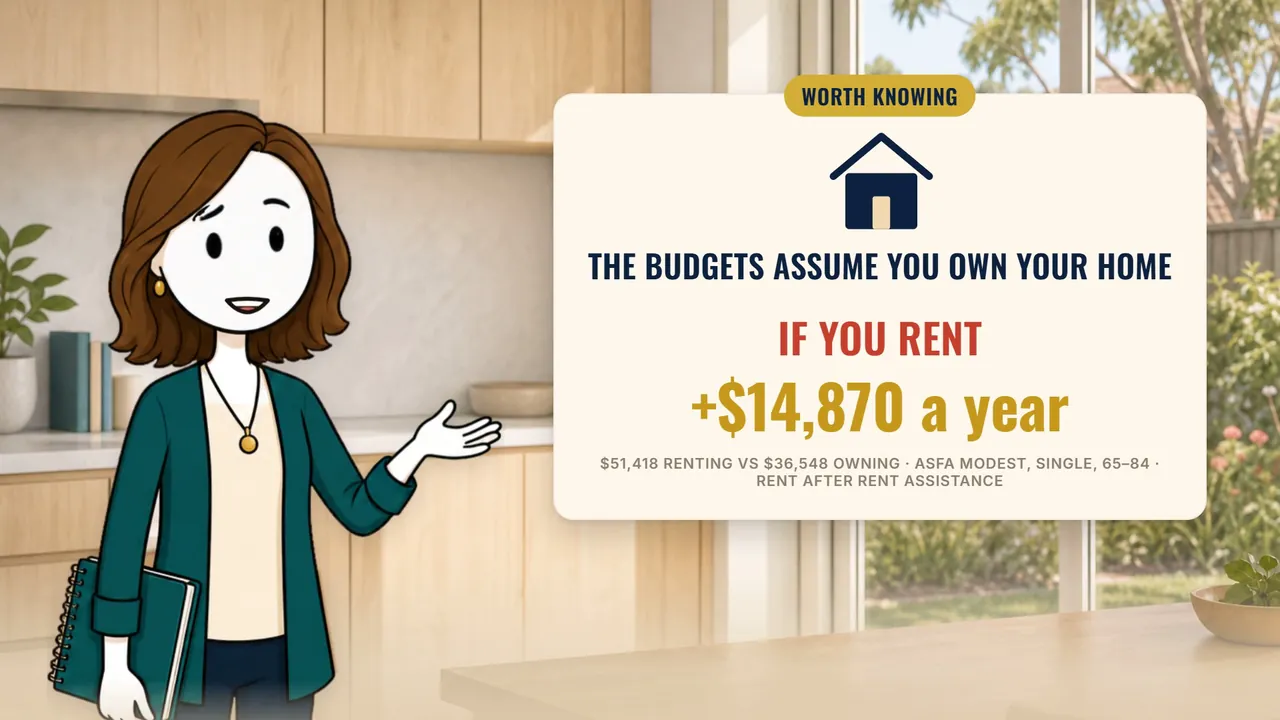
- If you rent, ASFA's modest budget for a single person is $51,418 a year, even after Rent Assistance - $14,870 more than for a homeowner.
- Spending tends to be highest early in retirement, slow from about 70 and fall faster after 80. Health and housing costs such as council rates are the exceptions.
- The full Age Pension covers about 88% of ASFA's modest budget for a single homeowner aged 65 to 84, and about 57% of the comfortable one. The share is higher for the over-85s.
How much super do I need to retire? The best-known answer comes from ASFA: $630,000 for a single person and $730,000 for a couple to retire comfortably. Those figures are real and useful - but they rest on assumptions about when you stop, where you live and how you spend. This guide sets out what the figures assume, what changes if you retire early or rent, and how to work out your own number. It then looks at how spending changes from 65 to 85, and how much of it the Age Pension covers - at the rates from 20 September 2026.

This video was recorded in August 2026, using ASFA's March quarter 2026 budgets. The figures in this article are the current ones, checked again on 11 November 2026.
How much super do you need to retire comfortably in Australia?
The Association of Superannuation Funds of Australia (ASFA), the super industry body, publishes the ASFA Retirement Standard. It costs out two lifestyles - modest and comfortable - for singles and couples, and turns them into the savings you'd need at retirement (ASFA Retirement Standard).
| Savings needed at 67 | Single | Couple |
|---|---|---|
| Comfortable, homeowner | $630,000 | $730,000 |
| Modest, homeowner | $110,000 | $120,000 |
| Modest, renting privately | $340,000 | $385,000 |
ASFA also publishes yearly budgets for retirees aged 65 to 84, and updates them every quarter.
| Budget a year, aged 65 to 84 | Single | Couple |
|---|---|---|
| Comfortable, homeowner | $56,166 | $78,998 |
| Modest, homeowner | $36,548 | $52,690 |
| Modest, renting privately | $51,418 | $69,376 |
Comfortable means a reasonable car, top-level private health cover, regular leisure activities, occasional restaurant meals, an annual domestic trip and one overseas trip every seven years. Modest means an older, more basic car, basic health cover, infrequent leisure activities and an annual domestic trip or a few short breaks. ASFA describes modest as better than the Age Pension alone, but still only the basics.
What does ASFA's $630,000 assume?
ASFA states its assumptions. Each one matters if it doesn't describe you.
- You retire at 67. The lump sums are "savings required for retirement at age 67".
- You own your home outright - except in the separate renters' figures.
- You're relatively healthy. The budgets are for retirees aged 65 to 84 who own their home and are relatively healthy.
- You spend it all. The lump sums assume you draw down all your capital.
- You get a part Age Pension, from the start and into the future. That's why the modest lump sums are so small: ASFA says the Age Pension and its supplements already meet much of a modest budget.
- A steady return. The figures assume investment earnings of 6% a year, and are shown in today's dollars, adjusted for wage growth of 2.75% a year.
ASFA doesn't update its lump sums every quarter, because the Age Pension it builds in is adjusted too. It revised the homeowner figures in February 2026 for price rises since March 2023.
So $630,000 isn't a pass mark. It's what one standard of living costs one kind of retiree, under one set of assumptions.
What if you retire before 67?
Two ages set the limits. Your preservation age - the earliest age you can usually get at your super - is 60 if you were born from 1 July 1964, according to the ATO. The Age Pension starts at 67.
Reaching 60 isn't enough on its own. Your fund also needs a condition of release - an event the super rules recognise, such as retiring. From 60, a job ending on or after your 60th birthday is enough by itself. If your job ended before 60, your fund also has to be satisfied you intend never again to work 10 hours a week or more. Our guide to retiring at 60 covers the details.
Stopping early costs twice. You have more years to fund, and your contributions stop sooner - along with the growth they would have earned.
- Stop at 60 and that's seven years with no Age Pension. Seven years of ASFA's comfortable single budget comes to about $393,000 at today's prices, before any returns.
- Stop at 55 and, if you were born from 1 July 1964, your super generally stays locked for five years. Five years of the same budget is about $281,000, and it has to come from money outside super - savings or investments in your own name.
Money still invested keeps earning while you draw on it, which lowers those amounts. By how much depends on returns, which aren't guaranteed.
One thing to check if you're under 67 and on a means-tested payment. While you're under Age Pension age, Centrelink doesn't count your super in the income and assets tests - the two checks on what you earn and what you own that set your pension or payment - if your fund isn't paying you a pension. Once it pays you one, it's assessed as an income stream - a regular payment from your super (Services Australia). If you get JobSeeker, living on your super before 67 can reduce that payment. It matters for couples with an age gap too: once your partner is Age Pension age, their super counts even if they don't get a payment. Our complete guide to retirement in Australia works through an age-gap couple.
What if you rent in retirement?
ASFA's main budgets assume you own your home outright. Renters don't pay the council rates, insurance and repairs that come with owning a home, but ASFA says rent costs more. ASFA's modest budget for a renting single is $51,418 a year - $14,870 more than for a homeowner. That's after Rent Assistance, the regular extra payment Centrelink makes to people on an eligible payment who pay rent.
Put another way, a single renter's modest budget is almost the same as a homeowner couple's ($52,690). For couples, renting adds $16,686 a year.
ASFA's renter lump sums are $340,000 for a single and $385,000 for a couple, for a modest lifestyle from 67. It doesn't publish a comfortable figure for renters.
Two things work in a renter's favour. The Age Pension assets test has higher limits for people who don't own their home, so a renter can own more before the assets test starts to reduce the pension: up to $600,000 for a single and $766,000 for a couple, against $333,000 and $499,000 for homeowners. (For money in super and the bank, the income test's limit - about $192,320 for a single - is the same whether you own or rent.) And Rent Assistance is paid on top of the pension (ASFA's renter budgets already allow for it). Moneysmart suggests renters include rent in their budget and allow for it to rise over time.
How do you work out how much super you need?
There's no single answer, as Moneysmart puts it - the amount depends on your spending, your housing and the lifestyle you want (Moneysmart: how much you need to retire). This guide works backwards from spending, not forwards from a balance.
An example: Denise
Denise is an illustration, not a real person. She's 61, single, owns her home outright, gets no Centrelink payment, and plans to stop work at 63.
- What she spends. She adds up her last 12 months: $52,000. About $4,000 of that is commuting and other work costs that stop when she does. That leaves $48,000 a year - between ASFA's modest and comfortable budgets. (Costs that don't come every year, like a car or a roof, belong in that figure too - our complete guide covers that spending.)
- The years before 67. From 63 to 67 she has no Age Pension. Four years at $48,000 is $192,000, before returns. Because her job ends after 60, her super is unlocked to help fund it.
- From 67. The full Age Pension for a single person is $1,237.70 a fortnight - about $32,180 a year, including supplements. If she were paid the full rate, her own money would need to cover about $15,820 a year.
- Whether she'd get the full rate. That depends on what she owns and earns. The assets test allows the full pension with up to $333,000 of assets for a single homeowner. For money in super and the bank, the income test sets a lower limit - about $192,320 with no other income (full Age Pension limits). Above either limit she'd get a part pension, and her savings would fill more of the gap.
- Testing it. Her savings and her pension are linked - above the limits, more of one means less of the other - so a single sum can't settle it. Moneysmart's retirement planner asks for your retirement age, super and other assets, then compares the estimated income with a target - so you can change one input and see how far the answer moves.
That's the same logic ASFA uses: its lump sums assume a part pension, not the full rate.
Why the order of returns matters
ASFA's lump sums use one steady return. Real returns arrive as a sequence of good and bad years. The government's Retirement Income Review calls the risk this creates sequencing risk: "the risk of lower returns and losses occurring when a person needs to withdraw their capital".
The reason is simple. When you're drawing an income, a fall in markets can mean selling investments at lower prices to cover living costs, and what's sold can't share in any recovery. Two people with the same balance and the same average return can end up in different places, depending on when the bad years arrive.
How much this matters depends on your balance, how much you draw, how your money is invested and what other income you have. That makes it a question for a licensed financial adviser.
How does spending change at 65, 70, 75 and 80?
ASFA's budget is a costed shopping list, not a record of what retirees actually spend - and it has just two age groups, 65 to 84 and 85 and over. For what happens in between, researchers use spending surveys. The Retirement Income Review and the Grattan Institute both used the Australian Bureau of Statistics' Household Expenditure Survey, up to 2015-16, so their findings show the shape of retirement spending, not today's prices.

At 65: the biggest-spending years
In a 2018 analysis of the actual spending of more than 300,000 Australian retirees, Milliman, an actuarial firm, found couples spent the most between 65 and 69. The Grattan Institute's 2018 report Money in retirement found spending is highest in early retirement, when retirees are healthiest and travelling. And some costs stop with work, like the commute and work clothes.
At 70: spending starts to ease
Grattan's finding, from following the same generations through successive surveys: "Spending tends to slow at around the age of 70, and decreases rapidly after 80." Milliman found the same shape - for couples, a fall of about 6% to 8% across each four-year age band in early retirement, speeding up after 80. Grattan puts the fall down to less spent on transport, recreation and food, and clothes and furniture replaced less often.
At 75: what people buy changes
The government's Retirement Income Review (final report dated July 2020) found that retirees spend less on transport, clothing and recreation as they age, while total spending on essentials stays roughly flat. The main essential that falls is food, likely because people eat out less and have more time to cook at home.
At 80 and over: the drop speeds up
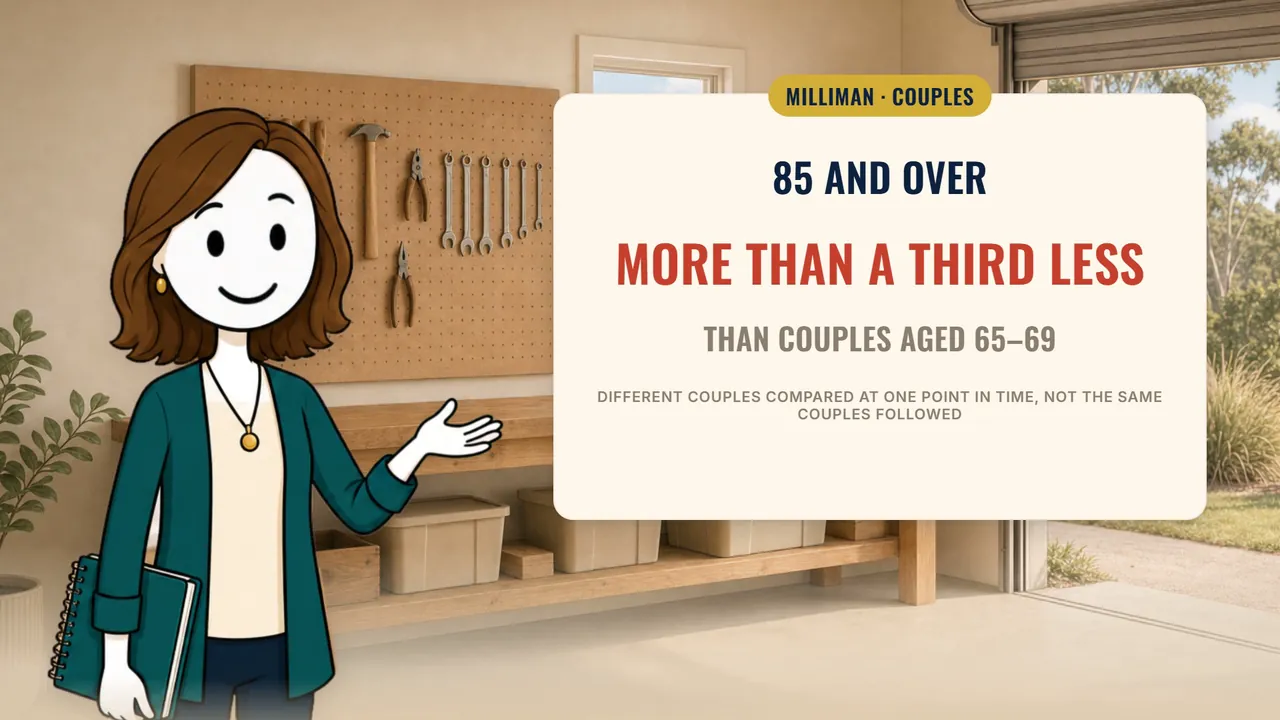
For households aged 80 and over in 2015-16, the review found 19% of spending went on discretionary items - things like transport, recreation and clothes - compared with 41% when the same group was aged 55 to 59. Milliman found the median couple aged 85 and over spends more than a third less (36.7%) than couples aged 65 to 69. That compares different couples at one point in time, not the same couples followed through.
The two costs that go up
- Health. In the review's figures, medical costs rose from 5% of median spending at 55 to 59 ($28 a week) to 9% at 80 and over ($40 a week, in 2018-19 dollars). Part of that rise in share is because total spending fell. Grattan notes governments pay for most of the cost of health and aged care.
- The house. Grattan found housing costs rise late in retirement - possibly in part because council rates have risen faster than inflation. Owning your home outright doesn't make it free.
What ASFA's budget does at 85
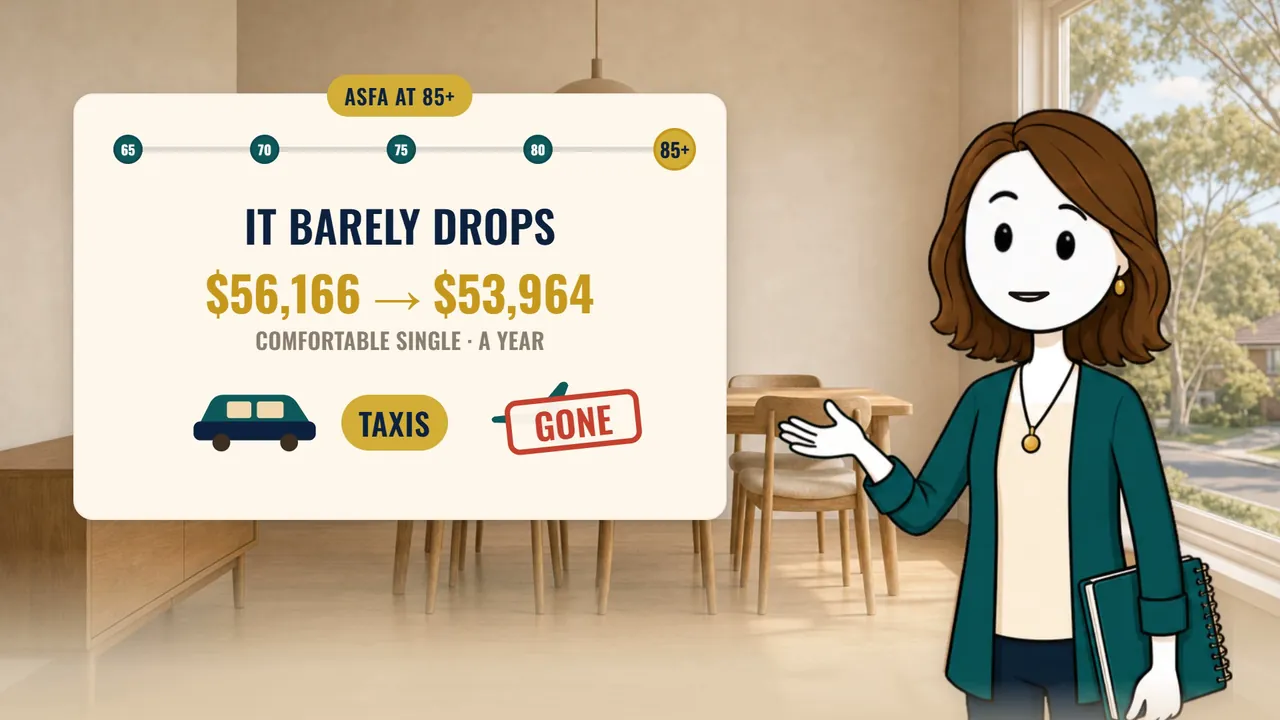
ASFA's budget for the over-85s barely drops. For a comfortable single homeowner it's $53,964 a year, against $56,166 at 65 to 84 - about $2,200 less. The money moves rather than disappears: the car goes and taxis come in, overseas travel goes, and there's more for health and for help at home.
| Comfortable single, a week | 65 to 84 | 85 and over |
|---|---|---|
| Transport | $193.81 | $49.63 |
| Overseas travel | $22.57 | $0.00 |
| Health | $125.45 | $179.81 |
| Cleaning and home care | $23.48 | $142.44 |
How sure is this?
These are averages, not promises. Grattan thinks the fall may be understated, because people on higher incomes tend to live longer - so those still surveyed in their eighties were often better off to begin with. Others disagree on the size of the fall: a study for the Australian Institute of Superannuation Trustees, using a different survey, suggested spending may not fall much at all, while Grattan says that survey captures only about half of household spending. And a health problem, or needing care, can make the later years the expensive ones.
Does the Age Pension cover retirement spending?
Put the full Age Pension against ASFA's budgets for homeowners. The full rate is $1,237.70 a fortnight for a single person - about $32,180 a year, including supplements - and $1,866.00 for a couple combined, about $48,516 a year, both partners 67 or older.
| Full pension covers | Aged 65 to 84 | 85 and over |
|---|---|---|
| Single, modest | 88% | 93% |
| Single, comfortable | 57% | 60% |
| Couple, modest | 92% | 98% |
| Couple, comfortable | 61% | 65% |
On the full pension, a modest life in your own home is mostly paid for; a comfortable one leaves a much bigger gap. And the share is bigger from 85 on, because ASFA's budget is a little lower while the pension isn't. The pension is adjusted every 20 March and 20 September, so if your spending eases with age, the same pension covers more of it. The gap is widest in the earlier years of retirement - when the spending studies say people spend the most.
Three limits on that table:
- The full rate needs modest savings and income. With more, you get a part pension, and your own money covers more of the gap.
- Renters. The full pension covers about 63% of ASFA's modest budget for a single renter (a budget that already allows for Rent Assistance).
- A couple with one partner under 67. Only the older partner is paid, at the partnered rate of $933.00 a fortnight - half the couple figure - and the younger partner's income still counts.
The bottom line
ASFA's $630,000 and $730,000 are a well-built benchmark for one kind of retiree: 67, a homeowner, relatively healthy, on a part Age Pension and spending all their savings. Retire earlier and you add years with no pension - and before 60, years with no super. Rent, and ASFA's own modest figure for a single person rises to $340,000. Your own number starts with what you'll actually spend, less the costs that stop with work, and less the Age Pension you're likely to get.
Spending isn't flat either. On the averages, it's highest in the first years, eases from about 70 and falls faster after 80, while health and the house cost a bit more. The full pension covers a bigger share of ASFA's budgets after 85 than before.
The ASFA figures and Age Pension rates change: ASFA updates its budgets every quarter, and the pension changes every March and September. For how your super and savings would affect your own pension, Services Australia's Financial Information Service is free - call the Older Australians line on 132 300 and ask for a FIS officer.
Frequently asked questions
Retirement calculators plan to my nineties. How long should I plan for?
That's personal, but the averages help. In the Bureau of Statistics' latest life tables (2022-2024), a man aged 67 could expect to live about another 18.5 years, to around 85 and a half, and a woman about another 21 years, to around 88. Those are averages, so many people live longer. ASFA's lump sums assume you draw down all your savings - so the longer you plan for, the more a balance has to stretch.
Isn't ASFA's comfortable budget too low? One overseas trip every seven years isn't much.
It's a benchmark, not your budget. ASFA's comfortable lifestyle includes a reasonable car, top-level health cover, regular leisure, an annual domestic trip and one overseas trip every seven years - and it assumes you own your home outright. The full Age Pension covers about 57% of the comfortable single budget of $56,166 a year. If you travel more than that, your own number is higher.
My costs have gone up since I retired, not down. How can spending fall?
Both can be true. The research on falling spending is measured after prices - the Retirement Income Review's figures are in 2018-19 dollars, adjusted for inflation. So prices still rise; what falls on average is how much people buy. ASFA updates its budgets every quarter for price changes, and the Age Pension is adjusted every 20 March and 20 September.
Does spending really fall that much in retirement?
Most of the studies agree on the direction more than the size. The Retirement Income Review summarised an American study that found real spending fell by about 2% a year at 75 and about 1.5% at 85. In Australia, Milliman found couples' spending fell about 6% to 8% across each four-year age band early in retirement, then faster after 80. A study for the Australian Institute of Superannuation Trustees suggested spending may not fall much at all. These are averages - your health and your plans matter more.
Sources
- ASFA Retirement Standard - June quarter 2026 budgets for 65-84 (homeowners and renters); lump sums $630,000 / $730,000, $110,000 / $120,000 and $340,000 / $385,000 for retirement at 67; draw down all capital, part Age Pension
- ASFA Retirement Standard summary - assumptions: home owned outright, relatively healthy, 6% earnings, 2.75% AWE deflator; homeowner lump sums revised February 2026; renter budget includes Rent Assistance
- ASFA Retirement Standard detailed budgets, June quarter 2026 - weekly items for 65-84 and 85+ homeowners and 65-84 renters; 85+ budgets $53,964 / $34,619 single, $74,484 / $49,611 couple
- ATO - Super withdrawal options - preservation age 60 from 1 July 1964; conditions of release (updated 10 July 2026)
- APRA - SPG 280 Payment Standards - from 60, a job ending on or after 60 is enough; the intention test applies only if it ended before 60
- Services Australia - Who can get Age Pension - Age Pension age 67 (updated 1 December 2025)
- Services Australia - How much Age Pension you can get - $1,237.70 a fortnight single, $933.00 each and $1,866 combined for a couple, including supplements (updated 20 September 2026)
- Services Australia - Assets test for Age Pension - full-pension limits $333,000 / $600,000 single and $499,000 / $766,000 couple, homeowner / non-homeowner (from 20 September 2026)
- Services Australia - Income test for Age Pension and Deeming - $226 a fortnight free area; deeming 1.75% on the first $66,800, 3.75% above (updated 20 September 2026)
- Services Australia - Superannuation (JobSeeker Payment) and (Age Pension) - super not counted under Age Pension age unless it pays a pension; a partner's super counts from their Age Pension age (updated 3 February 2025)
- Services Australia - Rent Assistance - what it is (updated 14 July 2026)
- Moneysmart - Work out how much you need to retire - no single answer; costs that stop with work; renting in retirement (updated 6 November 2026)
- Moneysmart - Retirement planner (updated 14 July 2026; inputs read in the browser 11 November 2026) and Budget planner (updated 27 October 2026)
- Retirement Income Review - Final Report - sequencing risk (glossary); spending by age, discretionary share 19% vs 41%, medical 5% vs 9% (Appendix 6A, ABS HES 1988-89 to 2015-16); the Blanchett US figures (report dated July 2020)
- Grattan Institute - Money in retirement: More than enough - spending slows around 70 and falls rapidly after 80; rates and insurance; survivorship bias; HILDA captures half of spending (November 2018)
- Milliman - Retirees' spending falls faster than expected into old age - 300,000+ retirees; couples peak at 65-69, 36.7% less at 85+; 6% to 8% per four-year band; AIST counter-view (23 April 2018)
- ABS - Life expectancy, 2022-2024 - life tables: further life expectancy at 67 of 18.5 years (men) and 21.0 years (women) (released 11 November 2025)
- Services Australia - Financial Information Service and Phone us - a free service with FIS officers; the Older Australians line, 132 300
General information only. This article is general information only. It doesn't take into account your objectives, financial situation or needs, and it isn't personal financial advice. Speak with a licensed financial adviser about your own situation. Services Australia's Financial Information Service (132 300) is free. Figures are current from 20 September 2026 and change every March, July and September - check servicesaustralia.gov.au and ato.gov.au for the latest.
A note on how this is made: Every article starts with real research and is checked against current ATO and Services Australia figures - that part isn't automated. AI tools help draft the text and produce the video's narration and visuals. We write, verify and stand behind every word.
Keep reading
- Average Super Balance at Retirement in Australia - and What the Age Pension Adds
- Can You Retire at 60 in Australia? The Rules That Unlock Your Super
- How Much Is the Age Pension? Rates for Singles and Couples, Homeowners and Renters
New here? Start with the complete guide: Retirement in Australia, explained - every rule, every test and a countdown to your last working day.