
Transition to Retirement Pensions Explained: How a TTR Works

Figures current from 20 September 2026. How this is made
Key takeaways
- A transition to retirement (TTR) pension lets you draw an income from your super once you reach preservation age - 60 - while you keep working. It's a separate account, and you must draw between 4% and 10% of its balance each financial year.
- A TTR's investment earnings are still taxed at 15%, the same as your accumulation account. They become tax-free only when it moves into retirement phase: automatically at 65, or once you retire and tell your fund.
- From 60, TTR payments from a taxed fund are generally tax-free. On its own, a TTR saves no tax - any saving comes from salary sacrificing into super alongside it, within the $32,500 concessional cap for 2026-27.
- You can't add money to a TTR once it's paying. To add more, you close it and start a new one - and if a personal contribution you want to claim a tax deduction for is involved, your notice of intent has to come first.
- Before 67, super isn't counted by Centrelink while it isn't paying a pension. Start a TTR and the TTR counts - for example, for your own JobSeeker Payment, or for an older partner's Age Pension.
A transition to retirement pension lets you start drawing an income from your super at 60 without retiring. You can use it to cut back your hours and top up your pay. Or, while still working full time, you can pair it with salary sacrifice to move more of your pay into super. But a TTR isn't a tax-free retirement pension, and the rules on how much you take out, what you can put in, and when it switches over all matter. This guide explains how transition to retirement works, using the 2026-27 rates.

This video was recorded in August 2026, using the 2026-27 rates. The rules and figures in this article were checked again on 11 November 2026.
What is a transition to retirement pension?
A transition to retirement (TTR) pension is an income from your super that you can start once you reach your preservation age - the earliest age you can normally get at your super. The ATO calls it a transition to retirement income stream. That's 60 for anyone born after 30 June 1964, which now covers everyone still to reach it. You don't have to stop work or change jobs (ATO: transition to retirement).
In practice it's a second account. You choose an amount, and your fund moves it out of your accumulation account - the account your super builds up in while you work. It goes into a TTR pension account, which pays you regular amounts.
- Your accumulation account stays open. Your employer still has to pay super guarantee while you're on a TTR, and those contributions go into accumulation, along with any salary sacrifice.
- It pays an income, not a lump sum. A TTR is "non-commutable": it generally can't be turned into cash in one go while you're still working. Lump sums are allowed only in limited cases.
- Your fund has to offer it. Whether you can start one depends on your fund's rules.
How much can you draw from a TTR each year?
Until you're 65 (or meet another full condition of release - an event that unlocks all your super, covered below), the payments in each financial year must be at least 4% and no more than 10% of the TTR's balance.
Both limits are worked out on your balance on 1 July each year. In the year you start, they're based on the balance on your start date, and two special rules apply:
- The minimum is scaled back for the part of the year that's left - by the number of days from your start date to 30 June.
- Start on or after 1 June, and no minimum payment is needed for that financial year.
The 10% maximum isn't scaled back for a part first year. Within the band, you can choose a different amount each year.
How the amount you move sets the minimum
The minimum is 4% of whatever is in the TTR account, so the more you move across, the more you have to take out. Move $480,000 into a TTR and the minimum is $19,200 a year. If you only need $15,000, that's $4,200 a year leaving super that you didn't need to take. Moving less across keeps the minimum lower, and the rest stays in accumulation.
Can you add money to a TTR?
No. A contribution made after a pension has started can't be added to it. The only way to add accumulation money to a TTR is to close it - fully commute it, in super terms - and start a new pension with the bigger balance. Before a TTR is fully closed, the minimum payment for that part of the year has to be paid.
That's one more reason the accumulation account stays open: every new contribution lands there.
Insurance inside super
If you have life, total and permanent disability or income protection cover through super, the premiums are deducted from your super balance. Moneysmart notes that cover can stop if an account becomes inactive or its balance gets too low. Before moving money across, ask your fund which account your cover is attached to, and how much needs to stay there to keep paying for it.
The notice of intent comes first
Some people put extra money into super themselves and claim a tax deduction for it. To claim it, you give your fund a notice of intent - the form that tells it you'll claim - and get its written acknowledgment before you claim the deduction on your tax return.
The notice isn't valid once your fund has started paying a pension using any of that contribution. Starting a TTR, or closing one and restarting it with more money, can do exactly that. So the notice goes in after the contribution and before the pension starts, and the fund's acknowledgment comes back before you claim the deduction.
How is a TTR taxed?
There are two separate questions: tax on what you take out, and tax on what the account earns.
Payments. From 60, payments from a TTR in a taxed super fund are generally tax-free, and you don't usually have to include them in your tax return. The exception is an untaxed element - money your fund hasn't paid tax on, most commonly in a public sector fund - which can still be taxed.
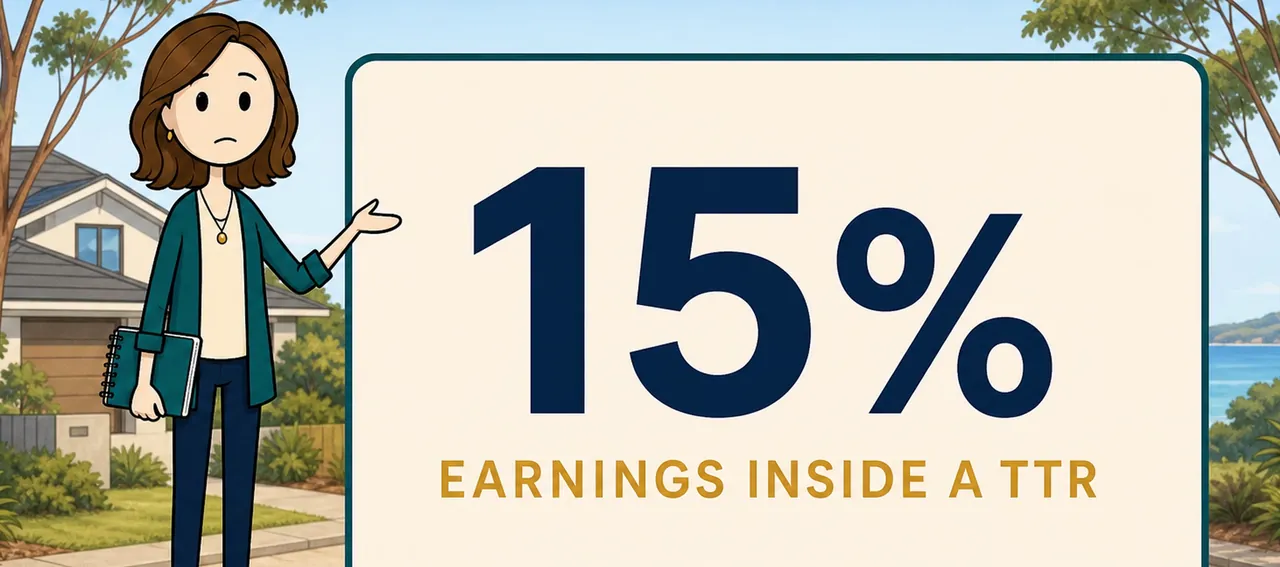
Earnings. Here's the catch. A TTR isn't in retirement phase - the stage where pension earnings are tax-free - until you meet a full condition of release. Until then, its earnings are taxed the same way as your accumulation account: at 15%.
So moving money from accumulation into a TTR doesn't change the tax on its earnings. Any tax saving has to come from somewhere else - which is where salary sacrifice comes in.
When does a TTR become tax-free?
A TTR moves into retirement phase when you meet one of these conditions of release:
- you turn 65 - whether or not you're still working
- you retire - from 60, a job ending on or after your 60th birthday is enough on its own; only if the job ended before 60 must your fund be satisfied that you intend never again to work 10 hours a week or more
- permanent incapacity, or a terminal medical condition.
At 65 the move is automatic. For the others, it happens only once you tell your fund, and it takes effect from the date you notify them. Until you do, the earnings are still taxed at 15%. Our guide to retiring at 60 explains the retirement rule in more detail.
Once it's in retirement phase:
- the earnings are tax-free
- the 10% maximum no longer applies, and nor do the TTR's limits on lump sums
- you still draw a minimum each year: 4% of the balance under 65, and 5% from 65 to 74
- its value counts towards your transfer balance cap - the lifetime limit on what you can move into retirement phase. The general cap is $2.1 million for 2026-27.

If you've already met one of these conditions - say you stopped work at 61 - you don't need a TTR at all. A retirement phase pension can be started instead, and its earnings are tax-free from the start. Our guide to super mistakes after 60 covers that one.
How does salary sacrifice work with a TTR?
Salary sacrifice means having some of your pay go into super before tax. The amount you sacrifice isn't taxed as your income. Instead, the fund pays 15% contributions tax on it - usually less than your own marginal rate. Your employer still has to pay your full super guarantee as if you hadn't sacrificed anything.
The TTR's job is to replace the pay you've sacrificed, so your take-home income stays the same while more goes into super. The limits:
- The concessional contributions cap - the yearly limit on before-tax contributions - is $32,500 for 2026-27 (ATO: contributions caps). Your employer's super guarantee counts towards it. The super guarantee is 12% for 2026-27.
- Carry-forward. If your total super balance - everything you hold in super - was under $500,000 on the previous 30 June, you may be able to use unused cap amounts from up to five earlier years.
- Going over means the excess is included in your taxable income and taxed at your marginal rate, less a 15% tax offset for the contributions tax the fund has already paid.
- Division 293. If your income and concessional contributions together are over $250,000, an extra 15% tax applies to some or all of your contributions.
An example: Dave, 62
Dave is an illustration, not a real person. He's 62, single, earns $90,000 and has $500,000 in super. He sets up a TTR on 1 July 2026 and salary sacrifices to fill the concessional cap.
- His employer's super guarantee is 12% of $90,000 - $10,800. That leaves $21,700 of room under the $32,500 cap. His balance was also $500,000 on 30 June 2026 - not under $500,000 - so carry-forward isn't open to him.
- He salary sacrifices $21,700. His taxable income falls from $90,000 to $68,300.
- His tax and Medicare levy fall by $6,944, from $19,320 to $12,376.
- His take-home pay drops by $14,756, from $70,680 to $55,924. So that's what he draws from the TTR - tax-free, because he's over 60.
- He moves $360,000 into the TTR, not all $500,000. His minimum is $14,400 and his maximum $36,000, so $14,756 sits inside the band. The other $140,000 stays in accumulation, where his contributions keep landing.
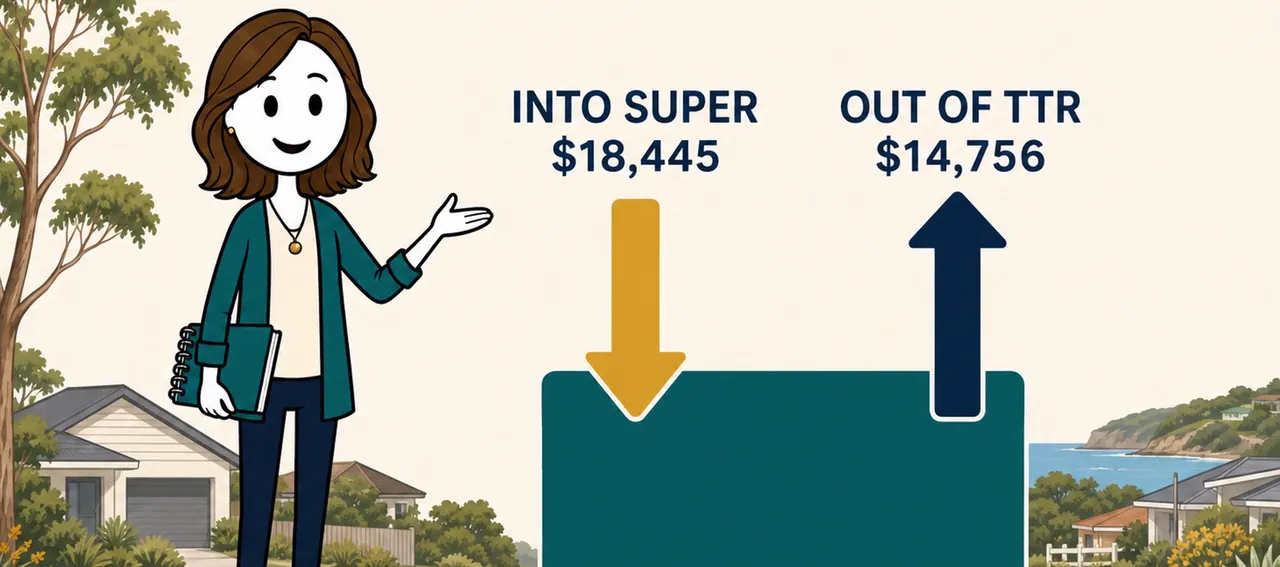
- The super side. The $21,700 is taxed at 15% going in, so $18,445 reaches his super, against $14,756 coming out of the TTR.
| Dave, 2026-27 | Without a TTR | With salary sacrifice and a TTR |
|---|---|---|
| Taxable income | $90,000 | $68,300 |
| Income tax | $17,520 | $11,010 |
| Medicare levy | $1,800 | $1,366 |
| Take-home pay | $70,680 | $55,924 |
| TTR payments (tax-free) | $0 | $14,756 |
| Total in his pocket | $70,680 | $70,680 |
The result: the same money in his pocket, and his super ends the year $3,689 higher than it would otherwise have been. That's simply the tax he saved ($6,944) less the contributions tax the fund paid ($3,255).
The assumptions. Dave is an Australian resident for tax for the whole year, with no other income, no deductions and no Medicare levy surcharge. The low income tax offset doesn't apply at either income, because both are above $66,667. His whole salary counts for super guarantee, his fund is a taxed fund, and the TTR runs for the full year. The example leaves out fees and investment returns - his earnings are taxed at 15% in both accounts, so moving money into the TTR doesn't change them. His income plus contributions is far below the Division 293 threshold.
Note where the gain comes from. It's the salary sacrifice, not the TTR. Start a TTR and keep contributing exactly as before, and you've only taken money out of super early.
Who can a TTR suit, and who doesn't it suit?
The ATO describes the original purpose: once you reach preservation age, a TTR may let you reduce your working hours without reducing your income. The salary sacrifice use, in Dave's example, is the other common one. Either way, how much difference it makes depends on a few things.
Your tax rate. The saving is the gap between your own tax rate and the 15% the fund pays on a salary sacrificed contribution. The lower your income, the smaller that gap. In 2026-27, the rate on income from $18,201 to $45,000 is 15c in the dollar before the 2% Medicare levy and any tax offsets, and income up to $18,200 isn't taxed at all - below that threshold, salary sacrifice adds tax rather than saving it.
Room under the cap. Your employer's 12% counts towards the $32,500 cap, so the higher your salary, the less room is left to sacrifice.
Whether you've already met a condition of release. If you've retired after 60, or you're 65 or over, a retirement phase pension's earnings are tax-free, where a TTR's aren't.
Fees. Ask your fund what fees apply to a TTR account.
Your fund. Not every fund offers a TTR. A defined benefit fund, where your benefit is worked out by a formula rather than from an account balance, works differently - your fund can tell you what it allows.
Centrelink. For anyone on a means-tested payment, or with a partner on one, this can outweigh everything else. That's the next question.
Does a TTR affect Centrelink payments?
It can - and this is the part to check before starting one if you, or your partner, get a means-tested payment.
While you're under Age Pension age (67), Centrelink doesn't count your super in its income and assets tests as long as your fund isn't paying you a pension. A TTR is a pension. Once it starts, it's assessed as an income stream (Services Australia: superannuation). A TTR is an account-based pension. For one started from 1 January 2015, Services Australia counts the account balance in the assets test. In the income test it applies deeming - the rate of return Centrelink assumes your savings earn.
That matters in two common situations:
- You get JobSeeker Payment. Starting a TTR from your super counts for that payment, where super left in accumulation doesn't.
- There's an age gap and your partner gets the Age Pension. Their pension is means-tested on the couple's combined income and assets.
What changes if Dave had a partner on the Age Pension
Say Dave, at 62, had a partner aged 68 getting the Age Pension. Dave can't get the Age Pension himself until 67. Only his partner is paid, at the partnered rate, and the couple's combined income and assets are tested.
- His accumulation account isn't counted while he's under 67 and it isn't paying a pension.
- His $360,000 TTR is counted - at its balance in the assets test, and deemed in the income test. Money Centrelink couldn't see before is now on the couple's means test, and that can cut his partner's pension or stop it.
- His wages count too. Services Australia includes salary sacrifice amounts in employment income, so sacrificing pay into super doesn't lower the income Centrelink counts.
For a homeowner couple where only one partner is eligible, the assets test allows the full pension with up to $499,000 of combined assets. Our complete guide to retirement in Australia works through a couple with an age gap.
Services Australia's Financial Information Service is free - call the Older Australians line on 132 300 and ask for a FIS officer.
The bottom line
A transition to retirement pension is a second account that pays you between 4% and 10% of its balance a year from 60 while you keep working. Its payments are generally tax-free, but its earnings are taxed at 15% until it moves into retirement phase - automatically at 65, or when you retire and tell your fund. On its own it saves no tax; the saving comes from salary sacrifice within the $32,500 cap. And once it starts, Centrelink counts it.
Your fund can tell you whether it offers a TTR, what fees apply, where your insurance sits, and whether an existing TTR is in retirement phase. For how one would affect a Centrelink payment - yours or your partner's - Services Australia's Financial Information Service is free on 132 300.
Frequently asked questions
Does my TTR switch to retirement phase at 65 if I'm still working?
Yes. Turning 65 is a condition of release whether or not you're working, and the ATO says a TTR moves into retirement phase automatically as soon as you reach 65. From then its earnings are tax-free, the 10% maximum no longer applies, and the minimum draw becomes 5% of the balance a year from 65 to 74. If you retire before 65, it doesn't happen on its own - you have to tell your fund.
Can I change how much I draw from a TTR each year?
Yes, as long as the year's payments stay between 4% and 10% of the balance. The limits are recalculated each year on your 1 July balance, so you can pick a different amount within the band each year. How and when you can change your payments during a year depends on your fund.
Is a TTR only worth it on a higher income?
The saving depends on the gap between your own tax rate and the 15% contributions tax. In 2026-27, income from $45,001 to $135,000 is taxed at 30c in the dollar plus the 2% Medicare levy, before any tax offsets, so the gap is wide while your taxable income stays in that band. Once salary sacrifice takes your taxable income below $45,001, the rate on those dollars is 15c plus the levy, and the gap shrinks.
How do I know if my super is a defined benefit fund?
The ATO describes a defined benefit interest as one where the benefit is generally worked out from a specified amount or formula - commonly your salary at a particular time or an average salary. Your fund can tell you which kind you have, and whether it offers a TTR.
From 65, can I start a tax-free pension while I'm still working?
Yes. At 65 your super unlocks with no cashing restrictions, working or not, and a retirement phase pension's earnings are tax-free. The amount you can move into retirement phase is limited by your transfer balance cap ($2.1 million general cap for 2026-27). Your accumulation account can stay open for your employer's contributions, because contributions can't be added to a pension. If you put some of your payments back into super, they're non-concessional contributions, unless you claim a tax deduction for them: the cap is $130,000 for 2026-27, and it's nil if your total super balance was at or over the general transfer balance cap on the previous 30 June.
Sources
- ATO - Transition to retirement - reduce hours without reducing income; non-commutable; employers still pay super guarantee; a TTR isn't in retirement phase until 65, retirement, permanent incapacity or a terminal condition (updated 5 June 2026)
- ATO - Retirement withdrawal: lump sum or income stream - 4% to 10% under 65; moves to retirement phase automatically at 65, otherwise when you notify your fund; defined benefit interests (updated 31 March 2026)
- ATO - Transition to retirement income streams (SMSF) - limits on the start-date and 1 July balance; contributions can't be added, full commutation to combine; the 10% maximum isn't reduced in a part first year; payments over 60 generally tax-free (updated 2 April 2025)
- Superannuation Industry (Supervision) Regulations 1994, Schedule 7 - first-year minimum pro-rated by days; no minimum if started on or after 1 June (Compilation No. 159, 1 July 2026)
- ATO - Super withdrawal options - preservation age 60; the meaning of retirement (updated 10 July 2026)
- ATO - Conditions of release (APRA-regulated funds) - leaving a job at 60 or over; no cashing restrictions at 65 (updated 13 October 2025)
- APRA - SPG 280 Payment Standards - when the job ended after 60, future work intentions are not a consideration
- ATO - Tax on super benefits - earnings taxed at 15% in accumulation; the untaxed element (updated 2 August 2023)
- ATO - Payments from super - minimum drawdown 4% under 65, 5% from 65 to 74 (updated 16 September 2026)
- ATO - Transfer balance cap - $2.1 million for 2026-27 (updated 27 April 2026)
- ATO - Contributions caps - concessional $32,500 from 1 July 2026; non-concessional $130,000; excess concessional contributions taxed at marginal rates; carry-forward (updated 11 September 2026)
- ATO - Concessional contributions cap - carry-forward needs a total super balance under $500,000 on the previous 30 June (updated 2 July 2026)
- ATO - Super guarantee percentage - 12% for 2026-27 (updated 17 April 2026)
- ATO - Salary sacrificing super - taxed at 15% in the fund; doesn't reduce the super guarantee base (updated 21 April 2026)
- ATO - Division 293 tax - $250,000 threshold, extra 15% (updated 24 August 2026)
- ATO - Personal super contributions - when a notice of intent is valid; acknowledgment before claiming (updated 23 May 2024)
- ATO - Tax rates for Australian residents - 2026-27 rates; Medicare levy 2% (updated 13 August 2026)
- ATO - Low income tax offset - nil above $66,667 (updated 8 June 2026)
- Moneysmart - Insurance through super - premiums deducted from your balance; when cover can stop
- Services Australia - Superannuation (Age Pension) and (JobSeeker Payment) - super isn't counted under Age Pension age unless it's paying a pension; the Older Australians line, 132 300 (updated 3 February 2025)
- Services Australia - Income streams - account-based income streams started from 1 January 2015: account balance in the assets test, deemed in the income test (updated 26 May 2026)
- Services Australia - Employment income - salary sacrifice amounts count as employment income
- Services Australia - Assets test for Age Pension - $499,000 for a homeowner couple, one partner eligible (from 20 September 2026)
- Services Australia - Who can get Age Pension - Age Pension age 67 (updated 1 December 2025)
- Services Australia - Financial Information Service - a free service
General information only. This article is general information only. It doesn't take into account your objectives, financial situation or needs, and it isn't personal financial advice. Speak with a licensed financial adviser about your own situation. Services Australia's Financial Information Service (132 300) is free. Figures are current from 20 September 2026 and change every March, July and September - check servicesaustralia.gov.au and ato.gov.au for the latest.
A note on how this is made: Every article starts with real research and is checked against current ATO and Services Australia figures - that part isn't automated. AI tools help draft the text and produce the video's narration and visuals. We write, verify and stand behind every word.
Keep reading
- Can You Retire at 60 in Australia? The Rules That Unlock Your Super
- Super Mistakes After 60: Five That Cost Australians Money
- Retiring at 55 in Australia: Bridging the Gap to Your Super
New here? Start with the complete guide: Retirement in Australia, explained - every rule, every test and a countdown to your last working day.