
The 2027 CGT Changes: Investment Property, Shares and ETFs

Figures current from 20 September 2026. How this is made
Key takeaways
- From 1 July 2027, the 50% capital gains tax discount for individuals, trusts and partnerships is replaced by cost base indexation - lifting what you paid by inflation - for gains made after that date. It's law: the Treasury Laws Amendment (Tax Reform No. 1) Act 2026 received royal assent on 26 June 2026.
- If you're an Australian resident individual, almost everything you hold on 30 June 2027 is treated as sold and bought straight back at market value. The gain up to then is deferred until you sell or another CGT event happens, and it keeps the 50% discount. No tax is payable on the night.
- A new 30% minimum tax applies to the part of a gain made after 1 July 2027, for Australian resident individuals. It's a floor, not a flat rate - and it doesn't apply in any income year you receive the Age Pension, JobSeeker, the Disability Support Pension, Carer Payment or another payment the Act lists.
- Capital losses must now go against your frozen, discounted gains first, so a dollar of loss can save half as much tax.
- Negative gearing is limited from 2027-28 for residential property bought after 7:30pm on 12 May 2026, unless it's a new build. The main residence exemption and the six-year rule don't change.
These are the CGT changes 2027 brings for anyone holding an investment property, shares or ETFs outside super. The headline - "the 50% discount is being scrapped" - is only half the story. The gain you've already made keeps its discount, automatically, and you don't have to sell anything to protect it. What changes is how the growth after 1 July 2027 is taxed, how losses are used, and how negative gearing works for property bought after Budget night - 7:30pm on 12 May 2026.
What are the CGT changes from 1 July 2027?
Capital gains tax (CGT) is the tax on the profit when you sell an asset - a rental property, shares, ETF units - for more than it cost you. The changes are in the Treasury Laws Amendment (Tax Reform No. 1) Act 2026, which received royal assent on 26 June 2026. The Federal Register of Legislation lists no amendments or compilations of it since. From 1 July 2027:
| What | Before 1 July 2027 | From 1 July 2027 |
|---|---|---|
| Individuals, trusts, partnerships | 50% discount on assets held 12 months or more | Cost base indexation for assets held 12 months or more |
| Minimum tax | None | 30% floor on gains made after 1 July 2027, for resident individuals |
| Gain already made by 30 June 2027 | - | Keeps the 50% discount when you sell |
| Capital losses | You choose which gains they reduce | A fixed order, frozen gains first |
| New builds and affordable housing | 50% discount, or more for qualifying affordable housing | Can keep the current discount instead of indexation |
| Pre-CGT assets (bought before 20 September 1985) | Exempt | Still exempt for gains to 1 July 2027; gains after that are taxed |
The ATO says three things aren't changing: what counts as a CGT asset, the framework of CGT events, and the main residence exemption for your home (ATO: capital gains tax reform). The 2027-28 tax return is the first one the CGT changes can affect, and only if you sell something, or another CGT event happens, in that year.
What happens to the gain you've already made?
It's frozen, and it keeps the old rules.
If you're an Australian resident individual, the Act treats almost every asset you hold on 30 June 2027 as if you sold it just before 1 July 2027, at its market value, and bought it straight back for the same amount. There's no buyer, no agent and no tax bill on the night. The gain up to that point - the deferred gain - is set aside until you sell the asset or another CGT event happens to it, whether that's the next year or decades later. Trusts have a similar rule. Pre-CGT assets have their own, whoever holds them: the gain up to then stays exempt.
When you do sell, the deferred gain is worked out under the old rules, including the 50% discount, as long as you've owned the asset for at least 12 months by the time you sell. Only the growth from 1 July 2027 onwards is taxed the new way.
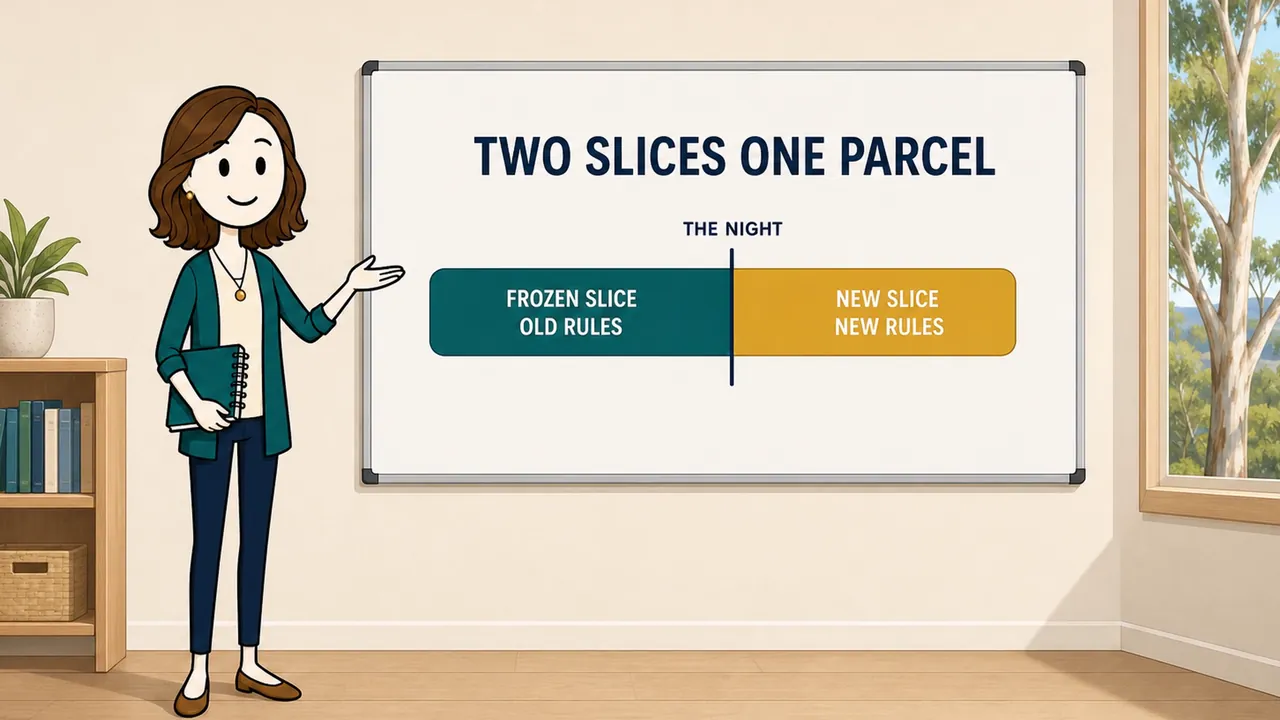
So selling before July 2027 to "lock in" the discount doesn't lock in a discount the law doesn't already give the frozen gain (the exception is how capital losses are used - see below). It brings the tax on the gain forward to an earlier year, and the selling costs come with it.
The Act doesn't apply the deemed sale to assets that qualify as new residential dwellings or affordable housing under the new rules - those can keep the current discount (50%, or more for qualifying affordable housing) instead.

This video was recorded in September 2026. Since then the ATO has published its guidance and the next tranche of legislation has been introduced - this article covers both, and corrects two points noted below.
How does indexation work, and is it better than the discount?
Indexation lifts your cost base - broadly, what the asset cost you - by inflation, measured by the consumer price index, before the gain is worked out. You pay tax on the real gain rather than half the nominal one.
Two details matter:
- It only runs from 1 July 2027. For an asset you held before then, the new cost base is its market value on that date, and only that is indexed. Someone who bought in 2011 doesn't get indexation back to 2011 - that period is covered by the frozen gain and the old discount.
- It needs 12 months of ownership, just as the discount does now. Sell within a year and there's no indexation.
An example: Denise's rental unit
Meet Denise. She's an illustration, not a real person: 60, single, retired early, owns her home, and owns a unit she's rented out since 2011. She isn't on JobSeeker or any other Centrelink payment. She's under Age Pension age (67), and later on the unit alone would put her over the assets test cut-off for a single homeowner, which is $745,750 at today's rates.
Say the unit is worth $800,000 on 30 June 2027 and she sells it eight years later. We'll assume inflation of 2.5% a year - an assumption for the illustration, not a forecast.
- Indexed for eight years, her new cost base rises from $800,000 to about $975,000.
- If she sells for $1.1 million, her taxable gain on the slice after 1 July 2027 is about $125,000.
- Under the old 50% discount, the same slice would have been $150,000. With slow growth, the taxable gain is smaller.
- If the unit instead grows 7% a year, she sells for about $1.37 million. Her taxable slice is about $400,000, where the old discount would have left about $287,000.
| Denise's unit, slice after 1 July 2027 | Sells for | Taxable under indexation | Under the old 50% discount |
|---|---|---|---|
| Slow growth (about 4% a year) | $1,100,000 | about $125,300 | $150,000 |
| Strong growth (7% a year) | about $1,374,500 | about $399,800 | about $287,300 |
As a rough guide, with inflation at 2.5%, indexation beats the discount while the asset grows by less than about 4.4% to 4.8% a year, over holding periods of 4 to 15 years (the break-even slips a little the longer you hold). Above that, the taxable gain is larger. Both comparisons are before the 30% minimum tax, which can change the comparison for someone with little other income. It's a change to the tax on future growth, not on what's already been made.
Indexation can't create a loss
The Act lets costs be indexed in working out a gain, but not a loss. So there's a band where you have neither. Buy shares after 1 July 2027 for $10,000, and three years of 2.5% inflation lifts the cost base to about $10,770. Sell for $10,500 and there's no gain - and no loss to claim either.
What is the 30% minimum tax on capital gains?
It's a floor. For Australian resident individuals, the part of a capital gain made after 1 July 2027 must be taxed at no less than 30%, before tax offsets are applied. If the tax that gain adds to your bill already works out at 30% or more, nothing changes. If it's less, you pay a top-up to bring it to 30%.
It applies only to the new slice. The frozen gain to 30 June 2027, with its 50% discount, sits outside it. Gains from new residential dwellings and affordable housing are outside it too, and so are companies and super funds - it's for individuals only.
Denise in a low-income year
Say Denise - in her early 60s by then, and still on no payment - has $30,000 of other taxable income in a year after the change, and sells shares she bought after 1 July 2027 for a $20,000 gain after indexation.
- At the tax rates legislated for 2027-28 and later years, the gain adds $3,600 to her income tax - about 18% of it (before tax offsets, and leaving out the Medicare levy).
- The floor is 30% of $20,000: $6,000.
- So she pays a top-up of $2,400.
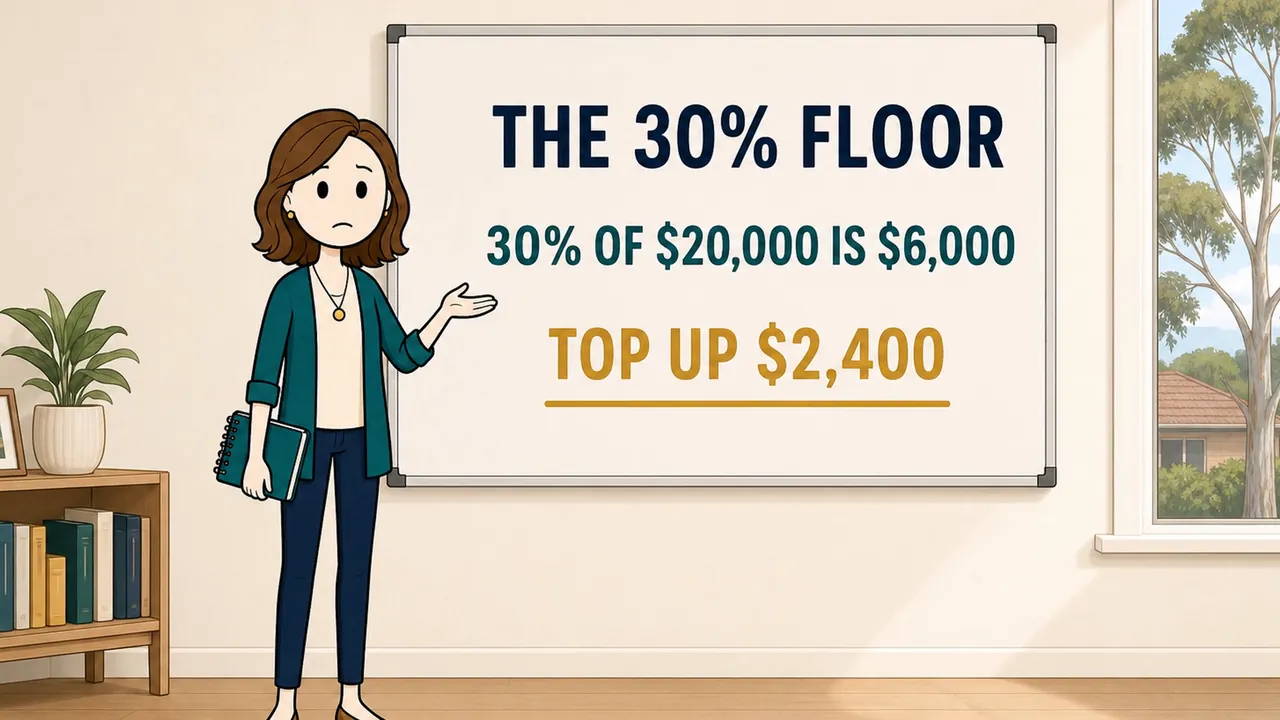
A quick check: if the rest of your taxable income - including any frozen, discounted gain in that year - is already $45,000 or more, every dollar of the new gain is taxed at 30% or more under those rates, and the floor adds nothing.
A deductible super contribution, or any other ordinary deduction, still reduces your taxable income - but not the gain the floor is measured on. Of the deductions, the Act lets only gifts and conservation covenants reduce that.
Who is exempt from the minimum tax?
The minimum tax doesn't apply at all for an income year in which you receive, at any time, one of the payments listed in section 119-15 of the Act. They include:
- the Age Pension, JobSeeker Payment, the Disability Support Pension, Carer Payment and Parenting Payment
- Austudy, Youth Allowance, Special Benefit and the Double Orphan Pension
- Family Tax Benefit, Farm Household Allowance and Parental Leave Pay
- the ABSTUDY living allowance, and several DVA and military compensation payments, including the age service pension.
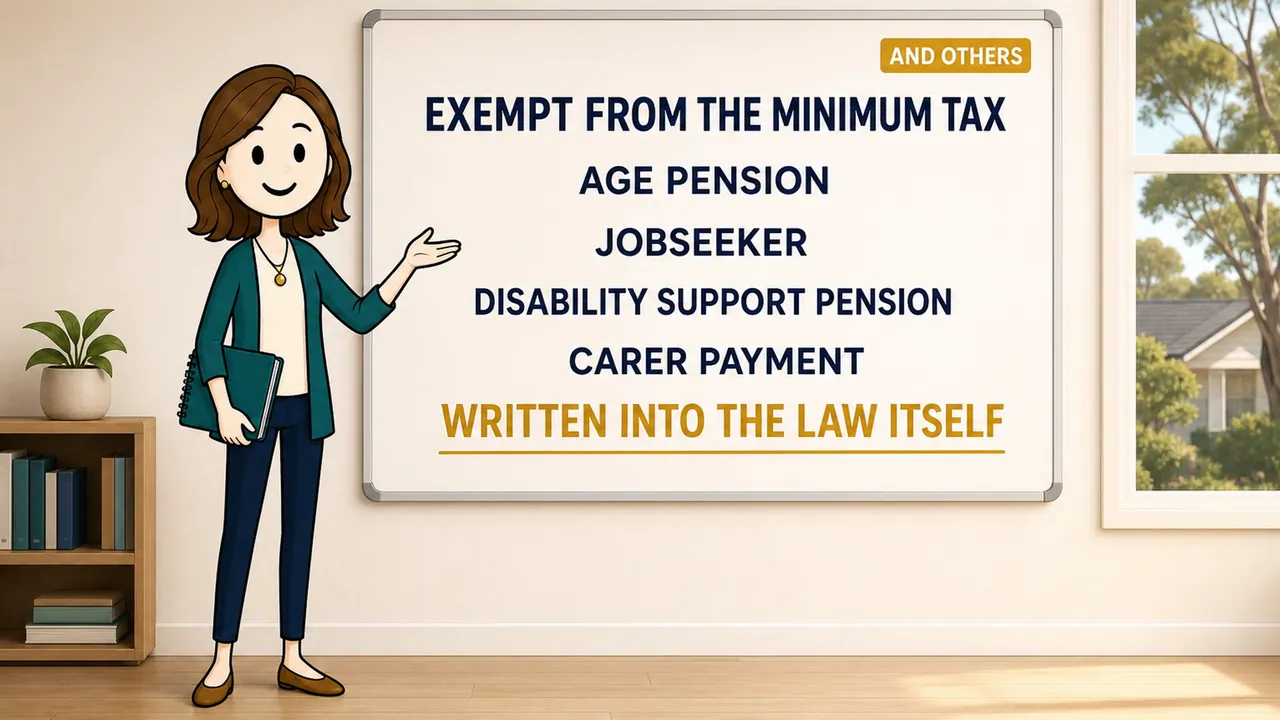
The list is written into the Act itself. The lead video said it would come in an instrument that hadn't been made yet. That was wrong: the list has been in the Act since it passed.
How do the changes affect shares and ETFs?

The same rules apply, with two differences that matter for share investors.
The value on the night is easy to find. For listed shares and ETFs, the market publishes a price. Property owners are the ones who may need a valuation (see below).
Losses now follow a fixed order. Under the current rules, the ATO's 2026 guide for personal investors says to subtract capital losses "in the manner that gives you the greatest benefit" - usually against gains that don't get the discount first. From the income year that includes 1 July 2027, the Act takes that choice away. Losses for the year must reduce gains in this order:
- frozen gains on assets other than residential property (shares, ETFs, commercial property)
- frozen gains on residential property
- new gains on assets other than residential property
- new gains on residential property.
Carried-forward losses from earlier years then go through the same order. Because a frozen gain gets the 50% discount, cancelling a dollar of it only removes 50 cents of taxable gain.
Denise's shares and a loss
In one year after the change, Denise sells three parcels:
- shares she held on 30 June 2027, for exactly what they were worth that night - a frozen gain of $30,000, and nothing after
- shares bought after 1 July 2027, with a $10,000 gain after indexation and no discount
- shares bought after 1 July 2027, sold at a $10,000 loss.
- If she could choose, the loss would cancel the $10,000 new gain. The frozen $30,000 is halved to $15,000. Her net capital gain: $15,000.
- Under the fixed order, the loss must go against the frozen gain first: $30,000 less $10,000 leaves $20,000, halved to $10,000. Add the $10,000 new gain. Her net capital gain: $20,000.
Same three sales, $5,000 more of gain taxed. The $10,000 loss was worth $5,000 of taxable gain, not $10,000.
What else to know for shares
- A share that's under water on the night has its loss frozen too. It's counted when you sell or another CGT event happens, just like a frozen gain.
- ETF and managed fund distributions can include capital gains. How the new rules apply to trusts and managed investment vehicles is being adjusted in the Tax Reform No. 3 Bill (see below).
- Records. The ATO says existing record-keeping rules continue: when you bought each asset, what you paid, and any change to it. Each dividend reinvestment buys a new parcel with its own cost base.
Do I need a valuation before 1 July 2027?
No. When you sell an asset you held before 1 July 2027, you may need its market value just before that date. But the ATO says this doesn't require a valuation in place on that date, and that taxpayers shouldn't get one before it, "as a valuation can't be forward-looking" (ATO: CGT reform - guidance and market valuations, 19 October 2026).
There's also an alternative to a valuation: the apportionment method, which splits a gain between the periods before and after 1 July 2027 without needing the market value on that date. The Government's draft method covers real property and assets without a readily available market price. As at 19 October 2026, the ATO said the Government was still developing it. Under the Act, you don't have to choose until you lodge your tax return for the year you sell.
The ATO has said it will publish guidance before the start date on how to work out market value for different assets, which kinds of professionals to consider, and the records to keep.
What changes for negative gearing?
Negative gearing is when a rental property's costs - interest, rates, repairs - are more than its rent, and the loss reduces your tax on other income such as wages.
From the 2027-28 income year, for residential property, that excess can't be deducted against your other income. It's quarantined, not lost:
- it can still reduce income from other residential property
- it can reduce capital gains on residential property in the same year
- anything left over carries forward to the next year.
The limit doesn't apply to:
- a property you acquired before 7:30pm (Canberra time) on 12 May 2026 - for a property bought under a contract, the contract date counts
- a new residential dwelling
- complying super funds and widely held unit trusts.
If your rent already covers your costs, there's no excess to quarantine.
The definition of a new residential dwelling isn't settled yet. The Act leaves it to a ministerial instrument; the Government has said the final definition will be in legislation instead, and the Tax Reform No. 3 Bill includes it. The Government's draft said a property would generally count as new where it genuinely adds to housing supply and is acquired within 24 months of its certificate of occupancy - a draft, not law.
The two dates are separate. 12 May 2026 is the negative gearing date. It has nothing to do with whether your gain keeps the 50% discount - that's decided by the 30 June 2027 freeze.
Does the main residence exemption or the six-year rule change?
No. The ATO lists the main residence exemption among the things not changing.
That includes the six-year rule. If you move out of your home and rent it out, you can choose to keep treating it as your main residence - and exempt from CGT - for up to six years after you stop living in it. If you don't use it to produce income, there's no time limit. While you do this, you can't treat another property as your main residence (except for up to six months when moving house). Each time you move back in and later leave again, a new six-year period applies. You make the choice in the tax return for the year you sign the sale contract.
If part of your home earns income - a room rented out, or a business run from it - the part that isn't covered by the exemption is subject to CGT - and for growth after 1 July 2027, under the new rules.
What about property and shares in super?
The Act doesn't change the separate CGT discount that complying super funds get, and super funds are outside both the minimum tax and the negative gearing limit. Our guide to super mistakes after 60 covers how super earnings are taxed once you retire.
One change does reach self-managed super funds. The same Act stops new limited recourse borrowing arrangements - a loan structure an SMSF can use to buy an asset such as property - being used for real property unless it's business real property, which the ATO describes as land and buildings used wholly and exclusively in a business. That applies to arrangements entered into from 10 August 2026; existing loans and refinancing of them aren't affected. (The lead video said super funds weren't touched by the Act - this is the exception.)
Does selling a rental change your Age Pension?
This isn't part of the CGT changes, but it can happen at the same moment.
While you own a rental, Centrelink counts it in the assets test at its market value, less any loan secured against it, and counts the rent, less allowed costs, under the income test. Sell it, and the money you're left with is a financial asset. It still counts in the assets test, and under deeming - the set rate of return Centrelink assumes your financial assets earn - it's treated as earning 1.75% on the first $66,800 for a single person and 3.75% on the rest, whatever it really earns.
So the sale changes how the money is assessed, not whether it's counted. Our guide to the Age Pension assets test shows how much each $1,000 over the limit costs. And if you do get the Age Pension in the year you sell, the 30% minimum tax doesn't apply to you that year.
What's still to come?
- The Tax Reform No. 3 Bill. Introduced on 14 October 2026, it passed its third reading in the House of Representatives on 29 October 2026. It's been referred to the Senate Economics Legislation Committee, whose report is due on 13 November 2026, and it hasn't passed the Senate. It adjusts the CGT changes for trusts and managed investment vehicles, defines new residential dwellings, and sets exemptions from the negative gearing limit for affordable and public housing. (It also brings in a separate minimum tax on discretionary trusts from 1 July 2028.)
- The apportionment method. Still being developed (ATO, 19 October 2026).
- Later tranches. The Treasurer has said further legislation will cover CGT roll-overs and similar concessions, foreign, mixed and temporary residents, and special cases such as tax consolidated groups.
The core - the deemed sale, the frozen gain's discount, indexation, the minimum tax and its exemptions, and the loss order - is already law.
The bottom line
Nothing you've built up by 30 June 2027 loses its 50% discount, and you don't need to sell or buy a valuation now to keep it. What changes is the tax on growth after that date: indexation instead of the discount, a 30% floor for lower-income sellers who aren't on a listed payment, and a fixed order for losses. For property bought after Budget night, negative gearing losses are quarantined from 2027-28 unless it's a new build.
How it plays out depends on your own assets, income and timing. A registered tax agent can work through both paths with your numbers. For how a sale would affect your Age Pension, Services Australia's Financial Information Service is free - call the Older Australians line on 132 300 and ask for a FIS officer. For the wider picture, our complete guide to retirement in Australia puts the rules in order.
Frequently asked questions
If my shares are worth less on 30 June 2027 than I paid, what's my cost base?
Both figures are used. What you paid is used to work out the loss up to 30 June 2027, and that loss is frozen until you sell or another CGT event happens - it isn't lost. For the period from 1 July 2027, your cost base is the market value just before that date. When you sell, you have the frozen loss plus a separate gain or loss on the period after the change.
I've booked valuations for my rentals dated 30 June 2027. Is that a waste?
The ATO's concern is with valuations done before that date: it says taxpayers shouldn't get one early, because a valuation can't be forward-looking. Whether to get a valuation as at that date, or rely on the apportionment method once it's made, is a choice you'll make when you sell - the method is still being developed, and the ATO has said it will publish guidance on valuing different types of assets. A registered tax agent or valuer can talk through which suits your properties.
My rental is positively geared. Does the negative gearing change affect me?
The limit only bites when a year's deductions for residential property are more than the rent from it. If your rent covers your costs, there's no excess to quarantine. A property you held before 7:30pm on 12 May 2026 is outside the limit anyway.
I'll be on a part Age Pension when I sell. Does the 30% minimum tax apply?
Not for that year. The Act exempts you from the minimum tax for any income year in which you receive an age pension at any time, and it doesn't set a minimum amount. The other changes - indexation and the loss order - still apply.
I'm not an Australian resident. Do the changes apply to me?
The deemed sale on 30 June 2027, and the 50% discount on the frozen gain, don't apply where the discount rules for foreign or temporary residents would apply. Indexation is only available if you weren't a foreign or temporary resident at any time from 1 July 2027 (or from when you bought, if later) until you sell. The minimum tax applies to individuals who are Australian residents at any time in the year. The Treasurer has said the remaining rules for foreign, mixed and temporary residents will come in a later tranche of legislation, so the full picture for non-residents isn't settled yet.
Sources
- Treasury Laws Amendment (Tax Reform No. 1) Act 2026 - Schedule 1 (deemed sale, deferred gains and losses, indexation, the 12-month rule, loss order, 30% minimum tax and the s119-15 payment list), Schedule 2 (negative gearing), Schedule 5 (SMSF borrowing); assent 26 June 2026, no amendments listed at 4 November 2026
- Income Tax Rates Act 1986, compilation from 1 July 2026 - resident tax rates for 2027-28 and later years (14% to $45,000, 30% to $135,000)
- ATO - Capital gains tax reform - what changes and what doesn't, pre-CGT assets, the first affected return (published 13 October 2026)
- ATO - CGT reform: guidance and market valuations - no valuation needed on the date, apportionment method still being developed (19 October 2026)
- ATO - Tax reform: reforming negative gearing and capital gains tax - measures are law; properties held at 7:30pm AEST 12 May 2026 exempt from the negative gearing change (updated 29 June 2026)
- ATO - Treating former home as main residence - the six-year rule (updated 22 June 2026)
- ATO - Personal investors guide to capital gains tax 2026, part B - applying losses under the current rules
- ATO - SMSF investment restrictions: business real property - what business real property means
- Parliament of Australia - Treasury Laws Amendment (Tax Reform No. 3) Bill 2026 - introduced 14 October 2026, third reading in the House 29 October 2026, Senate committee report due 13 November 2026, not passed the Senate (checked 4 November 2026)
- Treasurer - Second reading speech, Tax Reform No. 3 Bill - Schedules 4 and 5 (14 October 2026)
- Treasurer - Consultation on next tranche of tax reform legislation - draft new-dwelling definition, draft apportionment method, later tranches (4 August 2026)
- Services Australia - Assets test for Age Pension - $745,750 single homeowner cut-off (from 20 September 2026)
- Services Australia - Real estate assets and Real estate income - rentals counted at market value; rent counted as income
- Services Australia - Deeming - 1.75% / 3.75%, $66,800 single threshold
- Services Australia - Who can get Age Pension - Age Pension age 67
General information only. This article is general information only. It doesn't take into account your objectives, financial situation or needs, and it isn't personal financial advice. Speak with a licensed financial adviser about your own situation. Services Australia's Financial Information Service (132 300) is free. Figures are current from 20 September 2026 and change every March, July and September - check servicesaustralia.gov.au and ato.gov.au for the latest.
A note on how this is made: Every article starts with real research and is checked against current ATO and Services Australia figures - that part isn't automated. AI tools help draft the text and produce the video's narration and visuals. We write, verify and stand behind every word.
Keep reading
- Rent Out Your Home to Retire at 55? The 6-Year Rule Explained (video)
- Super Mistakes After 60: Five That Cost Australians Money
- The Age Pension Assets Test: What Counts, Where the Pension Stops, and Whether Losing It Matters
New here? Start with the complete guide: Retirement in Australia, explained - every rule, every test and a countdown to your last working day.