
The Age Pension Assets Test: What Counts, Where the Pension Stops, and Whether Losing It Matters

Figures current from 20 September 2026. How this is made
Key takeaways
- The Age Pension assets test counts almost everything you own except your home. It allows the full pension with up to $333,000 of assessable assets for a single homeowner, and $499,000 combined for a homeowner couple.
- Once the assets test sets the rate, the pension drops $3 a fortnight for every $1,000 over the limit - $78 a year, or 7.8% of every extra dollar. It stops altogether at $745,750 for a single homeowner and $1,121,000 for a homeowner couple.
- Under the limit you may still not get the full rate: for a single homeowner with most of their money in super, the income test sets the rate up to about $368,000 of assets.
- For a single homeowner drawing 5% a year, total income is lower anywhere between about $407,000 and $935,000 of assets than it is at $333,000 - more savings, less income.
- Losing the pension generally also means losing the Pensioner Concession Card - though the Commonwealth Seniors Health Card has no assets test.
The Age Pension assets test decides whether you get the pension and how much. It's also the reason a retiree with $745,750 can end up with less income each year than one with $333,000. Here's what the test counts, how the pension shrinks above the limit, and where losing it matters - worked through with the rates from 20 September 2026.
How does the Age Pension assets test work?
Centrelink runs two means tests - an assets test (what you own) and an income test (what you earn, or are assumed to earn) - and pays you whichever gives the lower rate. Below the full-pension limit, the assets test doesn't reduce the pension. Above it, the pension shrinks, until it stops at the cut-off point.
| Household | Full pension up to | Part pension stops at |
|---|---|---|
| Single, homeowner | $333,000 | $745,750 |
| Single, renter | $600,000 | $1,012,750 |
| Couple, homeowner (combined) | $499,000 | $1,121,000 |
| Couple, renter (combined) | $766,000 | $1,388,000 |
For a couple, the limit is for both partners' assets combined - not each. (For the payment rates themselves, see how much the Age Pension pays.)
What counts as an asset for the Age Pension?
Everything you or your partner own, in Australia or overseas, counts - unless the rules leave it out. That includes things you only own part of, and money other people owe you.

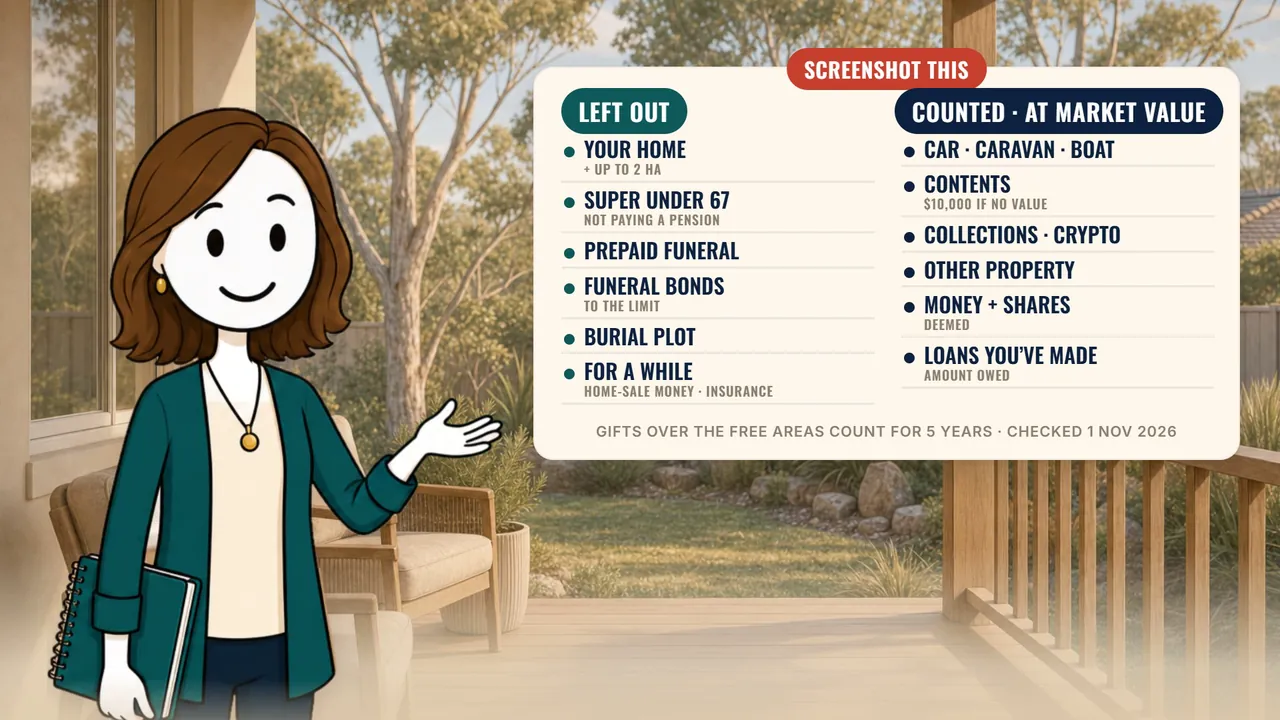
Not counted:
- Your home, and up to 2 hectares of land it's on, on a single title. (Land beyond that, and any part of the home used only for business, generally is counted.)
- Super, while you're under Age Pension age (67) and your fund isn't paying you a pension from it. The same goes for a partner under 67.
Counted:
- Super from 67, at the balance on your latest statement - even if you've never touched it. A partner's super counts once they reach 67, even if they aren't getting a payment.
- Money and investments: bank accounts, term deposits, cash, shares, managed funds.
- Money you've lent, including to family - it counts at the amount still owed.
- Other real estate: a holiday house, a rental, or a place you let someone live in for free.
- Cars, caravans and boats, at what they'd sell for, less any loan secured against them.
- Household contents and personal effects. If you don't give a value, Centrelink uses $10,000. You can give a lower figure if that's what they'd really fetch, and you must declare them if they're worth more.
- Gifts above the free areas - $10,000 in a financial year, and no more than $30,000 over five financial years - for five years after you give them.
Everything is counted at market value - what you'd get if you sold it, not what you paid.
How much does the pension drop for every $1,000 over the limit?
$3 a fortnight (for a couple, $3 off the two pensions combined). Centrelink takes the amount over the limit, divides it into whole lots of $250 (rounding down), and takes $19.50 a year off for each one.
That sounds small. But there are 26 fortnights in a year, so once the assets test is the one setting your rate, every $1,000 over the limit costs $78 a year - 7.8% of it, every year. That's a high bar for savings to clear: money has to earn 7.8% a year just to replace the pension it costs.
An example: an inheritance
Meet Denise. She's an illustration, not a real person: 67, single, owns her home, and has $500,000 of assessable assets (everything the test counts) - $470,000 in super plus $30,000 of car and contents.
- An aunt leaves her $100,000. Her assets rise to $600,000.
- Her pension drops by 400 lots of $19.50 - $7,800 a year.
- If the inheritance earns 5% a year, it brings in $5,000.
- So for the first year, she's about $2,800 a year behind on income - for inheriting $100,000.
She still has the $100,000, of course. The point isn't that inheriting is bad. It's that above the limit, extra savings replace pension rather than adding to it.
Worked example: $300,000, $500,000 or $800,000 in super
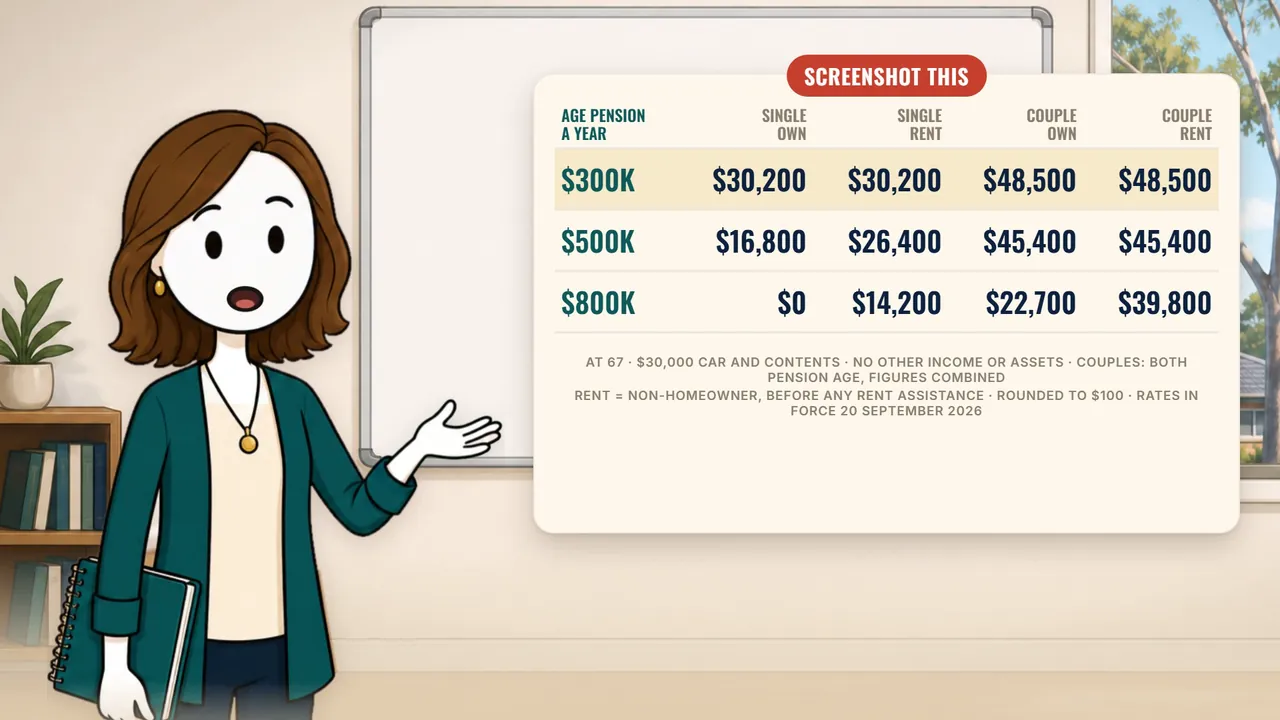
Now run Denise through three balances. She's 67, single, owns her home, has $30,000 of car and contents and no other income. Pension rates are from 20 September 2026.

| Denise's super (assets incl. car) | Assets test | Income test | Her Age Pension |
|---|---|---|---|
| $300,000 ($330,000) | Under the limit - full rate | about $1,160 a fortnight | $30,161 a year |
| $500,000 ($530,000) | $197,000 over - $646.70 a fortnight | about $1,016 a fortnight | $16,814 a year |
| $800,000 ($830,000) | Over the $745,750 cut-off - nil | about $799 a fortnight | Nil |
- At $300,000, she's under the assets limit, but deeming - the set rate of return Centrelink assumes her super earns - puts her assumed income over the free area, the income allowed before the pension starts to fall. The income test trims her pension a little.
- At $500,000, the assets test bites. The extra $200,000 in super costs her $13,347 a year in pension.
- At $800,000, she's past the cut-off. She gets no Age Pension at all, until her assets fall back under $745,750.
Add what her super pays
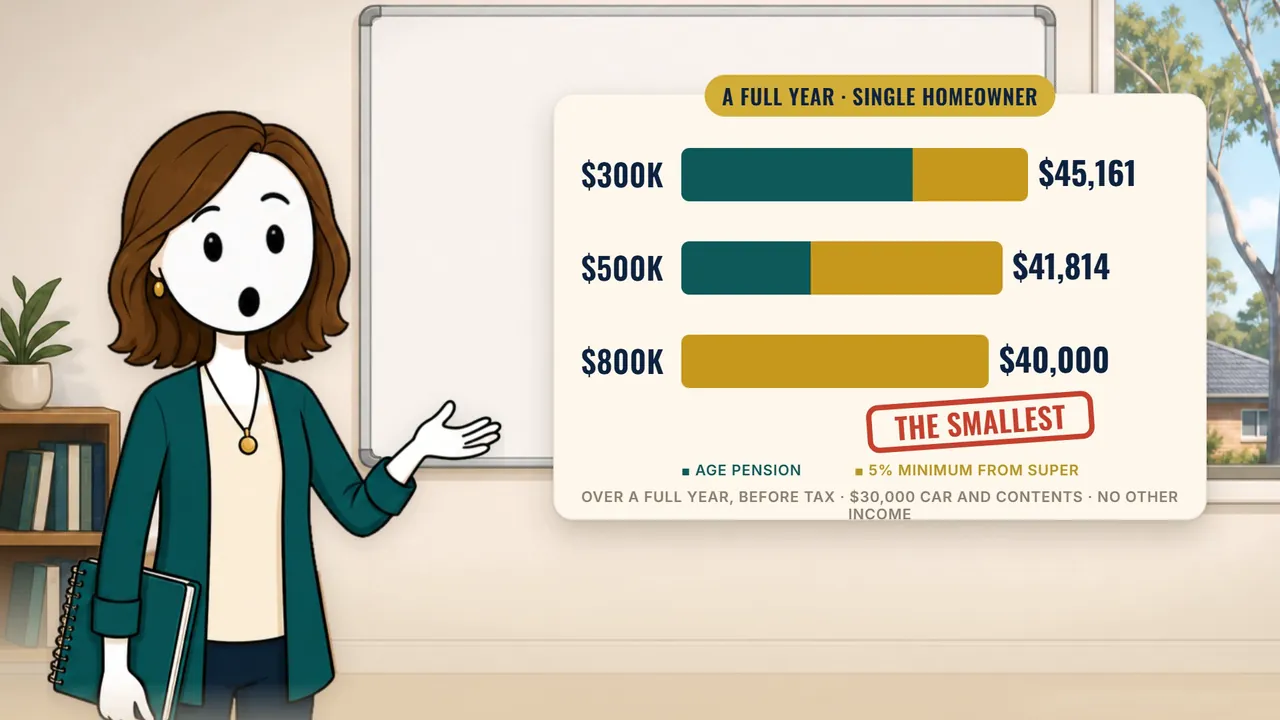
If her super is in an account-based pension - a super pension that pays her a regular income - she has to draw at least 5% a year at her age (65 to 74). Pension plus the minimum drawdown, in the first year:
| Denise's super | Age Pension | 5% minimum drawdown | Total a year |
|---|---|---|---|
| $300,000 | $30,161 | $15,000 | $45,161 |
| $500,000 | $16,814 | $25,000 | $41,814 |
| $800,000 | Nil | $40,000 | $40,000 |
The biggest balance brings the smallest income. Once the assets test sets the rate, every extra $1,000 costs $78 a year in pension - but adds only $50 a year at a 5% drawdown.
What changes if you rent, or you're a couple
The same three balances look very different in other households:
| Super (combined for the couple) | Single renter | Homeowner couple (both 67+) |
|---|---|---|
| $300,000 | $30,161 a year | $48,516 a year |
| $500,000 | $26,411 a year | $45,395 a year |
| $800,000 | $14,240 a year | $22,698 a year |
A renter has more room on assets, but their rent comes out of that money every fortnight. For renters, the bigger balance still comes out ahead once the drawdown is added. For the homeowner couple, the middle balance comes out on top.
Is the income test the real limit?
For someone like Denise, up to about $368,000 of assets, yes. Being under $333,000 doesn't guarantee the full pension.
The income test uses deeming: it assumes your financial assets - including super from 67 - earn a set rate, whatever they really earn. For a single person that's 1.75% on the first $66,800 and 3.75% on the rest. Above a free area - the income allowed before the pension starts to fall - of $226 a fortnight, the pension drops 50 cents for every dollar.
At exactly $333,000 of assets ($303,000 in super plus the car and contents), Denise's pension would be about $1,158 a fortnight - about $2,075 a year short of the full rate, before the assets test has taken anything. The income test starts trimming her pension from about $222,320 of assets, and sets her rate until about $368,000, where the assets test takes over.
The difference is how gently the income test bites. Above the $66,800 deeming threshold, each extra $1,000 costs about $18.75 a year under the income test. Under the assets test, it's $78.
Does losing the Age Pension actually matter?

This video was recorded in August 2026, before the 20 September indexation. The figures in this article are the current ones.
Here's the comparison that answers it. Two single homeowners, both 67 or older and retired, both drawing 5% of their savings a year, each with $30,000 of car and contents:
- Retiree one has $333,000 of assets. Pension plus drawings: about $45,255 a year.
- Retiree two has $745,750 - the exact point where a single homeowner's pension stops. Drawings only: about $35,788 a year.
Retiree two has $412,750 more - and about $9,467 a year less to live on.
The band where more savings means less income
It isn't just that one point. At a 5% drawdown, a single homeowner has less total income than at $333,000 anywhere between about $407,000 and $935,000 of assets - over half a million dollars of extra savings that buys no extra income.
How wide that band is depends on what you draw or earn:
| Drawing or earning | Worse off than at $333,000 between |
|---|---|
| Earning 4% a year | about $388,000 and $1,086,000 |
| 5% a year | about $407,000 and $935,000 |
| 6% a year | about $449,000 and $835,000 |
| 7% a year | about $593,000 and $763,000 |
For a homeowner couple drawing 5%, measured against a couple at their own $499,000 limit, the band runs from about $590,000 to $1,419,000.
And those figures count cash only. When your pension reaches zero, the Pensioner Concession Card - cheaper medicines, bulk-billed doctor visits and help with hearing services - generally goes with it. The Commonwealth Seniors Health Card is the fallback for people of Age Pension age: it has an income test - $105,048 a year for a single person - but no assets test.
The other side of the argument
None of this makes the bigger balance worse. Three things are true on the other side:
- Wealth isn't income. The retiree with $745,750 still has it - for a new car, help for family, or the cost of care later on.
- It depends on returns. The band shrinks as returns rise, and a balance that falls back under the cut-off starts earning a part pension again.
- The rules move. The $3-per-$1,000 taper has applied since 1 January 2017, and the rates and limits are reviewed several times a year.
So what costs income isn't losing the pension as such. It's having assets anywhere in that band - about $407,000 to $935,000 at a 5% drawdown - and part of that stretch lies past the cut-off.
What if one partner is younger?
If only one of you has reached 67, only that partner can be paid the Age Pension - at the partnered rate, up to $933.00 a fortnight. Your assets are still added together and measured against the couple limits, and the younger partner's wages and other income count in the couple income test. But the younger partner's super isn't counted while they're under 67 and it isn't paying them a pension. Starting a pension from it makes it count - which can cost the older partner pension, and can affect the younger partner's own payment if they get one, such as JobSeeker. Our complete guide to retirement in Australia works through a couple with an age gap.
The bottom line
The assets test leaves out your home and counts nearly everything else. Once the assets test sets the rate, each $1,000 over the limit costs $78 a year of pension, which is why a bigger balance can bring a smaller income for years. For a typical balance, the pension does most of the work - what the average Australian retires with shows how much.
Your own position depends on everything you and your partner own and earn. Services Australia's Financial Information Service is free and can inform you about how the rules apply - call the Older Australians line on 132 300 and ask for a FIS officer.
Frequently asked questions
If I'm in the taper, why not just draw more than 5% a year?
The ATO says you can withdraw as much as you like each year from an account-based pension (a transition to retirement pension is different), as long as you take at least the minimum. Money you spend leaves your assets, and while the assets test sets your rate, your pension rises again as they fall - by $3 a fortnight for every $1,000. Whether that suits you depends on how long your savings need to last, which is a question for your own numbers.
Are lump sums taken out of super counted as income?
Taking money out of super doesn't, by itself, change your payment. What you do with it can. If you put it in the bank or buy an income stream, it's still counted in both tests. If you spend it - on a holiday or a car, say - the car is counted at its market value, and the rest is no longer an asset.
Is money spent on the home still counted?
Your principal home isn't counted in the assets test, so money that has been spent on it - on renovations, say - no longer shows up as savings. Giving money away is treated differently: gifts above $10,000 in a financial year, or $30,000 over five financial years, still count for five years. The Financial Information Service can explain how a particular change would be assessed.
Why can't everyone over 67 get a concession card?
The Pensioner Concession Card comes with any rate of Age Pension. If you don't qualify for the pension because of your assets, the Commonwealth Seniors Health Card has an income test but no assets test - $105,048 a year for a single person, $168,076 for a couple.
Would putting cash into super help me qualify?
Not once you're 67. From Age Pension age, super counts in the assets test at its statement balance and is deemed in the income test - the same as money in the bank.
Sources
- Services Australia - Assets test for Age Pension - full-pension limits and cut-offs (from 20 September 2026)
- DSS Social Security Guide 4.2.3 - reduction of $19.50 a year per $250; $3 a fortnight per $1,000 from 1 January 2017; the assets test applies only if it gives the lower rate
- Services Australia - Asset types - market value, secured debts, money loaned
- Services Australia - Real estate assets - the principal home and 2 hectares
- Services Australia - Superannuation - not counted under Age Pension age unless paying a pension; counted from Age Pension age
- DSS Social Security Guide 4.6.5.10 - household contents assessed at $10,000 unless you give a value
- Services Australia - How much you can gift - $10,000 a year, $30,000 over five years
- Services Australia - Income test for Age Pension and Deeming - free area $226; 1.75% / 3.75%
- Services Australia - How much Age Pension you can get - $1,237.70 single, $933.00 each for a couple, from 20 September 2026
- Services Australia - Commonwealth Seniors Health Card income test - $105,048 / $168,076; no assets test
- Services Australia - Who can get a Pensioner Concession Card
- Services Australia - Financial Information Service
- ATO - Payments from super - 5% minimum drawdown at 65 to 74
- ATO - Retirement withdrawal: lump sum or income stream - withdrawals above the minimum
General information only. This article is general information only. It doesn't take into account your objectives, financial situation or needs, and it isn't personal financial advice. Speak with a licensed financial adviser about your own situation. Services Australia's Financial Information Service (132 300) is free. Figures are current from 20 September 2026 and change every March, July and September - check servicesaustralia.gov.au and ato.gov.au for the latest.
A note on how this is made: Every article starts with real research and is checked against current ATO and Services Australia figures - that part isn't automated. AI tools help draft the text and produce the video's narration and visuals. We write, verify and stand behind every word.
Keep reading
- How Much Is the Age Pension? Rates for Singles and Couples, Homeowners and Renters
- Average Super Balance at Retirement in Australia - and What the Age Pension Adds
- $300K, $500K or $800K in Super at 67: What the Age Pension Adds to Each (video)
New here? Start with the complete guide: Retirement in Australia, explained - every rule, every test and a countdown to your last working day.
More Age Pension
- When Only One Partner Is Eligible for the Age Pension: What an Age-Gap Couple Gets
- How to Boost Your Age Pension, Legally: Four Ways and the One That Backfires
- How Much Can You Have and Still Get the Full Age Pension? The Income Test and Deeming
- How Much Is the Age Pension? Rates for Singles and Couples, Homeowners and Renters