How Much Can You Have and Still Get the Full Age Pension? The Income Test and Deeming

Figures current from 20 September 2026. How this is made
Key takeaways
- For money in super and the bank, the income test sets a lower limit than the assets test. Above about $192,320 of super and savings for a single person, or $333,547 for a couple combined, you're no longer on the full rate, if you have no other income - whether you own your home or rent.
- That's because of deeming: Centrelink assumes your savings earn 1.75% on the first $66,800 (single) and 3.75% on the rest, whatever they really earn.
- The assets test allows the full pension with up to $333,000 of assets for a single homeowner. The gap between the two limits - $140,680 - is room for your car, furniture and everything else.
- Going over the savings limit is a slope, not a cliff. For a single person, every $10,000 over trims about $7.21 a fortnight.
- Deeming rates have risen three times since the freeze ended. For a single person whose rate is set by the income test and who is over the free area, each half-point rise takes about $1 a fortnight off the pension for every $10,400 of savings.
The full Age Pension limits you usually see quoted come from the assets test. But if most of your money is in super and the bank, a lower limit applies first. It's set by the income test - even if you have no income at all. Here's where that limit sits for singles and couples, owners and renters, why it has fallen, and what happens when you go over it. Figures are the rates from 20 September 2026.
What are the full Age Pension limits?
To get the full rate, you have to pass two means tests. The assets test looks at what you own. The income test looks at what you earn - or what Centrelink assumes you earn. The assets test only applies if it gives a lower rate than the income test, so in effect you're paid on whichever gives you less.
The figure you usually see quoted is the assets test's. It's the one Services Australia lists under "What the limits are for a full pension":
| Household | The assets test allows the full pension up to |
|---|---|
| Single, homeowner | $333,000 |
| Single, renter | $600,000 |
| Couple, homeowner (combined) | $499,000 |
| Couple, renter (combined) | $766,000 |
The home you live in, and up to 2 hectares of land it's on, on a single title, isn't counted. (Our guide to the Age Pension assets test covers what it counts and how fast the pension shrinks above these limits.)
But for super and savings, the income test bites first - long before you reach those figures.
How much can you have in super and savings and still get the full pension?
About $192,320 for a single person, and about $333,547 for a couple combined. Above that, the income test reduces your pension. It's the same whether you own your home or rent.

Why the income test applies when you have no income
Centrelink doesn't look at what your savings actually earn. It uses deeming - it assumes your financial assets earn a set rate (Services Australia's deeming page):
| Deeming from 20 September 2026 | 1.75% on the first | 3.75% on the rest |
|---|---|---|
| Single | $66,800 | above $66,800 |
| Couple, at least one on a pension | $110,600 combined | above $110,600 |
If your money earns more than that, the extra isn't counted. If it earns less - or nothing - you're still assessed on the deemed amount.
From Age Pension age (67), your super is deemed too, even if you've never touched it. Under Age Pension age, super isn't counted unless the fund is paying you a pension from it - and the same goes for your partner's.
The deemed income then meets the income test. The free area - the income you can have before the pension starts to fall - is $226 a fortnight for a single person and $396 for a couple combined. Above it, a single pension drops 50 cents for every dollar. For a couple where both partners get the Age Pension, each pension drops 25 cents - 50 cents off the two pensions combined.
Where the savings limit comes from
The savings limit is simply the balance whose deemed income uses up the free area. For a single person:
- The free area over a year: $226 x 26 = $5,876.
- The first $66,800 is deemed at 1.75%: $1,169 a year.
- That leaves $4,707 of the free area. At 3.75%, that's covered by another $125,520.
- $66,800 + $125,520 = $192,320.
For a couple, the same steps with a $396 free area and the $110,600 threshold give $333,547 (rounded). For a couple, it's your savings combined, whoever's name they're in.
Every household has two limits
Put the two tests together, and every household has two limits: one for super and savings, set by the income test, and one for everything you own, set by the assets test. The gap between them is room for everything else.
| Household | Savings limit (income test) | Assets limit | Room for everything else |
|---|---|---|---|
| Single, homeowner | $192,320 | $333,000 | $140,680 |
| Single, renter | $192,320 | $600,000 | $407,680 |
| Couple, homeowner | $333,547 | $499,000 | $165,453 |
| Couple, renter | $333,547 | $766,000 | $432,453 |
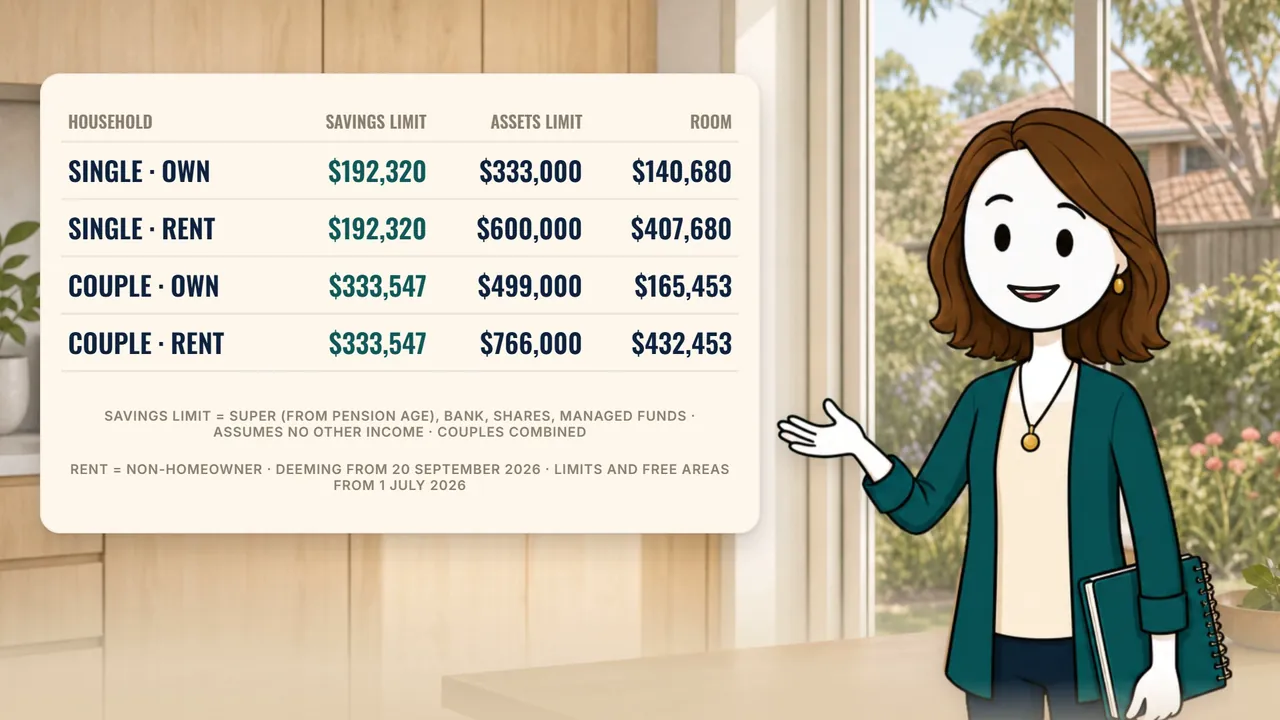
Single or couple sets the savings limit. Owning or renting only sets the room. So unless your car, furniture and other non-financial assets are worth more than that room, it's the savings limit that decides whether you're on the full rate. Rent Assistance doesn't change either limit - it raises the cut-off points, not the full-pension limits.
What counts as savings, and what doesn't?
Deeming applies to financial investments. Services Australia lists them, including:
- bank, building society and credit union accounts, and term deposits
- cash on hand
- shares and securities, and managed investments
- super, once you're over Age Pension age
- some income streams, such as account-based pensions (a regular income paid from your super) started from 1 January 2015
- money you've lent
- gold, silver or platinum bullion.
Your personal assets - home contents, personal effects, vehicles, boats and caravans - count towards the assets limit at what they'd sell for, less any loan secured against them. But they aren't deemed to earn anything. Cryptocurrency counts as an asset, but isn't deemed either.
And some things aren't counted at all: your home, a burial plot whatever its value, and a funeral you've fully prepaid under a contract that says there's nothing more to pay.
How does other income lower the limit?
The savings limit assumes deemed income is your only income. Most other income counts against the same free area, including:
- pensions from other countries
- rent from an investment property - gross rent less allowable deductions
- a defined benefit pension from a work scheme - the gross payment less the deductible amount your fund calculates.
So the more other income you have, the lower your savings limit. For a single person, every $1 a fortnight of other income lowers it by about $693 (for other income up to about $181 a fortnight; beyond that, each $1 lowers it by about $1,486). An overseas pension of $50 a fortnight, say, brings it down to about $157,653. And if your other income is over the free area on its own, the full rate is out of reach.
The Work Bonus
Income from work is treated more gently. The Work Bonus credits $300 a fortnight against your employment and self-employment income before the income test applies. If you don't use it, the unused credit builds up to a balance of $11,800. So up to $300 a fortnight of work income doesn't have to cost you the full rate, or lower your savings limit.
Worked example: Graham, under the assets limit but not on the full rate
Graham is an illustration, not a real person: 68, single, retired, and owns his home. He has $220,000 in super, in an account-based pension he started when he retired at 66, and about $25,000 of car and furniture. He has no other income.
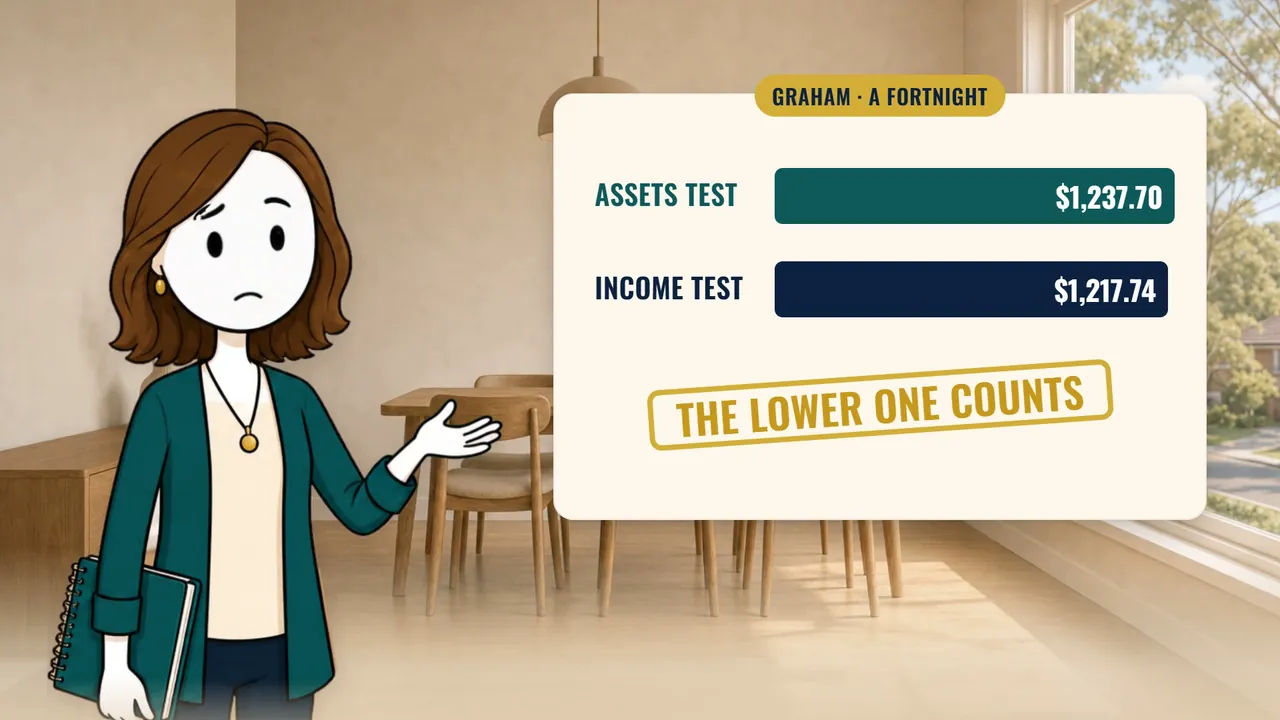
- Assets test: $245,000 of assets, under the $333,000 limit. The assets test would pay him the full rate, $1,237.70 a fortnight.
- Deemed income: $66,800 x 1.75% = $1,169, plus $153,200 x 3.75% = $5,745. That's $6,914 a year, or $265.92 a fortnight.
- Over the free area: $265.92 - $226 = $39.92. At 50 cents in the dollar, that's $19.96 off.
- Income test: $1,237.70 - $19.96 = $1,217.74 a fortnight.
- Centrelink pays the lower of the two: $1,217.74. Graham is $27,680 over the savings limit, and about $519 a year short of the full rate.
Because he still gets some Age Pension, Graham automatically gets the Pensioner Concession Card - cheaper medicine, bulk-billed doctor visits and help with hearing services.
What happens if you go over the savings limit?
It's a slope, not a cliff. For a single person whose savings are above the $66,800 threshold, every $10,000 over the savings limit trims about $7.21 a fortnight - $18.75 a year for every $1,000. Graham's $27,680 over works out at exactly his $19.96.

This video was published on 15 September 2026, using the deeming and pension rates that took effect on 20 September 2026 - the same rates as this article.
Go a long way over, and the assets test takes over. It bites harder: $3 a fortnight for every $1,000 of assets over its limit - $78 a year, against the income test's $18.75.
For someone like Graham, with $25,000 of car and furniture, the income test sets the rate from $192,320 of super and savings up to about $344,800 - about $370,000 of assets in all. Above that, the assets test pays less, so it takes over. With no car or furniture at all, the crossover would be about $377,800. For a single renter with the same $25,000 of car and furniture, it's about $696,300 of super and savings.
So for a single homeowner, being under the $333,000 assets limit doesn't mean the full pension, and being over it doesn't mean the assets test is the one cutting your pension. Every step in an example like Graham's needs both tests.
Why has the savings limit fallen?
Because deeming rates have gone up. They were frozen at 0.25% and 2.25% from 1 May 2020, and the freeze ended on 30 June 2025. Since then they've risen three times, half a percentage point on each rate each time.
| Deeming rates from | Lower rate | Higher rate | Single savings limit | Couple savings limit |
|---|---|---|---|---|
| 1 May 2020 (the freeze) | 0.25% | 2.25% | about $320,533 | about $555,911 |
| 20 September 2025 | 0.75% | 2.75% | about $262,255 | about $454,836 |
| 20 March 2026 | 1.25% | 3.25% | about $221,908 | about $384,862 |
| 20 September 2026 | 1.75% | 3.75% | $192,320 | $333,547 |
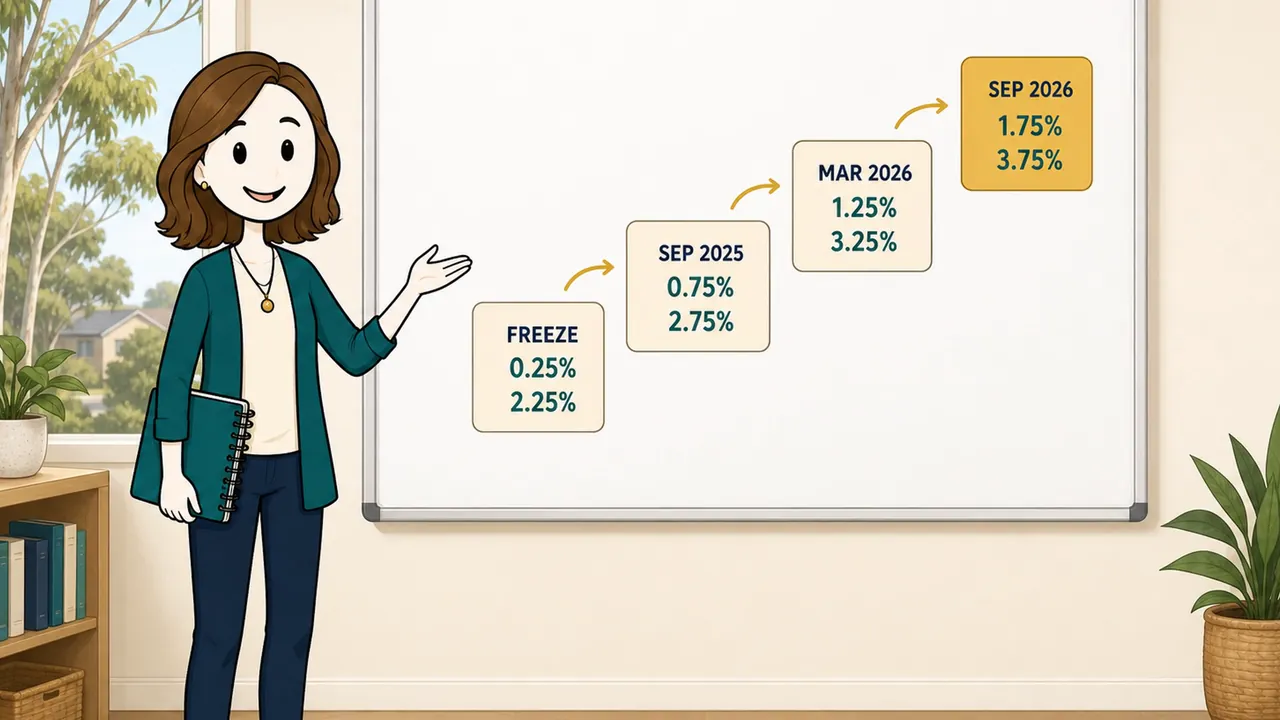
The free areas and deeming thresholds are indexed on 1 July, so they didn't move on 20 September 2026. That rise alone lowered the single savings limit overnight, from about $221,908 to $192,320 - a drop of about $29,588. The couple limit fell by about $51,315.
The Minister for Social Services sets the deeming rates. The last three changes landed on 20 September 2025, 20 March 2026 and 20 September 2026. The Australian Government Actuary now reviews the rates every six months, and recommended the March and September 2026 changes.
How a deeming rise flows through to your pension

Graham's $220,000 shows the first effect. At the 1.25% and 3.25% rates that applied until 19 September 2026, it was deemed to earn $5,814 a year - under the $5,876 free area, so he was on the full rate. From 20 September, at 1.75% and 3.75%, it's $6,914 - over it. The rise took him off the full rate without a dollar of his real income changing.
For someone who was already over the free area, there's a shortcut. When both rates rise by half a point, every dollar of financial assets is deemed to earn 0.5% more. Spread over 26 fortnights, then halved by the 50-cent taper - how fast the pension falls as income rises - that's 1/10,400 of your financial assets off your fortnightly pension.
Say Graham had $300,000 in super instead:
- At 1.25% and 3.25%, it's deemed to earn $8,414 a year. At 1.75% and 3.75%, $9,914.
- That's $1,500 a year more assumed income, or $57.69 a fortnight.
- At 50 cents in the dollar, the deeming rise takes $28.85 a fortnight off what his pension would otherwise be. (The maximum rate rose on the same day.)
- The shortcut: $300,000 / 10,400 = $28.85.
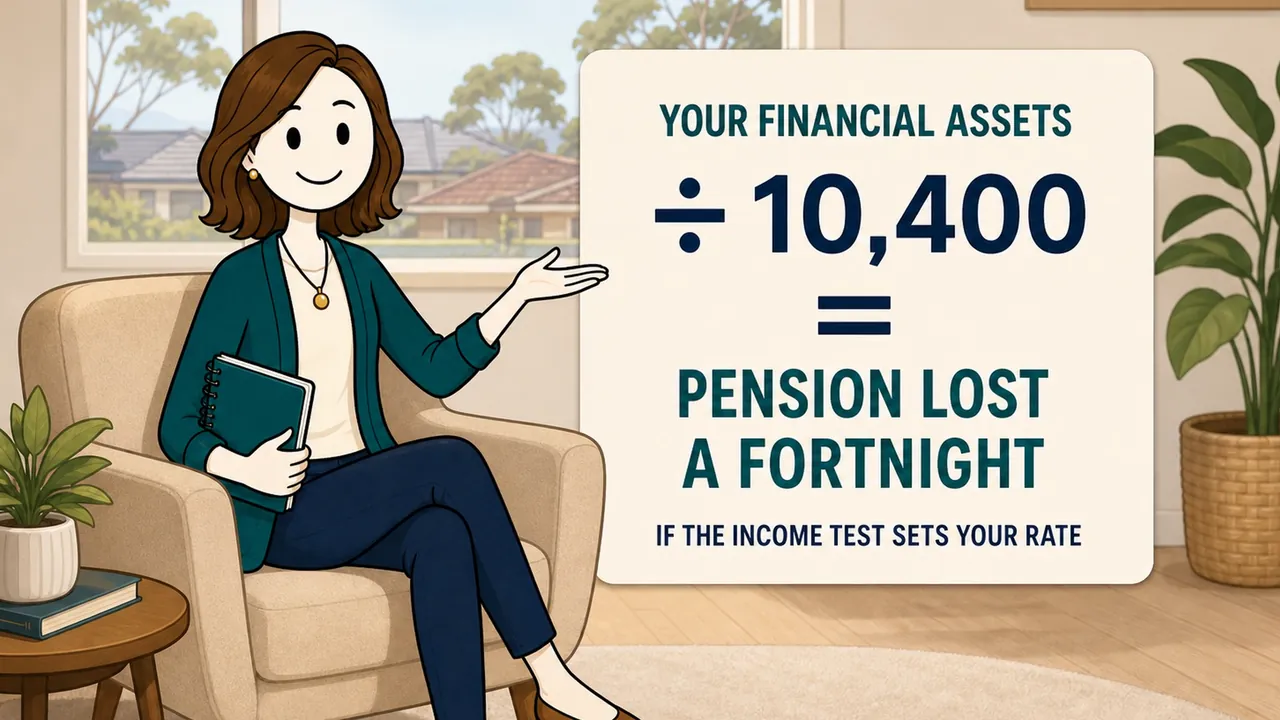
Where both partners get the Age Pension, the shortcut works the same way, on combined financial assets and the combined pension. If only one partner is paid, only their pension drops by 25 cents in the dollar, so the cut is about half that: combined financial assets divided by 20,800. The shortcut only holds if the income test sets your rate both before and after the change, and you were already over the free area. If the assets test sets your rate, a deeming change doesn't touch it. And if your deemed income is still under the free area, it makes no difference.
Are there exceptions?
A few groups are assessed differently:
- Older account-based pensions. If your account-based pension started before 1 January 2015, and you've been on a pension or allowance without a break since 31 December 2014, it isn't deemed. Centrelink assesses the gross payment less a deduction amount - the return of your own capital - instead (Services Australia: income streams).
- Lifetime income streams bought on or after 1 July 2019 have their own rules: once payments start, 60% of the gross payments counts as income.
- People who are legally blind and not claiming Rent Assistance may be able to get the Age Pension without the income and assets tests.
- Transitional rate pensioners - some people who were getting a pension on 19 September 2009 - have a 40-cent income test taper instead of 50 cents (20 cents each for a couple, instead of 25).
- Income or assets outside Australia can affect your rate.
What if one partner is younger?
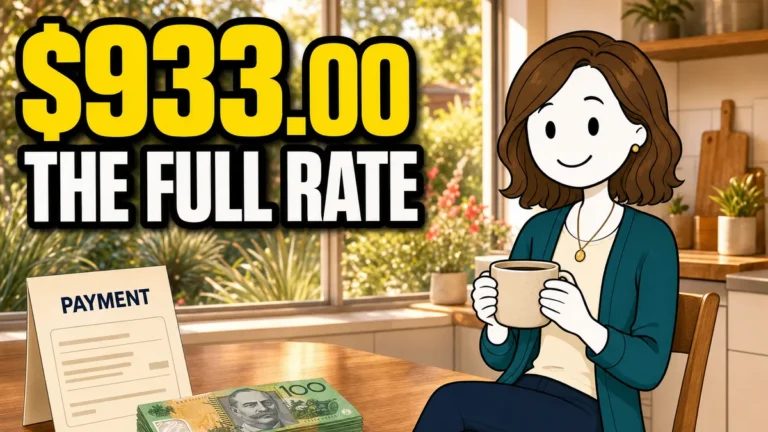
If your partner is under Age Pension age, their super isn't counted while the fund isn't paying them a pension. Once it pays them a pension, or they reach Age Pension age, it counts - in both tests, even if they aren't getting a payment. Only the partner who has reached 67 can be paid the Age Pension, at the partnered rate of up to $933.00 a fortnight. The younger partner's other income still counts in the couple income test. Our guide to what the Age Pension pays covers couples in more detail.
The bottom line
The limit you usually hear is the assets limit. For money in super and the bank, the one that decides your full rate is the savings limit - about $192,320 for a single person and $333,547 for a couple, at today's rates. Owning or renting doesn't change it; it only changes the room you have for everything else.
These limits can move in March, July and September, and whenever the deeming rates change, so check the date on any figure, including ours. To see where a typical balance lands, read what the average Australian retires with. For your own estimate, Services Australia's online Payment Finder can help you work out what you may get. Its Financial Information Service is free - call the Older Australians line on 132 300 and ask for a FIS officer.
Frequently asked questions
Will these limits change?
Yes. The income free areas, the assets test's full-pension limits and the deeming thresholds are indexed every 1 July, and Services Australia says the assets test limits and cut-off points are reviewed in March, July and September. The deeming rates are set by the Minister. They changed on 20 September 2025, 20 March 2026 and 20 September 2026, and the Australian Government Actuary now reviews them every six months. The figures in this article are the ones in force from 20 September 2026, so check the date on any figure you rely on.
Is the calculation the same if I don't own my home?
Yes. The deeming rates, the thresholds, the free area and the 50-cent taper are identical for homeowners and renters, so the savings limit is the same. Owning or renting only changes the assets test: a single renter can own $600,000 of assets before it reduces the pension, against $333,000 for a single homeowner.
Does cash kept at home count?
Yes. Services Australia lists cash on hand as a financial investment, alongside bank accounts and term deposits. It counts in the assets test and is deemed under the income test, the same as money in the bank.
Why did my pension go up by less than the 20 September increase?
If the income test sets your rate and your deemed income is over the free area, the 20 September 2026 deeming rise increased your assessed income on the same day the maximum rate went up. For a single person, the half-point rise took about 1/10,400 of financial assets a fortnight off what the pension would otherwise have been - about $28.85 on $300,000. Your payment statement shows your actual new rate.
My partner is younger. Does their super count?
Not while they're under Age Pension age and their fund isn't paying them a pension from it. If the fund starts paying them a pension, or they turn 67, it counts in both tests - even if they aren't getting a payment. The Financial Information Service can explain how a particular change would be assessed.
Sources
- Services Australia - Income test for Age Pension - free areas $226 single / $396 couple combined; 50c per $1 single, 25c each couple; transitional 40c (page updated 20 September 2026)
- Services Australia - Deeming - 1.75% / 3.75%; thresholds $66,800 and $110,600; returns above the deemed rate not counted; rates set by the Minister (page updated 20 September 2026)
- Services Australia - Assets test for Age Pension - full-pension limits; reviewed March, July and September (page updated 20 September 2026)
- Services Australia - How much Age Pension you can get - $1,237.70 single, $933.00 each for a couple, from 20 September 2026
- Services Australia - Superannuation - not counted under Age Pension age unless paying a pension; counted and deemed from Age Pension age, for a partner too
- Services Australia - Asset types - financial investments, personal assets, market value, cryptocurrency not deemed (page updated 16 July 2026)
- Services Australia - Income - pensions from other countries, real estate income less allowable deductions
- Services Australia - Income streams - account-based pensions started before 1 January 2015; defined benefit deductible amount; lifetime income streams from 1 July 2019 (page updated 26 May 2026)
- Services Australia - Real estate assets - principal home and the first 2 hectares on a single title
- Services Australia - Funeral bonds and prepaid funerals - burial plots and fully prepaid funerals not counted
- Services Australia - How the Work Bonus works - $300 a fortnight, balance up to $11,800
- Services Australia - Who can get Age Pension - Age Pension age 67; legally blind exemption
- Services Australia - Who can get a Pensioner Concession Card - sent automatically with the Age Pension
- Services Australia - Online estimators - Payment Finder
- Services Australia - Financial Information Service
- Australian Government Actuary - Deeming rates - reviewed every six months; March 2026 (1.25% / 3.25% from 20 March 2026) and September 2026 (1.75% / 3.75% from 20 September 2026; the freeze ended 30 June 2025) recommendations
- Social Security (Deeming Threshold Rates) Determination 2025 and its explanatory statement - 0.75% / 2.75% from 20 September 2025; 0.25% / 2.25% from 1 May 2020
- Services Australia - A guide to Australian Government payments, 20 September to 31 December 2026 - the test that gives the lower rate applies; $3 a fortnight per $1,000 over the assets free area; income test tapers; deeming table; pension income and asset thresholds and deeming thresholds indexed 1 July
General information only. This article is general information only. It doesn't take into account your objectives, financial situation or needs, and it isn't personal financial advice. Speak with a licensed financial adviser about your own situation. Services Australia's Financial Information Service (132 300) is free. Figures are current from 20 September 2026 and change every March, July and September - check servicesaustralia.gov.au and ato.gov.au for the latest.
A note on how this is made: Every article starts with real research and is checked against current ATO and Services Australia figures - that part isn't automated. AI tools help draft the text and produce the video's narration and visuals. We write, verify and stand behind every word.
Keep reading
- The Age Pension Assets Test: What Counts, Where the Pension Stops, and Whether Losing It Matters
- How Much Is the Age Pension? Rates for Singles and Couples, Homeowners and Renters
- The Deeming Rate Trap: Why Your Age Pension Rise Is Smaller Than the Headline (video)
New here? Start with the complete guide: Retirement in Australia, explained - every rule, every test and a countdown to your last working day.
More Age Pension
- When Only One Partner Is Eligible for the Age Pension: What an Age-Gap Couple Gets
- How to Boost Your Age Pension, Legally: Four Ways and the One That Backfires
- The Age Pension Assets Test: What Counts, Where the Pension Stops, and Whether Losing It Matters
- How Much Is the Age Pension? Rates for Singles and Couples, Homeowners and Renters