
When Only One Partner Is Eligible for the Age Pension: What an Age-Gap Couple Gets

Figures current from 20 September 2026. How this is made
Key takeaways
- When only one partner has reached Age Pension age (67), only that partner is paid - at the couple rate, up to $933.00 a fortnight from 20 September 2026, not the single rate.
- The younger partner's wages count in full in the couple's income test, and the Work Bonus never covers a partner's pay.
- Super held in accumulation isn't counted while the younger partner is under pension age and the fund isn't paying them. Once it pays them a pension, the money in that pension counts - and from Age Pension age it counts whether it's paying or not.
- If the younger partner gets JobSeeker, Carer Payment or the Disability Support Pension, starting a pension from their super counts for that payment too. JobSeeker stops completely once a homeowner couple's assets pass $499,000.
- Once both partners are 67, both can be paid at the couple rate.
Age Pension when only one partner is eligible: it's the situation every age-gap couple reaches. Picture Phil and Debbie. They own their home. Phil is turning 67, the Age Pension age. Debbie is 62 and still working part-time. Centrelink will count every dollar she earns - but, for now, not a cent of her super. Phil and Debbie are an illustration, but every rule below is real, and the figures are the rates in force from 20 September 2026.

Does only one partner get the Age Pension?
Yes. Only Phil is paid while Debbie is under 67. And he's paid at the couple rate - up to $933.00 a fortnight - not the higher single rate of $1,237.70. The single rate isn't for a couple living together, even when only one of them can claim. Debbie gets no Age Pension until she reaches pension age herself. (Our guide to what the Age Pension pays has every rate.)
Phil can lodge his claim up to 13 weeks before he turns 67, and the claim isn't just about him: Centrelink needs Debbie's income and assets too, even though she isn't claiming anything.
What counts, and what doesn't
Centrelink assesses a couple's income and assets together. For Phil and Debbie that means:
- Counted: their savings, car and furniture, Phil's super (he's at pension age), and Debbie's pay.
- Not counted: their home, and Debbie's $300,000 of super - because she's under pension age and her fund isn't paying her an income.
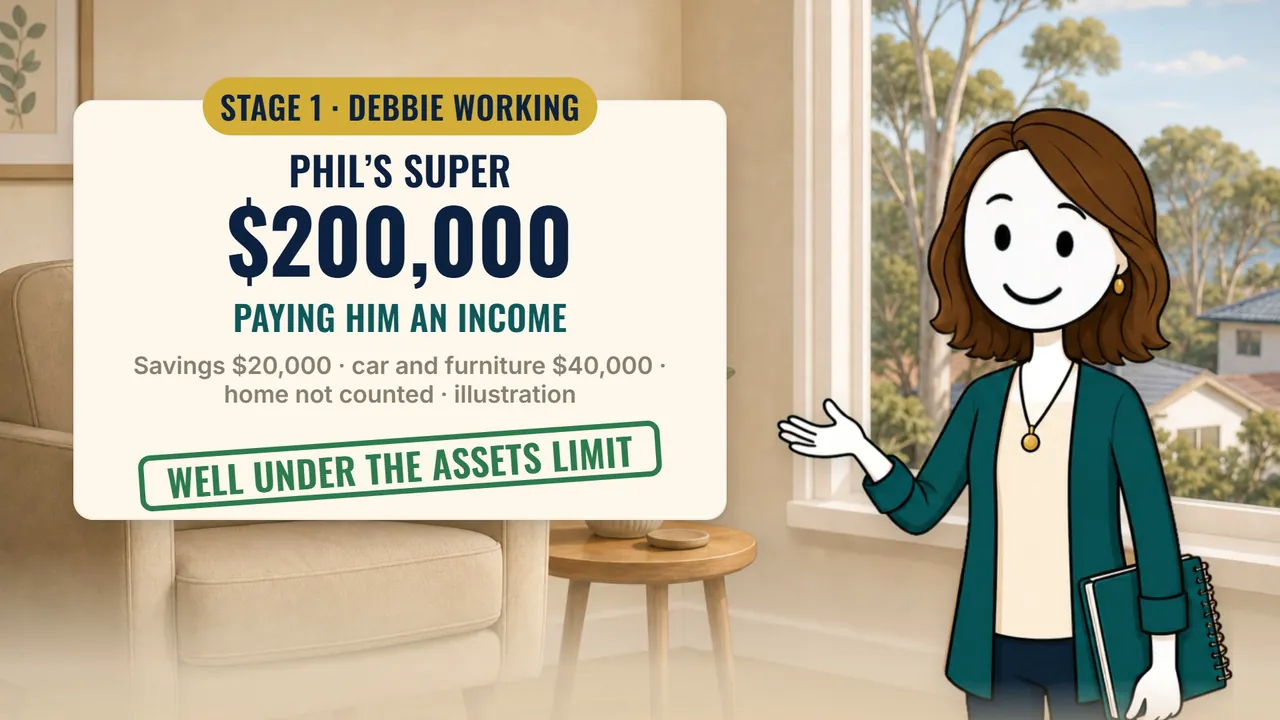
Their numbers: Phil's super is $200,000 and pays him an account-based pension. They have $20,000 in savings and a car and furniture worth $40,000. That's $260,000 of counted assets - well under the $499,000 full-pension assets limit for a homeowner couple.
Centrelink also assumes their savings earn some income, called deeming, and it counts Phil's super too. On $220,000, deeming comes to about $232 a fortnight - too small, on its own, to cut his pension at all.
Stage 1: the younger partner still working
Debbie earns $1,200 a fortnight, and Centrelink adds it to their other income. A couple gets one free area of income together - $396 a fortnight, combined - before the pension shrinks. Above it, every extra dollar cuts each pensioner's payment by 25 cents.
- Their income: $232 of deemed income plus Debbie's $1,200 = about $1,432 a fortnight.
- Over the free area by about $1,036, so Phil's pension falls by about $259.
- Phil gets about $674 a fortnight. Over a year, Debbie's wages cost his pension about $6,700.
She still keeps all her pay - it's Phil's pension that gets smaller - so they're still well ahead: working pays about a fifth less than her payslip says, before tax. The cut is slow. At twice her pay, his pension would fall to under $400 a fortnight, and it would only stop completely at around $100,000 a year of her pay. Debbie's pay has to be reported, even though it's Phil who gets the pension.
The Work Bonus doesn't help here. It sets aside some of a pensioner's own pay - Services Australia says you can't use it for your partner's wages. If Phil picked up some work himself, part of his pay would be protected. Debbie's isn't. (The Age Pension income and assets tests explain how the two tests work.)

Stage 2: the younger partner stops work
If Debbie stops work at 62, her pay stops counting. Their income drops back under the free area, so Phil gets the full couple rate: $933.00 a fortnight. Her super still isn't counted - it's sitting in her fund, not paying her anything.
If she wants another job, she may get JobSeeker, the payment for people looking for work. At the partnered rate that's up to $755.10 a fortnight from 20 September 2026. It has its own income and assets tests and stops at Age Pension age. For JobSeeker too, super left in her fund isn't counted. If she gets it, Phil's pension is worked out differently too - Services Australia says different rates apply when a partner gets a payment other than a pension.
Stage 3: drawing an income from her super
Once Debbie has stopped work she can start drawing an income from her super: she's over 60 and her job has ended. An account-based pension is a super account that pays a regular income, and earnings in a retirement pension account are tax-free, up to a lifetime limit on money moved in (the transfer balance cap).
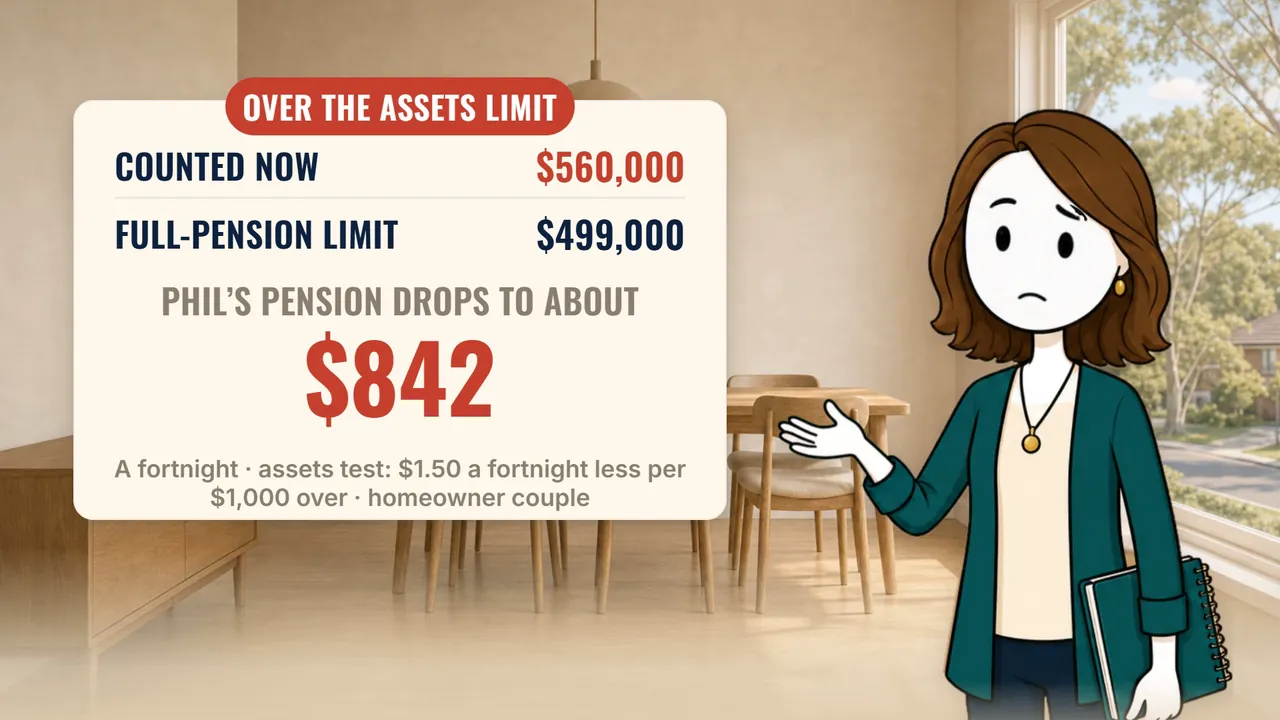
But Centrelink runs two tests - one on what a couple owns, one on their income - and the one that pays less applies. Say she moves all of her super into that pension. From the moment it pays her, Centrelink counts all $300,000.
- Counted assets rise to $560,000 - $61,000 over the $499,000 limit.
- The assets test now bites: Phil's pension drops to about $842 a fortnight.
- That's about $2,400 a year less pension, at today's rates.
Debbie now has an income from her super - her own money, being drawn down. And the same applies if someone draws on super while still working: a transition to retirement pension counts once it pays, too.
That doesn't make starting her pension a mistake. The tax saved can be worth more than the pension lost, or less. It depends on the numbers, and it's worth talking through with a licensed financial adviser.
The catch if the younger partner is on a payment
If Debbie gets JobSeeker, Carer Payment or the Disability Support Pension, her super counts for her own payment too, once it pays her. For JobSeeker it's stark: once a homeowner couple is over $499,000 of assets, JobSeeker stops completely. So that move could cost her whole JobSeeker payment, not just part of Phil's pension.
It works the other way too. While the younger partner is under pension age, super that isn't paying them isn't counted - including money added to it. Contributions have their own rules and limits, so that's another one for an adviser.
For Phil and Debbie the gap lasts five years. The whole time, her pay - and whether her super pays her - shows up in Phil's pension.
Stage 4: when the second partner turns 67
When Debbie turns 67, her super counts whether or not it's paying her - at pension age, Centrelink counts super even when it isn't paying. But she can claim the Age Pension too, so both are paid the couple rate.
At today's rates, and with their balances unchanged, they'd each get about $842 a fortnight: two part pensions instead of one. Together that's nearly $44,000 a year - exactly twice what Phil got once her super was paying.
If Debbie's still working then, the Work Bonus covers part of her pay, because she's a pensioner too. She can lodge her claim up to 13 weeks before she turns 67, the same as Phil.
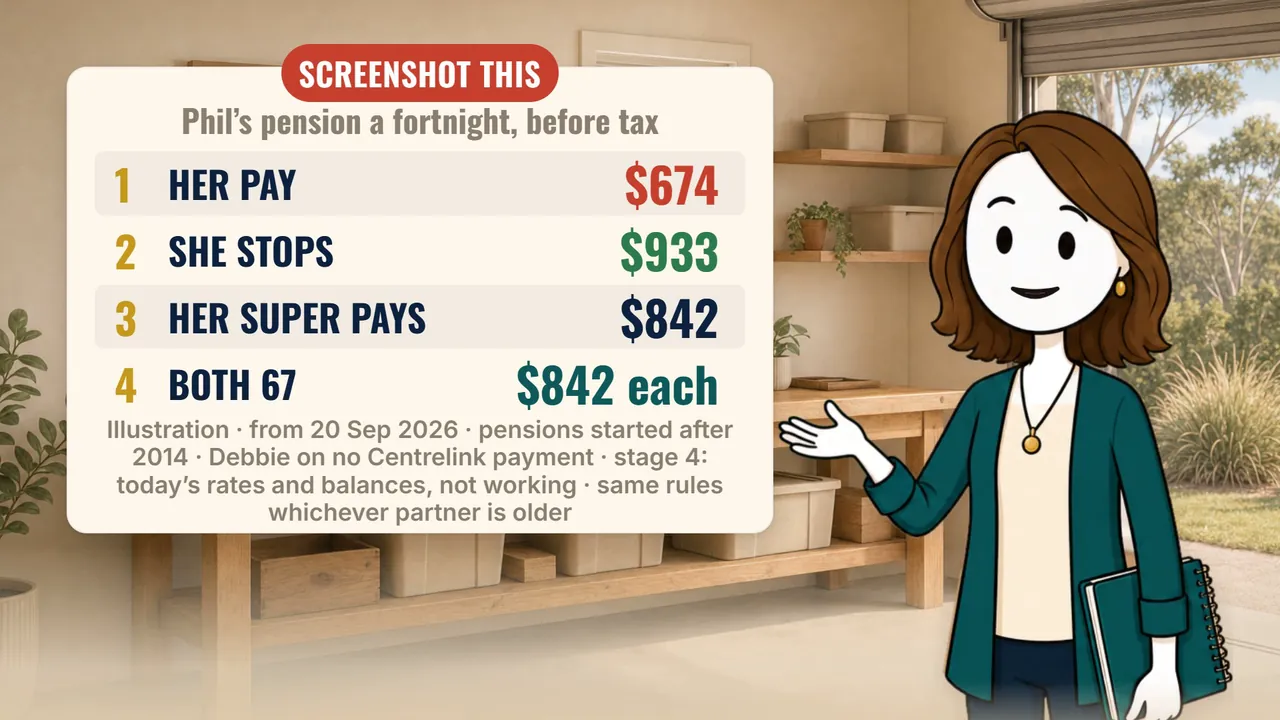
Phil's pension at each stage
| Stage | Phil's pension a fortnight |
|---|---|
| 1. Debbie working ($1,200 a fortnight) | about $674 |
| 2. Debbie stops work, super left in her fund | $933 |
| 3. Debbie's super pays her a pension | about $842 |
| 4. Debbie turns 67 | about $842 each |
Read down it and the pattern is clear. Her pay cost Phil the most. Her super cost less - and only once it paid her, or she reached pension age. The rules are the same whichever partner is older.
What could change these numbers
Two kinds of things. First, time: payment rates change every March and September, and the asset limits are reviewed in July as well; and as Phil draws on his super, less of it is counted. Second, how they live: if one of them has to live apart because of illness - say in care - the higher single rate can apply, though their income and assets are still counted together. And if they rented, the asset limits would be higher and Rent Assistance could apply.
Services Australia's free Financial Information Service can help you understand your own position.
Frequently asked questions
Is my partner's super counted for my Age Pension if they're under 67?
Not while it stays in accumulation and the fund isn't paying them. Once it pays them an income stream, or once they reach Age Pension age, it's counted in both the income and assets tests.
Do we get the single rate if only one of us is eligible?
No. A couple living together gets the couple rate - up to $933.00 a fortnight for each partner who is paid, from 20 September 2026 - even when only one of them can claim. The single rate can apply when a couple has to live apart because of illness.
Can I use the Work Bonus for my partner's wages?
No. Services Australia says you can't use your Work Bonus for your partner's wages. Your partner's pay counts in full in the couple's income test - unless they're also a pensioner of Age Pension age, when their own Work Bonus can shield part of it.
When can the younger partner claim the Age Pension?
From Age Pension age, 67. Like the older partner, they can lodge a claim up to 13 weeks before they turn 67.
Sources
- Services Australia - How much Age Pension you can get - couple $933.00 each, single $1,237.70 a fortnight, from 20 September 2026
- Services Australia - Income test for Age Pension - couple free area $396 a fortnight combined; 25 cents per dollar each
- Services Australia - Assets test for Age Pension - homeowner couple full-pension limit $499,000, from 20 September 2026
- Services Australia - Deeming - 1.75% on the first $110,600 for a couple, 3.75% above
- Services Australia - Superannuation (Age Pension) - super under pension age not counted unless it pays an income; counted at pension age
- Services Australia - Work Bonus and your partner's income - the Work Bonus can't be used for a partner's wages
- Services Australia - When to claim Age Pension - claims up to 13 weeks before Age Pension age
- Services Australia - How much JobSeeker Payment you can get - partnered maximum $755.10 a fortnight from 20 September 2026
- Services Australia - Superannuation (Carer Payment) - super under Age Pension age not counted unless the fund pays a pension
- Services Australia - Superannuation (Disability Support Pension) - the same rule for DSP
- Services Australia - Income and assets tests for Disability Support Pension - the DSP income and assets tests
- Services Australia - Income and assets tests for JobSeeker Payment - homeowner couple assets limit $499,000
General information only. This article is general information only. It doesn't take into account your objectives, financial situation or needs, and it isn't personal financial advice. Speak with a licensed financial adviser about your own situation. Services Australia's Financial Information Service (132 300) is free. Figures are current from 20 September 2026 and change every March, July and September - check servicesaustralia.gov.au and ato.gov.au for the latest.
A note on how this is made: Every article starts with real research and is checked against current ATO and Services Australia figures - that part isn't automated. AI tools help draft the text and produce the video's narration and visuals. We write, verify and stand behind every word.
Keep reading
- How Much Is the Age Pension? Rates for Singles and Couples, Homeowners and Renters
- The Age Pension Assets Test: What Counts, Where the Pension Stops, and Whether Losing It Matters
- Retirement Planning in Australia: Super, the Age Pension and the Three Ages That Matter
New here? Start with the complete guide: Retirement in Australia, explained - every rule, every test and a countdown to your last working day.
More Age Pension
- How to Boost Your Age Pension, Legally: Four Ways and the One That Backfires
- How Much Can You Have and Still Get the Full Age Pension? The Income Test and Deeming
- The Age Pension Assets Test: What Counts, Where the Pension Stops, and Whether Losing It Matters
- How Much Is the Age Pension? Rates for Singles and Couples, Homeowners and Renters