
Average Super Balance at Retirement in Australia - and What the Age Pension Adds

Figures current from 20 September 2026. How this is made
Key takeaways
- The median super balance for Australians aged 60 to 64 is $203,326 - men $236,126, women $174,655 (ATO data at June 2024, analysed by ASFA).
- Those medians leave out people with no super at all: about 1 in 10 men and nearly 1 in 5 women that age.
- A single 67-year-old homeowner with $200,000 in super and $30,000 of car and contents gets an Age Pension of $32,036 a year - more than 99% of the maximum.
- With the 5% minimum drawdown from super on top, that's $42,036 a year: above ASFA's modest budget, below comfortable. About three-quarters of it is the pension.
- Double the super to $400,000 and, at the minimum drawdown, the yearly income rises by only about $2,600 - because the assets test takes back most of the difference.

The average super balance at retirement in Australia is lower than the headlines suggest - and the typical balance is lower again. The person in the middle heading into retirement has about $200,000 in super, and for someone on that balance, the Age Pension, not the super, does most of the work. Below is exactly how much, to the dollar, for a single homeowner and for a couple.
What is the average super balance at retirement in Australia?
The latest figures come from the Tax Office's data at June 2024, analysed by ASFA, the super funds' industry body, in its 2026 report on super account balances.
For Australians aged 60 to 64 - the years just before most people retire - the median super balance is $203,326.
| Aged 60 to 64 | Median super balance |
|---|---|
| Everyone with super | $203,326 |
| Men | $236,126 |
| Women | $174,655 |
That's a gap of about 26% between men and women, right at the point of retirement.
Why the medians are still too high
Those medians only count people who have super. About 1 in 10 men aged 60 to 64 (9.8%) and nearly 1 in 5 women (17.6%) have none at all. So the real middle of everyone approaching retirement is lower than $203,326.
Median vs average: why you see bigger numbers quoted
You'll often see much bigger figures. Those are averages, not medians. The average balance for men aged 60 to 64 is about $413,700 - about 75% higher than the median - because a small group with very large balances pulls the average up.
The median is the person standing in the middle of the queue: half have more, half have less. That's the figure that describes most people, and it's the one this article uses.
How much does a comfortable retirement cost?
The benchmark most people quote is the ASFA Retirement Standard. For people aged 65 to 84 who own their home (June quarter 2026):
| Yearly budget | Single | Couple |
|---|---|---|
| Comfortable | $56,166 | $78,998 |
| Modest | $36,548 | $52,690 |
ASFA also publishes the lump sum it says you need at 67 to fund a comfortable retirement: $630,000 for a single person and $730,000 for a couple.
The fine print
That $630,000 already assumes three things:
- You receive a part Age Pension - ASFA's lump sums take the pension into account, both now and in future.
- You spend the whole balance down over your retirement.
- You own your home outright.
For a modest retirement, ASFA's lump sum is just $110,000 for a single homeowner ($120,000 for a couple). The benchmark itself is telling you the Age Pension does most of the lifting. So here's how much.
Worked example: what the Age Pension pays on $200,000 of super
Meet Carol. She's an illustration, not a real person.
- Age 67 - that's Age Pension age
- Single, and owns her home
- $200,000 in super, in an account-based pension (a super account that pays her a regular income)
- $30,000 of car and contents
- No other income
Centrelink runs two tests - an assets test and an income test - and pays whichever gives the lower rate. (Both are explained step by step in our complete guide to retirement in Australia.)
Step 1: the assets test
Her home isn't counted. So her assessable assets are $200,000 + $30,000 = $230,000.
A single homeowner can have up to $333,000 and still get the full pension under the assets test. Carol is well under, so this test pays her the full rate.
Step 2: the income test and deeming
Centrelink doesn't look at what Carol actually draws from her super, or what it earns. It uses deeming - it assumes her financial assets earn a set rate (Services Australia's deeming rates):
- 1.75% on the first $66,800
- 3.75% on the rest
If her fund earns more than that, she keeps the difference - Centrelink only counts the deemed amount.
- $66,800 x 1.75% = $1,169.00
- $133,200 x 3.75% = $4,995.00
- Deemed income = $6,164 a year, or $237.08 a fortnight
- The first $226 a fortnight is free, so she's $11.08 over
- Her pension drops by 50 cents for each dollar over: $5.54 a fortnight
Step 3: Carol's Age Pension
The maximum single rate is $1,237.70 a fortnight. Take off $5.54:
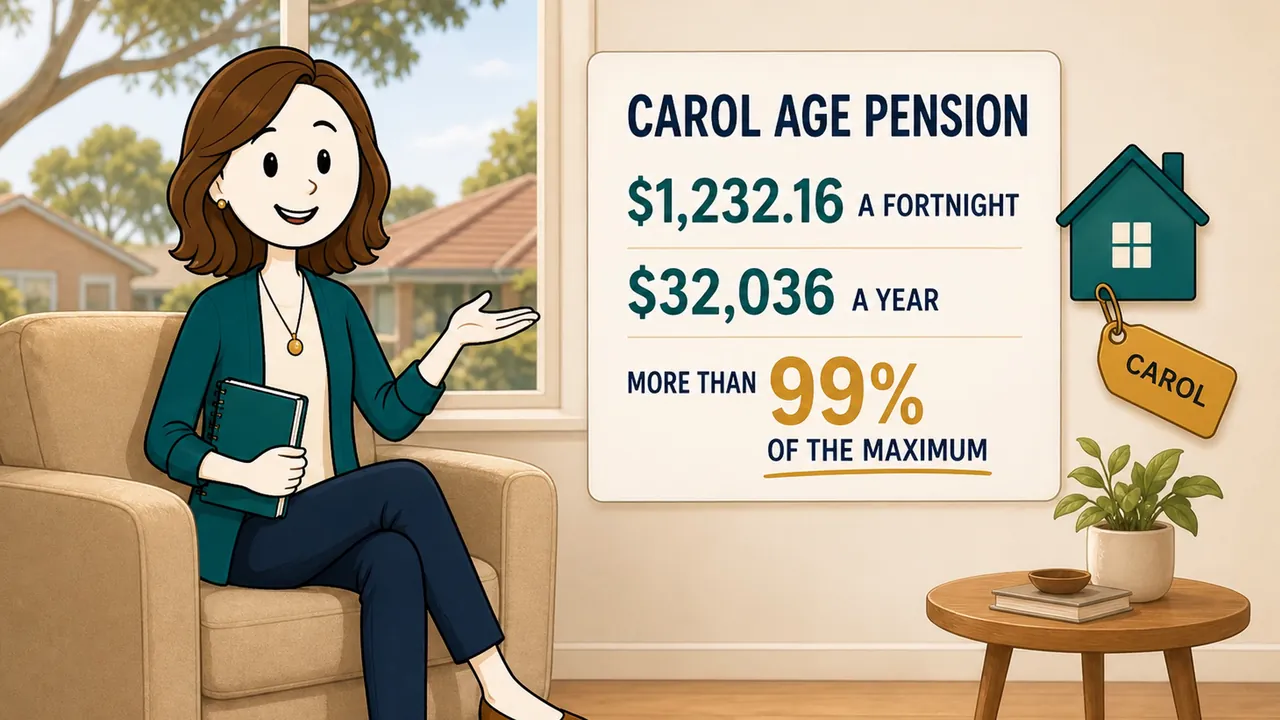
Carol's Age Pension is $1,232.16 a fortnight - $32,036 a year. That's more than 99% of the maximum.
Step 4: add her super
At 65 to 74, the minimum she must draw from an account-based pension each year is 5% of the balance - $10,000. Because she's over 60, payments from a taxed super fund are generally tax-free.
So Carol's income is $32,036 + $10,000 = $42,036 a year.
On top of the cash, the pension comes with a Pensioner Concession Card: cheaper health care and medicines, and some discounts.
Carol's retirement income on one page
| Carol, 67, single homeowner | A year |
|---|---|
| Super (5% minimum drawdown) | $10,000 |
| Age Pension | $32,036 |
| Total | $42,036 |
| ASFA modest (single homeowner) | $36,548 |
| ASFA comfortable (single homeowner) | $56,166 |
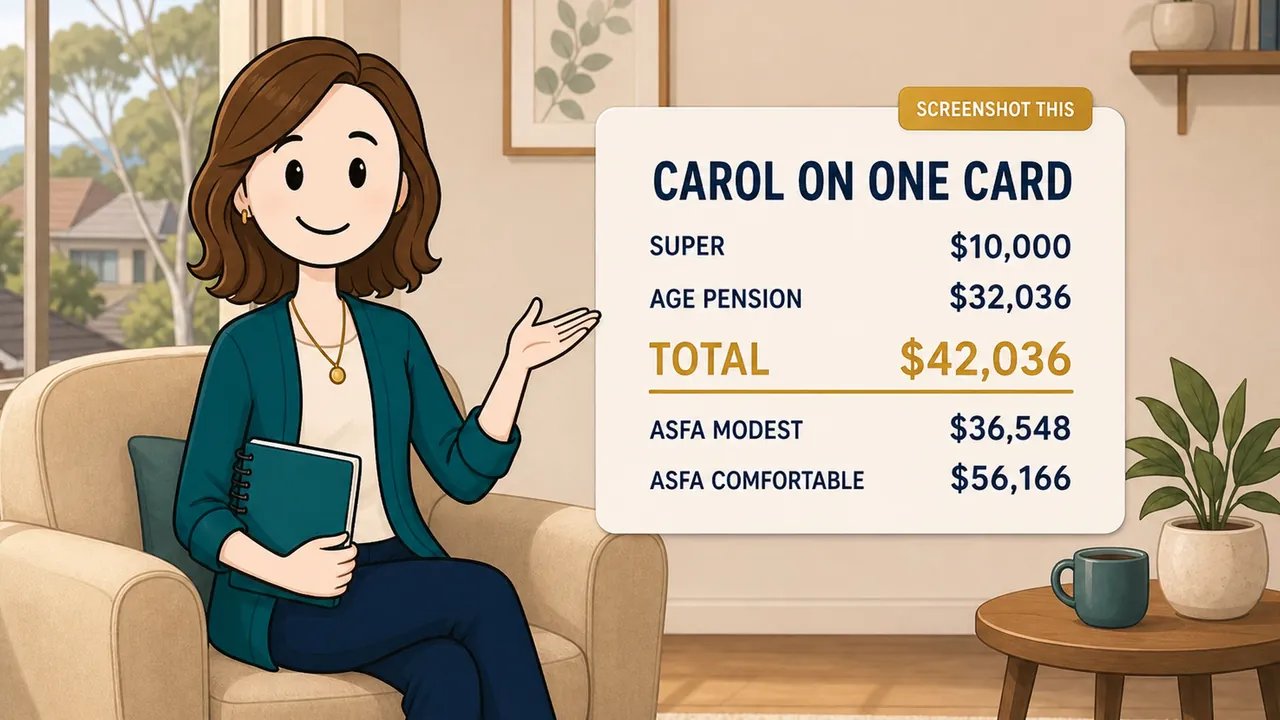
So the typical balance, with the pension on top, lands above ASFA's modest budget and below comfortable. And about three-quarters of Carol's income is the Age Pension. It isn't a safety net in her budget - it's the main event.
Carol can draw more than the minimum if she chooses. But every extra dollar comes out of the $200,000, so it runs down faster.
What if you rent?
Everything above assumes Carol owns her home. If she rented, three things change:
- More room on assets. The full-pension assets limit for a single non-homeowner is $600,000, not $333,000.
- Rent Assistance. She could get up to $223.80 a fortnight on top of the pension, if her rent is high enough.
- A much bigger target. Rent doesn't stop at retirement. ASFA's modest lump sum for a single renter is $340,000, not $110,000.
So for renters, the same $200,000 has a much harder job to do.
Does saving twice as much double your retirement income?
No. Same Carol, same home, but $400,000 in super instead of $200,000.
- Her assessable assets are now $430,000 - that's $97,000 over the $333,000 limit.
- For every $1,000 over, the pension drops $3 a fortnight: 97 x $3 = $291 a fortnight off.
- Her pension falls to $946.70 a fortnight - $24,614 a year. (The income test would pay $1,087.93, so the assets test now sets her rate.) That's $7,422 a year less than before.
- Her minimum drawdown doubles to $20,000, so her total is $44,614 a year.
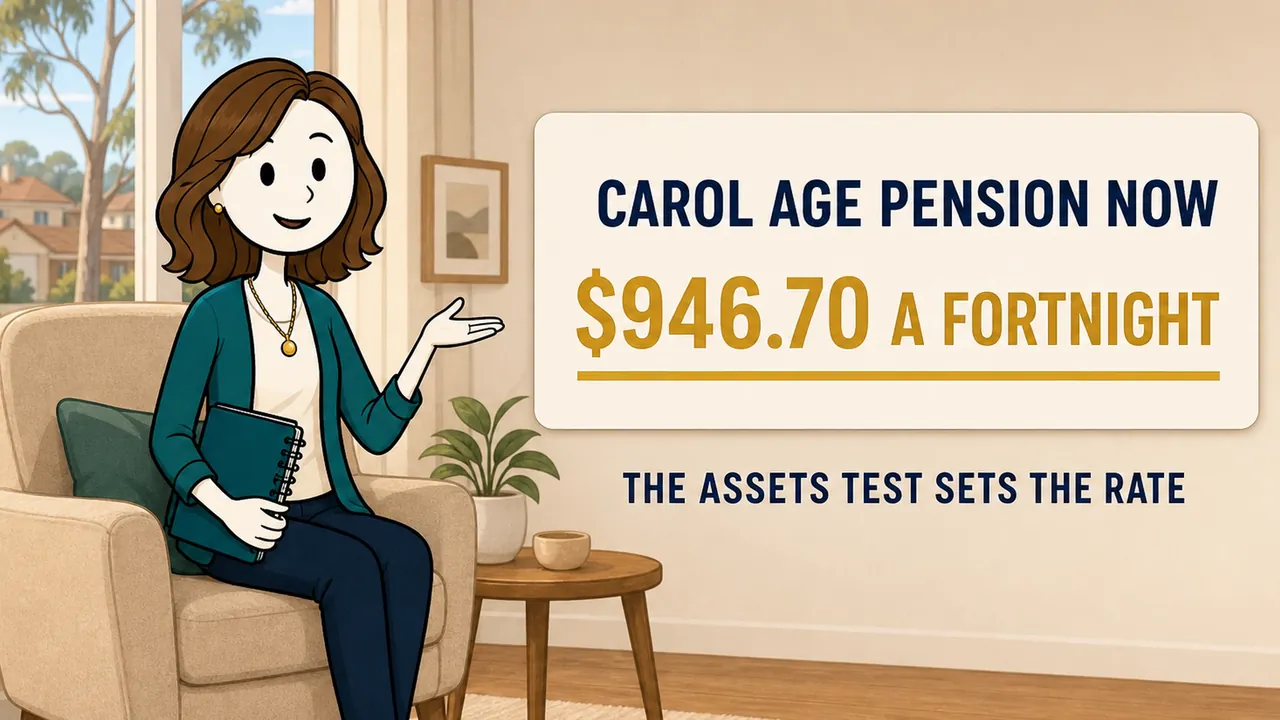
Twice the super, and at the minimum drawdown her income rises by only about $2,600 a year.
Why? Each $1,000 over the limit costs $3 a fortnight - $78 a year. That's like losing 7.8% a year on every dollar above the limit.
It's a feature of our means test: the UK, US and NZ pensions don't shrink as your savings grow. To be fair to the bigger balance, the extra $200,000 is still hers. It's a buffer for bad years and big bills. And as it runs down, her pension rises back. So this isn't a reason to save less - it's a reason to stop measuring yourself against one number.
What does the average couple retire with?
There's no such thing as "the median couple" - medians don't add up. So take a husband on the men's median and a wife on the women's median. Both are 67 and own their home.
- Super: $236,126 + $174,655 = $410,781. Add $30,000 for cars and contents: $440,781, under the couple homeowner limit of $499,000. Full rate on the assets test.
- Deeming at the couple rates (1.75% on the first $110,600, 3.75% above) gives $13,192 a year - $507.40 a fortnight.
- The couple free area is $396 a fortnight, so they're $111.40 over.
- Each partner's pension drops 25 cents per dollar over: $55.70 a fortnight combined.
- Their combined Age Pension is $1,866.00 - $55.70 = $1,810.30 a fortnight - $47,068 a year.
- Add 5% of their super ($20,539) and their income is about $67,600 a year.
ASFA's couple budgets are $52,690 (modest) and $78,998 (comfortable). So this couple lands in the same place as Carol: above modest, below comfortable - and again, the pension is the bigger share.
The bottom line
The typical Australian heading into retirement has about $200,000 in super. For a single homeowner on that balance, the Age Pension adds about $32,000 a year on top. The balance was never meant to do the job alone - and the benchmark everyone quotes doesn't assume it does either.
Your own figures depend on everything you own and earn, and on whether you rent. Services Australia's Financial Information Service is free and can explain how the two tests apply to your numbers - call 132 300 and ask for it.
Frequently asked questions
Why do so many people retire with only about $200,000?
The Superannuation Guarantee - the law that requires employers to pay super for most employees - began on 1 July 1992. Today the minimum is 12% of ordinary time earnings. Someone retiring now spent part of their working life before it began.
Is the average super balance the same as the median?
No. The average for men aged 60 to 64 is about $413,700; the median is $236,126. A small number of very large balances drag the average up. The median - the person in the middle - is the better guide to what's typical.
Is the Age Pension taxed?
The Age Pension is a taxable payment. Centrelink doesn't take tax out automatically, but it will if you ask. Payments from a taxed super fund are generally tax-free from age 60. Whether you end up paying tax depends on all your income - the ATO or a tax agent can tell you.
What changes if my partner is much younger than me?
A partner's super isn't counted while they're under Age Pension age and it stays in accumulation (not paying them a pension). Their wages, though, count against your pension under the income test. Moving their super into pension phase before they reach Age Pension age makes it count, which can reduce your pension - how much depends on the balance. The complete guide linked at the end of this article walks through a couple with an age gap.
Sources
- Services Australia - How much Age Pension you can get - maximum rates from 20 September 2026 (single $1,237.70, couple $1,866.00 a fortnight)
- Services Australia - Assets test for Age Pension - full-pension limits ($333,000 / $600,000 single, $499,000 couple homeowner) and part-pension cut-offs from 20 September 2026 (the $3 per $1,000 reduction reconciles exactly from the published couple cut-off)
- Services Australia - Income test for Age Pension - free areas $226 single / $396 couple; 50c and 25c reductions
- Services Australia - Deeming - 1.75% / 3.75% from 20 September 2026; thresholds $66,800 single and $110,600 couple from 1 July 2026
- Services Australia - How much Rent Assistance you can get - single maximum $223.80 a fortnight, from 20 September 2026
- ATO - Payments from super - minimum annual payments (5% at 65 to 74)
- ATO - How much super to pay - the Superannuation Guarantee rate (12% of ordinary time earnings from 1 July 2025)
- Superannuation Guarantee (Administration) Act 1992, on the ATO legal database - commenced 1 July 1992
- Services Australia - Pensioner Concession Card
- ASFA Retirement Standard - budgets and lump sums, June quarter 2026 (checked 3 November 2026)
- ASFA - An update on superannuation account balances (2026 edition) - medians, averages and the share with no super, ATO data at June 2024
General information only. This article is general information only. It doesn't take into account your objectives, financial situation or needs, and it isn't personal financial advice. Speak with a licensed financial adviser about your own situation. Services Australia's Financial Information Service (132 300) is free. Figures are current from 20 September 2026 and change every March, July and September - check servicesaustralia.gov.au and ato.gov.au for the latest.
A note on how this is made: Every article starts with real research and is checked against current ATO and Services Australia figures - that part isn't automated. AI tools help draft the text and produce the video's narration and visuals. We write, verify and stand behind every word.
Keep reading
- Age Pension vs UK State Pension, US Social Security and NZ Super: Who Pays More?
- What the Average Australian Actually Has in Super at 55, 60, 65 & 70 - and What the Age Pension Adds (video)
- How Much Can You Have and Still Get the Full Age Pension? Single or Couple, Own or Rent (video)
New here? Start with the complete guide: Retirement in Australia, explained - every rule, every test and a countdown to your last working day.
More Age Pension
- When Only One Partner Is Eligible for the Age Pension: What an Age-Gap Couple Gets
- How to Boost Your Age Pension, Legally: Four Ways and the One That Backfires
- How Much Can You Have and Still Get the Full Age Pension? The Income Test and Deeming
- The Age Pension Assets Test: What Counts, Where the Pension Stops, and Whether Losing It Matters