
Age Pension vs UK State Pension, US Social Security and NZ Super: Who Pays More?

Figures current from 20 September 2026. How this is made
Key takeaways
- Before tax, Australia's full Age Pension for a single person is about $32,180 a year - more than the full UK State Pension (about A$23,800) or NZ Super for a single person living alone (about A$27,100).
- The average retired worker in the US gets about A$35,800 a year from Social Security - more than our full rate - but US benefits depend on what you earned and paid in.
- Ours is the only one of the four that's means-tested. A single homeowner with $900,000 in savings gets no Age Pension here; in each of the other three countries, with a full record, she'd still get a pension.
- If you live in Australia, your UK State Pension is frozen at the rate when you first got it (or when you left). It only goes up while you're living in, or visiting, the UK.
- A UK pension generally counts as income under the Age Pension income test.

Age Pension vs UK State Pension, US Social Security and NZ Super: which pays more? On the full rate, Australia pays more than the UK and New Zealand. But a single retiree with a paid-off home and $900,000 in savings would still get a pension in three of the four countries - and nothing at all in ours. Here's why, with every figure on the same basis.
How the figures are compared
Every figure below is for a single person, before tax (unless it says couple), converted to Australian dollars at the Reserve Bank's exchange rates on 14 October 2026 (A$1 = US$0.7002 = £0.5275 = NZ$1.2444). New Zealand figures are for someone living alone. Where a figure is an average rather than a set rate, it says so.
Converting currencies isn't the same as comparing what money buys. Rents, health care and prices all differ, so treat this as a guide to how each system works.
Four pensions that aren't the same kind of thing
| Country | How you qualify |
|---|---|
| Australia | Age and years living here, then a means test on your assets and income |
| United Kingdom | Years of National Insurance contributions or credits |
| New Zealand | Being a resident who reaches 65, after 10 to 20 years living there |
| United States | What you earned and paid in over your working life |
So when someone says Americans get more than we do, they can be right. But it's a bit like comparing something you paid for with a safety net.
Australia's Age Pension
From 20 September 2026, the full Age Pension for a single person is $1,237.70 a fortnight - about $32,180 a year. A couple gets $1,866 a fortnight between them - about $48,500 a year. It starts at 67 and is adjusted every March and September.
The catch is the means test.
- Assets test: a single homeowner can have up to $333,000 before the pension starts to reduce (Services Australia). The home itself generally isn't counted. Above that, the pension shrinks by $3 a fortnight for every $1,000, and stops completely at $745,750. It's a slope, not a cliff.
- Income test: your savings are treated as earning income - called deeming - whether they do or not: 1.75% on the first $66,800 and 3.75% above. Income over $226 a fortnight reduces the pension by 50 cents a dollar. If your assets are mostly savings, the income test usually starts cutting in before the assets test does - though for a homeowner with more than roughly $380,000, the assets test usually cuts harder, as Margaret's example below shows.
These are Age Pension figures. If you're on the Disability Support Pension, Carer Payment or JobSeeker, check the rules for your own payment. Both tests are set out step by step in our complete guide to retirement in Australia.
The UK State Pension
The full new State Pension is £241.30 a week (from April 2026) - about A$23,800 a year. So on the full rate, a single Brit gets quite a bit less than a single Aussie. But there are three big differences:
- No couple rate. The new State Pension is usually paid on your own record, so two full pensions come to about A$47,600 - just under our couple rate.
- You have to earn it. The full amount usually needs 35 qualifying years of National Insurance. With fewer than 10, you get nothing.
- No means test. A retiree with £2 million in the bank gets the same pension as one with nothing, if their records match.
For people living in the UK, it rises every April under the triple lock: by whichever is highest of wage growth, inflation or 2.5%. The UK pension age is 66 and is rising to 67.
Why your UK pension is frozen in Australia
If you moved here from Britain, this is the part that stings. Live in Australia, and your UK State Pension is frozen. It stays at the rate when you first got it - or, if you were already getting it, when you left. It only goes up while you're living in, or visiting, the UK.
Say you reached UK pension age in late 2010 with a full record, already living here. Your basic State Pension would still be £97.65 a week. Someone with the same record who stayed in Britain now gets £184.90 - almost double.
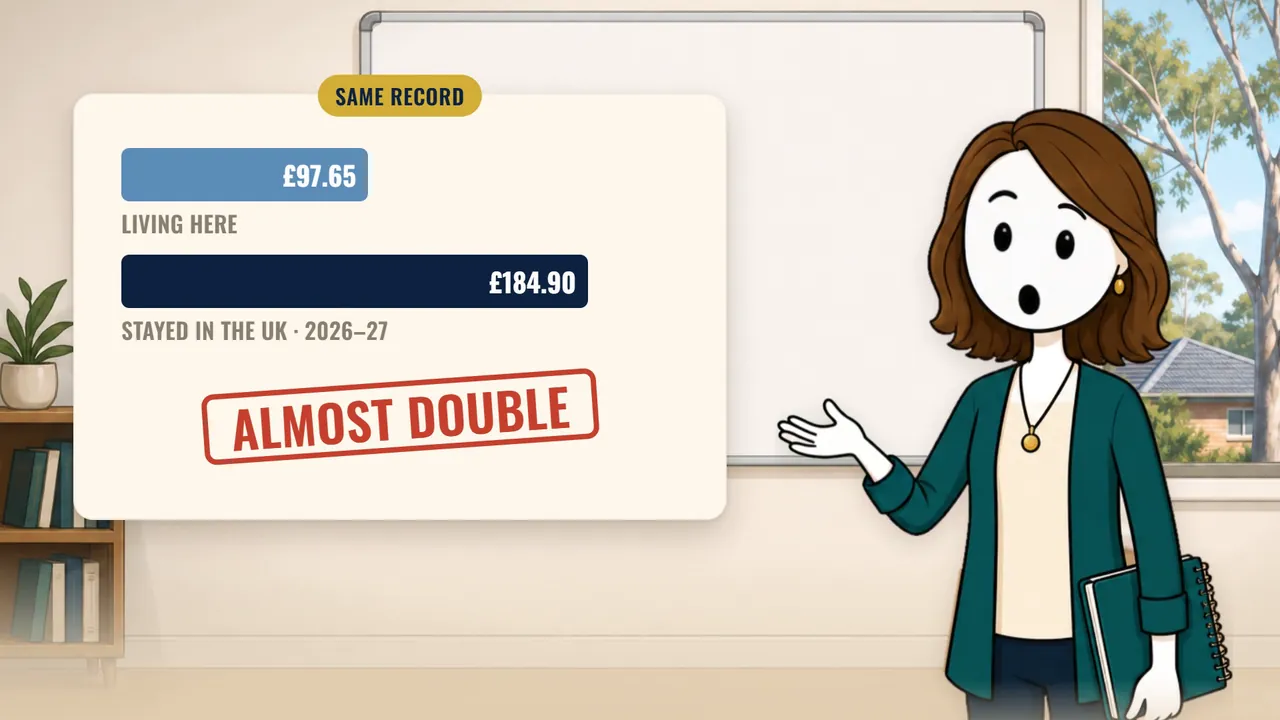
That's the old basic State Pension: anyone who reached UK pension age before 6 April 2016 is on that one, not the new one.
It's frozen because Britain only raises State Pensions paid in certain countries - mostly in Europe, plus a short list with an agreement (see GOV.UK: State Pension if you retire abroad). Australia isn't one of them. Australia ended its own social security agreement with the UK on 1 March 2001, because the UK declined to change its policy of not indexing pensions paid here.
And here, a UK pension generally counts as income under the Age Pension income test. If that's you, it's worth checking how yours is assessed.
US Social Security
Social Security is based on your highest 35 years of earnings, so there isn't one full rate.
- The average retired worker gets about US$2,090 a month (August 2026) - around A$35,800 a year. That's more than our full single rate. But that worker paid Social Security tax on their wages, and their employer matched it.
- At the very top, someone who earned at the cap their whole career and retires at 70 in 2026 gets US$5,181 a month - nearly A$88,800 a year.
- Timing matters. For anyone born in 1960 or later, full retirement age is 67. They can claim from 62, but the benefit is cut by about 30%; waiting until 70 pays about a quarter more than claiming at 67. Both US figures change with the cost-of-living rise each January.
Savings and property don't come into it - it's based on your work record. Part of it can be taxed if you have other income.
NZ Super
New Zealand is so like us, with a pension that works completely differently. NZ Super isn't means-tested. Reach 65, meet the residency rules, and you get it. You can keep working full time and still get it, though you may pay more tax.
One thing it does look at is a state pension from another country, including ours - that comes off NZ Super dollar for dollar.
- Before tax, a single person living alone gets NZ$1,294.74 a fortnight (from 1 April 2026) - about A$27,100 a year.
- Unlike our Age Pension, tax is taken out automatically before it's paid.
- By law, each April the couple rate after tax is set at no less than 66% of the average wage after tax, so it keeps up with pay packets, not just prices.
So before tax, a single Kiwi living alone gets about A$5,100 a year less than a single Aussie on the full rate (about A$4,800 less counting New Zealand's Winter Energy Payment, paid from May to October). But they get it two years earlier, and they get it whatever they own.
If you've lived in both countries, an agreement between Australia and New Zealand lets your time in each count. But if you need your Australian years to qualify for NZ Super, you wait until 67.
All four pensions compared
| Single, before tax | Pension age | A year (A$) | Means test? |
|---|---|---|---|
| Australia (full rate) | 67 | $32,180 | Yes |
| United Kingdom (full new State Pension) | 66, rising to 67 | about $23,800 | No |
| New Zealand (living alone) | 65 | about $27,100 | No |
| United States (average retired worker) | 67 (from 62, reduced) | about $35,800 | No |
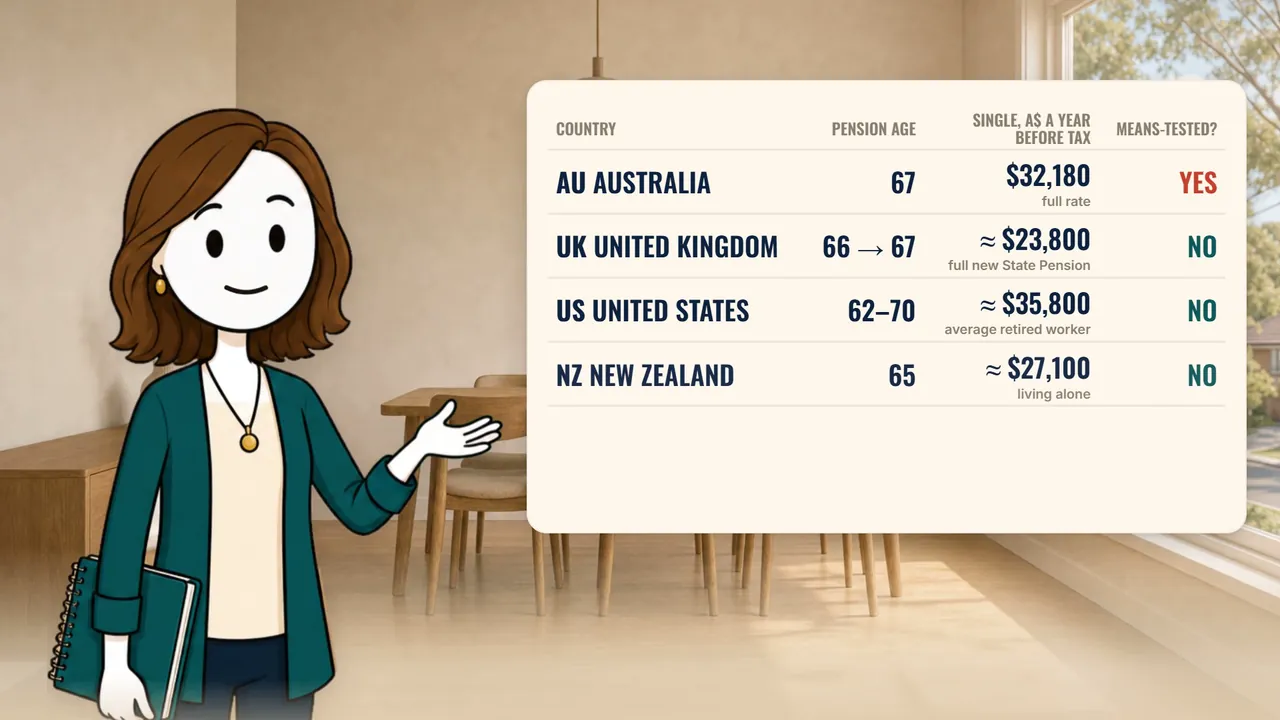
Ours pays the most of the three flat-rate pensions. Only the average American retiree gets more than our full rate. And ours is the only one that shrinks as your savings grow.
Worked example: one retiree in four countries
Meet Margaret. She's an illustration, not a real person: 67, single, lives alone, owns her home, with $400,000 in other assets - mostly savings and super. Picture her with a full record in whichever country she's in.
| Margaret, $400,000 in savings | A year, before tax (A$) |
|---|---|
| United Kingdom (full new State Pension) | about $23,800 |
| New Zealand | about $27,100 |
| Australia (part pension) | about $27,000 |
| United States (average retired worker) | about $35,800 |
Here, Margaret is $67,000 over the assets-test limit, so the assets test cuts her pension by 67 x $3 = $201 a fortnight, to $1,036.70 - about $27,000 a year. (If it's all savings and super, the income test would pay $1,087.93, so the assets test is the one that applies.)
So at $400,000, Margaret is about level with New Zealand, ahead of the UK, and behind the average American.
Now give her $900,000
- New Zealand: same pension.
- United Kingdom: same pension.
- United States: same pension.
- Australia: zero. She's over the $745,750 cut-off. Not a cent.
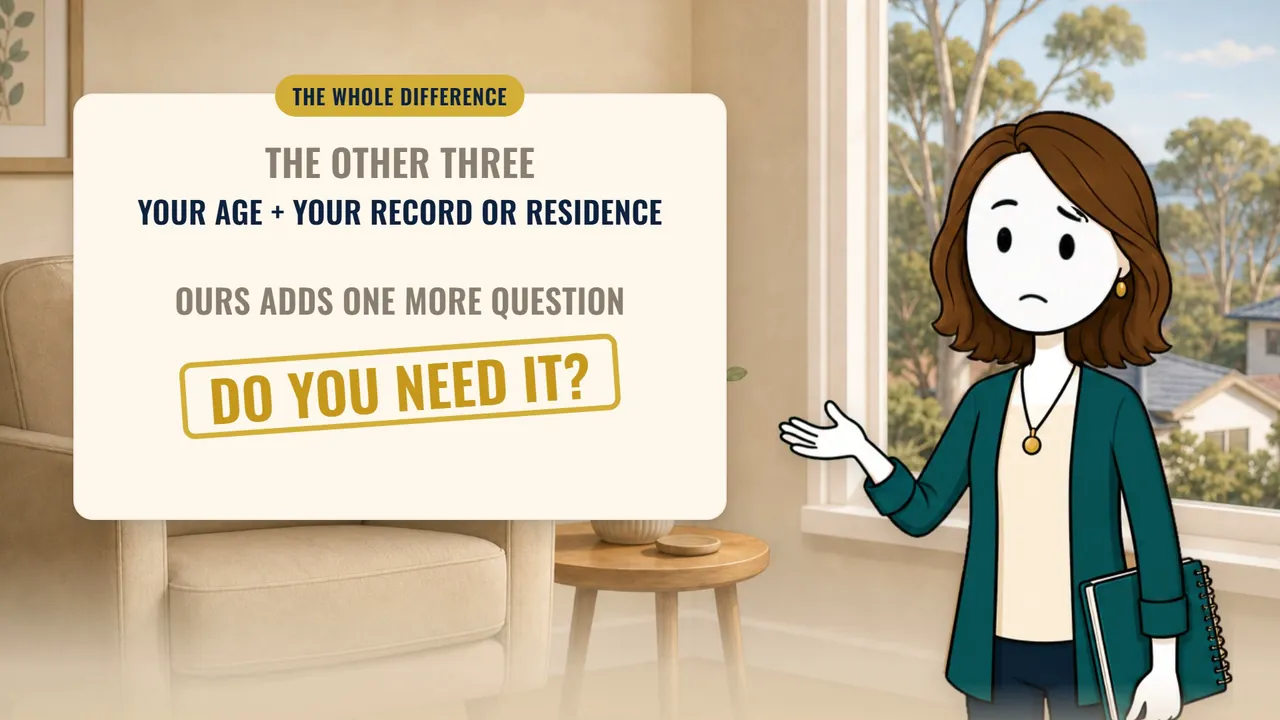
That's the whole difference in one example. The other three pay you for your age and your work record or years of residence. Ours adds one more question: do you need it?
So which country has the best pension?
- If you reach 67 with very little, ours is hard to beat. The full single rate is higher than the UK's or New Zealand's, and unlike the UK or US pensions, you don't need a work record - just enough years living here.
- If you reach 67 with a lot, our Age Pension pays nothing. The other three keep paying.
That's not an accident; it's the design. Since 1992, employers have had to pay super for most workers, and the Age Pension is the safety net underneath. So whether ours is the best really comes down to one question: how did your super go? (Here's what the typical Australian actually retires with, and what the Age Pension adds on top.)
For some people it's gone brilliantly, and they may never need a pension. For others, a late start, time out of work, divorce or just bad luck means the Age Pension will be most of their income. And for many people in the middle, it's the part pension - and how the means test treats their savings - that decides whether retirement is comfortable or tight.
Frequently asked questions
Does a pensioner in New Zealand only get $5,000 a year?
No. A single person living alone in New Zealand gets about A$27,100 a year before tax. That's about A$5,100 a year less than the full Age Pension for a single person here.
Doesn't tax change the comparison?
Yes - so every figure here is before tax, to keep one basis. The four countries tax their pensions differently: NZ Super has tax taken out before it's paid, the Age Pension is a taxable payment here, and part of US Social Security can be taxable if you have other income. Your own tax depends on everything else you earn.
What about Americans who hardly worked?
US Social Security generally needs 40 credits - about 10 years of work - before you qualify for a retirement benefit on your own record. With fewer, you don't get one on your own record (a spouse's benefit may still apply). That's a key difference from our Age Pension, which is based on residence, not work.
Does my UK pension reduce my Age Pension?
A UK pension generally counts as income under the Age Pension income test, so it can reduce your rate. How much depends on your other income and assets - Services Australia assesses it.
Can I get both the Age Pension and NZ Super?
Possibly a part of each. Under the Australia-New Zealand agreement, someone who has lived in both countries can get a payment from each, worked out from their years in each. In New Zealand, an Australian payment counts as an overseas pension and comes off NZ Super, so the total is usually close to one full pension rather than two. If you need your Australian years to qualify for NZ Super, you wait until 67.
Sources
- Services Australia - How much Age Pension you can get - single $1,237.70, couple $1,866 a fortnight from 20 September 2026
- Services Australia - Assets test for Age Pension - $333,000 limit (from 1 July 2026) and $745,750 cut-off (from 20 September 2026), single homeowner
- Services Australia - Income test for Age Pension and Deeming
- Services Australia - Income from outside Australia - foreign pensions in the income test
- DSS - International social security agreements - UK agreement ended 1 March 2001
- GOV.UK - The new State Pension - £241.30 a week from April 2026; 35 and 10 qualifying years
- GOV.UK - State Pension if you retire abroad - where pensions are increased
- The Social Security Benefits Up-rating Order 2010 - basic State Pension £97.65 a week from April 2010
- GOV.UK - State Pension age timetable
- SSA - Monthly Statistical Snapshot, August 2026 - average retired-worker benefit
- SSA - Maximum benefit, retirement age and claiming early and credits
- Work and Income NZ - Benefit rates April 2026 - NZ Super, single living alone
- Work and Income NZ - Overseas pensions and the Australia agreement
- Reserve Bank of Australia - Exchange rates (F11.1) - 14 October 2026
General information only. This article is general information only. It doesn't take into account your objectives, financial situation or needs, and it isn't personal financial advice. Speak with a licensed financial adviser about your own situation. Services Australia's Financial Information Service (132 300) is free. Figures are current from 20 September 2026 and change every March, July and September - check servicesaustralia.gov.au and ato.gov.au for the latest.
A note on how this is made: Every article starts with real research and is checked against current ATO and Services Australia figures - that part isn't automated. AI tools help draft the text and produce the video's narration and visuals. We write, verify and stand behind every word.
Keep reading
- Average Super Balance at Retirement in Australia - and What the Age Pension Adds
- Retire Overseas on the Age Pension? What You Actually Keep (video)
- What the Age Pension Actually Pays in 2026 - Single or Couple, Own or Rent (video)
New here? Start with the complete guide: Retirement in Australia, explained - every rule, every test and a countdown to your last working day.
More Age Pension
- When Only One Partner Is Eligible for the Age Pension: What an Age-Gap Couple Gets
- How to Boost Your Age Pension, Legally: Four Ways and the One That Backfires
- How Much Can You Have and Still Get the Full Age Pension? The Income Test and Deeming
- The Age Pension Assets Test: What Counts, Where the Pension Stops, and Whether Losing It Matters