
The Six-Year Rule: Renting Out Your Old Home (and State Land Tax)

Figures current from 20 September 2026. How this is made
Key takeaways
- The six year rule lets you keep treating your former home as your main residence - free of capital gains tax - for up to six years after you move out if it's rented out or available for rent, and with no time limit if it isn't. While you do, no other home can be your main residence.
- Only time the house is rented out or available for rent counts towards the six. Each new absence after you've moved back in gets its own six years.
- Rent it for longer than six years in one absence and part of the gain becomes taxable - usually worked out from the house's value on the day it first earned rent. The ATO says the main residence exemption isn't changing under the 2027 CGT reforms, but it hasn't published how the new rules apply to a home that's only partly exempt.
- Land tax is a separate, state tax. New South Wales and Victoria have their own six-year absence rules, but neither allows a normal year-round tenancy, and Queensland has no fixed absence period. On $700,000 of land, a rented-out former home that's the only land you own pays $0 in NSW, $2,850 a year in Victoria and $1,500 a year in Queensland at today's rates.
- Centrelink treats your home as exempt for up to 12 months after you move out, but only while you intend to return. After that - or straight away if you don't plan to go back - it counts as an asset, and rent counts as income from the start.
The six year rule lets you move out of your home, rent it out, and still sell it free of capital gains tax - as long as it hasn't been rented out or available for rent for more than six years while you were away. The Tax Office publishes worked examples of how to use it. But it's a federal tax rule only. Your state's land tax and Centrelink each have their own rules for the same house, and their clocks run differently. This guide covers all three, checked against the ATO, three state revenue offices and Services Australia.

This video was recorded in September 2026. The rules and figures in this article were checked again on 11 November 2026. Where the video says two extra years "cost" Julie $92,000, that's the part of her gain that isn't exempt, not a tax bill.
What is the six year rule?
Your main residence - your home - is generally exempt from capital gains tax (CGT), the tax on the profit when you sell an asset for more than it cost you. Normally a property stops being your main residence when you stop living in it.
The six year rule is the exception. The ATO says that for CGT you can keep treating a property as your main residence after you move out (ATO: treating former home as main residence):
- for up to 6 years if you use it to produce income, such as rent
- indefinitely if you don't - for example, if you leave it empty or use it as a holiday house.
While you treat it as your main residence, it stays exempt, even if you start renting it out after you leave. The trade-off: you can't treat any other property as your main residence at the same time, except for up to six months when you're moving house.
It's a choice you make when you sell
There's no form when you move out. You make the choice in your tax return for the year you sign the contract to sell - the contract date, not settlement - by claiming the main residence exemption or not. You can also choose when the period ends. The ATO's example: someone who rented a house out for five years could choose to treat it as their main residence for only three of them.
Who can use the six year rule?
The usual main residence rules apply, plus two conditions:
- It must have been your main residence first. The rule only covers time after the property became your home. If you rented a place out before you ever lived in it, those years can't be covered.
- You must have stopped living in it.
A part already earning income stays taxable
If you used part of your home to produce income before you moved out, the six year rule can't cover that part - before you left or after. The ATO's example is Helen, who used a quarter of her house as a doctor's surgery. When she sold, a quarter of her $400,000 gain was assessable - $100,000 - even though she chose to treat the house as her main residence for the six years it was rented out.
Working from home for an employer is usually different. The ATO's test is whether you'd be entitled to deduct part of your home loan interest. Using a home study to do work usually done at your workplace doesn't give you that, so it doesn't by itself reduce the exemption.
Does time the house sits empty count towards the six years?
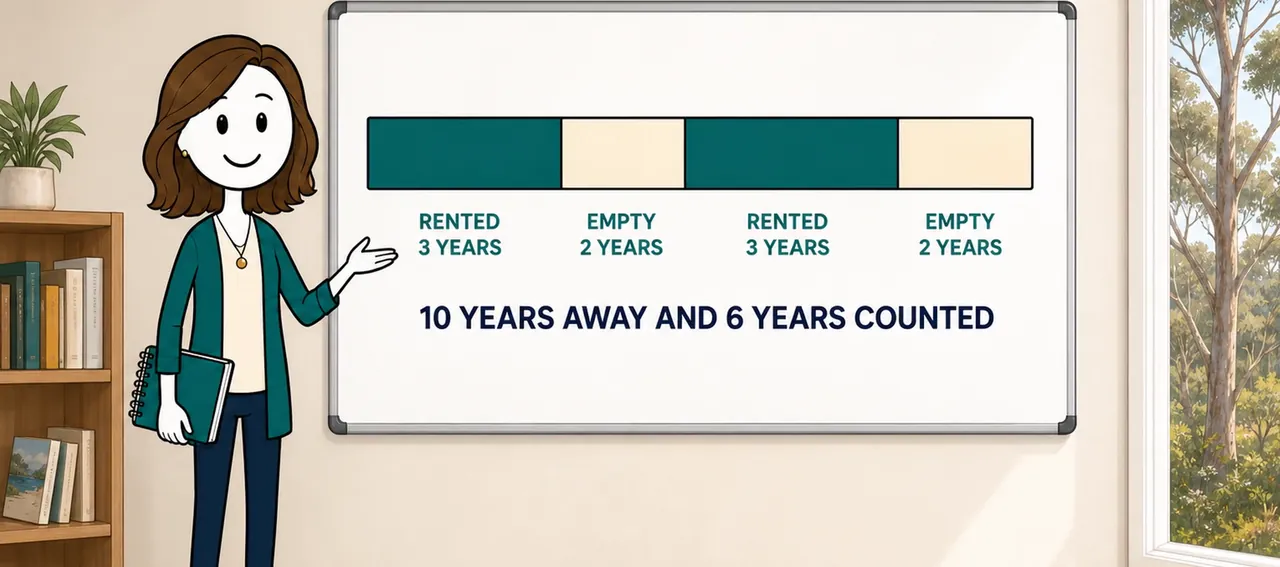
Not if it's simply left empty. Only time it's rented out or available for rent counts against the limit, and the six years don't have to be in one block.
The ATO's example is Lisa. After she moved out, she rented the house for 3 years, left it empty for 2, rented it for 3 more and left it empty for another 2. That's 10 years away but 6 years of income, so she could choose to treat the house as her main residence for the whole 10 years.
Does the six year rule reset if you move back in?
Yes. If you're away more than once, the 6-year limit applies to each period of absence. In the ATO's example, Jez rented his house out for 5 years, moved back in for 2, then moved out and rented it for 4 more. Both rental periods could be covered, and the whole gain was exempt when he sold.
The six-month overlap doesn't help a rented home
When you buy a new home before selling your old one, the ATO lets you treat both as your main residence for up to six months. But only if you lived in the old home for at least 3 months in a row in the 12 months before you sold it, and didn't use it to produce income in any part of those 12 months while it wasn't your main residence. A house you haven't lived in for at least 3 months in a row in the year before the sale doesn't qualify.
So if you buy a new home while using the six year rule on the old one, you choose which one is your main residence for those years. The other is exposed to CGT for that time. Renting the place you live in has no such cost - there's no gain to protect.
What happens if you rent it out for more than six years?
You don't lose the whole exemption - you lose part of it. If your former home earns income for more than 6 years in one absence, the ATO says it's subject to CGT for the period after the 6-year limit:
- If you bought it on or after 20 September 1985, first rented it out after 20 August 1996, and it was fully exempt up to then, you're treated as having bought your home on the day it first earned income, for its market value that day. This is the home first used to produce income rule.
- The gain from that value is split by days. The share of days past the 6-year limit is taxable; the rest is exempt.
The ATO says you need a market valuation from the time you first start renting it out, if that was after 20 August 1996.
An example: Julie rents for eight years
Julie is an illustration, not a real person. She's 55, single, an Australian resident, and owns only her home, outright. Her super is locked until 60, her preservation age - the earliest she can normally get at it - and the Age Pension doesn't start until 67. She moves out to rent a unit nearer her family, and rents her house out.
- The house first earns rent on 1 July 2026, when it's worth $900,000.
- She rents it out for eight years and signs a contract to sell for $1.3 million on 1 July 2034, at 63. Agent and legal fees are $30,000.
- The gain measured from the first-rent value is $1,300,000 less $930,000: $370,000.
- Of the 2,923 days from the first rent to the sale, 730 are past the six-year limit - about a quarter.
- So about $92,000 of the gain falls outside the exemption. Had she signed at the six-year mark, it would have been nil.
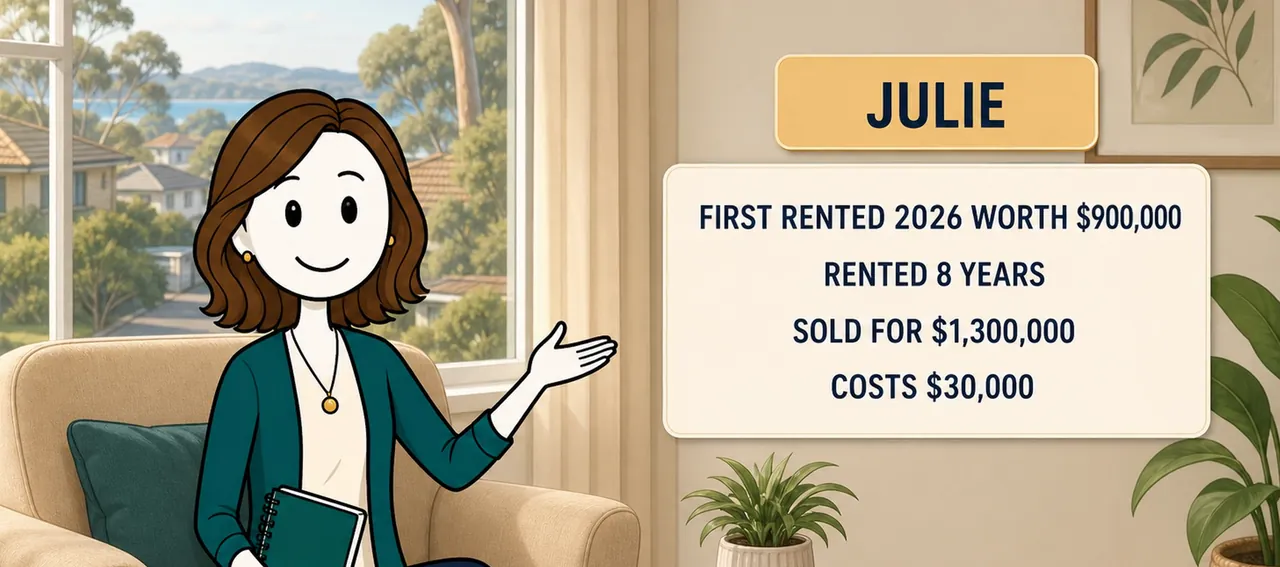
Under the main residence rules as the ATO describes them today, that $92,000 is the part of the gain left outside the exemption, not a tax bill. Julie sells after 1 July 2027, so how that part is taxed depends on the CGT changes below.
Do the 2027 CGT changes affect the six year rule?
The rule itself, no. The ATO lists the main residence exemption among the things that aren't changing under the CGT reforms (ATO: capital gains tax reform, published 13 October 2026). A former home that's fully covered by the six year rule stays tax-free when you sell.
What changes is how a gain that is taxable gets taxed. Under the Treasury Laws Amendment (Tax Reform No. 1) Act 2026, which became law in June 2026, from 1 July 2027:
- for individuals, the 50% CGT discount is replaced by cost base indexation - lifting what an asset cost you by inflation - for gains that build up from 1 July 2027
- a 30% minimum tax applies to individuals on certain gains that build up from 1 July 2027
- gains up to 30 June 2027 keep the 50% discount, through a deemed sale and buy-back of assets held on that date.
The ATO hasn't published how these transitional rules apply to a home that's only partly exempt, like Julie's. So this article doesn't put a tax figure on a partly exempt sale after July 2027. Our guide to the 2027 CGT changes covers indexation, the minimum tax and the deemed sale in detail - including that the minimum tax doesn't apply in any income year you receive the Age Pension, or another payment the Act lists.
Negative gearing and a former home
From the 2027-28 income year, if the costs of your residential properties exceed their rent, the excess can only be used against income and gains from residential property, and anything left over is carried forward. That limit doesn't apply to a dwelling you contracted to buy before 7:30pm (Canberra time) on 12 May 2026, or to a new residential dwelling. A former home you bought before Budget night isn't affected, whenever it becomes a rental.
Can you use the six year rule if you move overseas?
Generally not, if you're a foreign resident when you sell. The ATO says that if you're a foreign resident for tax purposes when you dispose of the property, you aren't entitled to the main residence exemption - including the partial exemption and the home first used to produce income rule - even if you were a resident for some of the time you owned it.
There's one exception, the life events test. It applies if you've been a foreign resident for a continuous period of 6 years or less, and during that time:
- you, your spouse or your child under 18 had a terminal medical condition
- your spouse or your child under 18 died, or
- the sale happened because of a formal agreement after your marriage or relationship broke down.
What counts is your residency when you sign the sale contract - the disposal time is the contract date, not settlement. A registered tax agent can work through it before you sign.
Does the six year rule apply to land tax?
No. The six year rule is a federal capital gains tax rule. Land tax is a state tax, charged every year on the land you own on one night, and each state writes its own exemptions:
| State | Taxing date | Land tax starts at (individuals) | Rate in the band above |
|---|---|---|---|
| New South Wales | Midnight 31 December | $1,075,000 | $100 plus 1.6% above $1,075,000 |
| Victoria | Midnight 31 December | $50,000 | Flat amounts, then $1,350 plus 0.3% above $300,000, and $2,250 plus 0.6% above $600,000 |
| Queensland | Midnight 30 June | $600,000 | $500 plus 1 cent per $1 above $600,000 |
Your home - what the states call your principal place of residence - is normally exempt. The question is what happens when you move out and a tenant moves in. Thresholds apply to all your taxable land added together, not each property, and each state values land its own way (New South Wales, for example, uses a three-year average).
Victoria's thresholds include the temporary COVID Debt Repayment Plan changes: a $500 flat amount from $50,000, $975 from $100,000, and from $300,000 the $975 plus an extra 0.1 percentage points, legislated until 30 June 2033.

This video was recorded in September 2026. Its land tax rates and rules were checked again on 11 November 2026 and haven't changed.
New South Wales: six years, but not with a normal tenancy
Revenue NSW has a concession for living away from home for up to 6 years, if you move out and live in a residence you don't own. You must:
- have lived there continuously for at least 6 months before moving away
- not own another principal place of residence, and
- either only earn enough income from the property to cover basic property expenses, such as rates, water and other amenities, or not lease it out for longer than 6 months in a calendar year.
Lease it out for longer than 6 months and you pay land tax the following year, unless you move back in before 31 December. An ongoing tenancy at market rent fails both tests. Revenue NSW's ruling adds that the exemption ends if you don't move back within six years, unless you sell before then. If you're away because you're in full-time care - in hospital, in aged care, or living with a carer - the 6-year limit doesn't apply.
Victoria: six years, but no rent at all
SRO Victoria's temporary absence provision also lasts up to 6 years from when the absence started. You must have had the exemption, or lived there as your home for at least 6 months in a row immediately before the absence. You must plan to move back in, and no other land in or outside Australia can be exempt as your home while you're away.
The rental rule is the difference. From the 2021 land tax year, no income can be earned from the property in the preceding year. Not limited rent, not six months of rent - none. So an empty former home can keep the exemption for up to six years, and a tenanted one can't.
Victoria also has a vacant residential land tax for homes left empty for more than six months of a year. Land that's exempt from land tax, including your principal place of residence, is exempt from it.
Queensland: no fixed absence period
Queensland has no general six-year rule. Land counts as your home if you've lived there, and nowhere else, for the 6 months up to 30 June, or if the Commissioner is satisfied it's your principal place of residence on 30 June. Temporary absences - the Queensland Revenue Office lists holidays, illness, fire, flood, business or employment - are judged case by case.
Two specific rules cover absences: being away to receive care (for up to 6 years, with limits on income from the land), and moving out while the home is demolished and rebuilt, or renovated so heavily you can't live in it.
Some letting is allowed, but only while you still live there: a room or a granny flat, no more than half the home's floor area, at no more than market rent. Leasing the whole house while you live elsewhere isn't one of those, and the exemption depends on the land being used as your home.
How much land tax would you pay on a rented-out former home?
Put Julie's house in each state. She rents it out on a 12-month lease at market rent, and rents where she lives. Say the land is worth $700,000 on each state's own measure, and it's the only land she owns.
| State | Does the exemption survive the lease? | Land tax a year |
|---|---|---|
| New South Wales | No - rent above basic expenses, leased over 6 months | $0 - $700,000 is under the $1,075,000 threshold |
| Victoria | No - any rent ends it | $2,250 + 0.6% of $100,000 = $2,850 |
| Queensland | No - a whole-house lease | $500 + 1 cent × $100,000 = $1,500 |
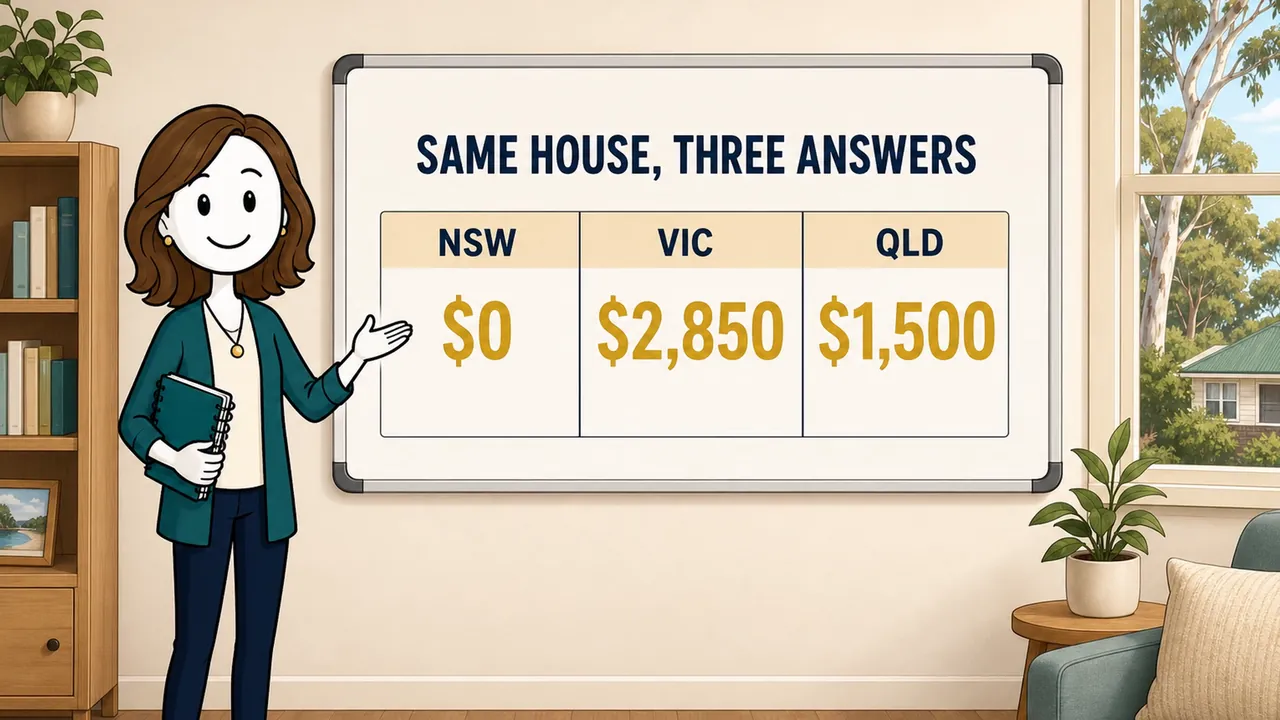
At today's rates and the same land value, six years of it would come to about $17,100 in Victoria and $9,000 in Queensland - all while the ATO still treats the house as her home for CGT. New South Wales's zero holds only while the rented house is the only taxable land she owns; add an investment unit and the two are added together against the threshold.
Does renting out your old home affect the Age Pension?
Yes, and on a third clock. While you live in your home, Centrelink doesn't count it in the assets test. Move out, and the Social Security Guide says it can stay your principal home - and you stay a homeowner - for up to 12 months of temporary absence, as long as you intend to return - even if you expect to be away longer (Social Security Guide 4.6.3.60). After that, it's no longer your principal home. And if you don't intend to return, the guide says the home is an assessable asset straight away, and the non-homeowner limits apply.
- The house then counts as an asset. Services Australia counts real estate other than your principal home at its market value, less any loan secured against it. If you don't own the place you live in, the non-homeowner limits apply: the assets test allows the full pension up to $600,000 of assets for a single non-homeowner, against $333,000 for a homeowner.
- The rent counts as income from the start. Services Australia counts rent from a former home as income: the rent less the costs it allows, such as loan interest, rates and maintenance. Depreciation can't be deducted. A loss counts as zero - it can't reduce your other income.
- Longer periods apply in specific cases: up to 24 months if you leave to enter care, or to care for someone in a private home.
- Moving back in starts a new 12 months, but the guide says Centrelink checks you've really resumed living there, not stayed briefly to extend the exemption.
These rules come from the same Social Security Guide chapter for every income support payment, so they apply to JobSeeker before 67 as well as the Age Pension. If you're not on a payment yet, the clock still matters the day you claim: by then the old house may already count. If Julie claimed JobSeeker more than 12 months after moving out, the house would be counted in her assets test from the start of her claim. JobSeeker has no taper: Services Australia says the payment cancels when your assets are over $333,000 for a single homeowner or $600,000 for a single non-homeowner (Services Australia: income and assets tests for JobSeeker). At $900,000, her house alone is over both, so she couldn't get JobSeeker at all. From 67, the Age Pension assets test tapers instead - our guide to the Age Pension assets test shows how much each $1,000 over the limit costs.
Can you retire at 55 on the six year rule?
The rule protects your capital gain, not your cash flow. It lets you sell later without CGT on the growth; it doesn't change how the rent is treated in the meantime. And if you've moved out, you're paying for somewhere else to live.
For someone stopping work at 55, the gap is long: super is locked until 60 for anyone born from 1 July 1964, and the Age Pension starts at 67. Our guide to retiring at 55 in Australia covers how those years can be funded, and what Centrelink expects of someone that age who claims a payment.
What the rule does cover is a sale inside the window: you can rent the house out for up to six years while you test a new town or a new arrangement, then sell without CGT on the gain.
The bottom line
The six year rule is well documented: up to six years rented out or available for rent with no CGT, unlimited time if it isn't, and a fresh six years each time you move back in. Run past six years in one absence and part of the gain becomes taxable - where the home-first-used rule applies, measured from the house's value on the day it first earned rent, so a valuation at that time matters. The 2027 CGT changes don't touch the rule, but they change how any taxable part is taxed, and the ATO hasn't yet said how that works for a partly exempt home.
Land tax and Centrelink answer different questions. New South Wales and Victoria allow up to six years away, but not with a normal tenancy, and Queensland has no fixed period. Centrelink allows about 12 months. Passing one tells you nothing about the others.
Your state revenue office can confirm how your former home is treated for land tax. For capital gains tax, a registered tax agent can work through your dates and values. For how a rented-out home would affect a Centrelink payment, Services Australia's Financial Information Service is free - call the Older Australians line on 132 300 and ask for a FIS officer.
Frequently asked questions
Why only six years? Can I ever get more?
If the house isn't rented out or available for rent - empty, or used as your own holiday house - there's no time limit at all. Only time it's rented out or available for rent counts towards the six, and they don't have to be in a row. And if you move back in and later leave again, the ATO applies the 6-year limit to each period of absence separately, so the next absence gets its own six years.
I work from home for my employer. Is part of my house no longer exempt?
Usually not. The ATO's test is whether you'd be entitled to deduct part of your home loan interest - which generally needs part of the home set aside exclusively as a place of business, like a doctor's surgery. Using a home study to do work usually done at your workplace doesn't qualify, so it doesn't by itself reduce your main residence exemption.
I'm in Victoria. Does the state's six-year rule work like the ATO's?
No. SRO Victoria does allow up to 6 years away, but from the 2021 land tax year no income can be earned from the property in the year before. An empty former home can keep the land tax exemption for up to six years; one earning any rent can't. With Victoria's threshold at $50,000 of land value, a rented former home will often pay land tax, even while the ATO still treats it as your main residence.
I'm in Queensland. How long can I be away?
There's no fixed period. Your land counts as your home if you've lived there for the 6 months up to 30 June, or the Commissioner is satisfied on the facts that it's your principal place of residence on 30 June. Specific rules cover being away for care and for a rebuild or major renovation. Letting is allowed only while you still live there, for no more than half the floor area - leasing the whole house while you live elsewhere isn't one of the allowable lettings.
I'm in South Australia. Which rules apply to me?
The six year rule for CGT is federal, so it's the same in every state. Land tax isn't: each state and territory sets its own thresholds and its own rules for a former home that's rented out. This article covers New South Wales, Victoria and Queensland only - RevenueSA can tell you how South Australia treats it.
Sources
- ATO - Treating former home as main residence - the six year rule; the Lisa, Jez, Roya and Helen examples; exceeding the limit; the choice in the contract year (updated 22 June 2026)
- ATO - Using your home for rental or business - the interest deductibility test; working from home; the home first used to produce income rule; market valuation (updated 22 June 2026)
- ATO - Moving to a new main residence - the six-month overlap and its conditions (updated 22 June 2026)
- ATO - Eligibility for main residence exemption - the general conditions (updated 22 June 2026)
- ATO - Main residence exemption for foreign residents - no exemption for foreign residents; the life events test; the contract date (updated 22 June 2026)
- ATO - Capital gains tax reform - the main residence exemption isn't changing; indexation, the 30% minimum tax, the deemed sale (published 13 October 2026)
- ATO - Reforming negative gearing and capital gains tax - the measures are law; properties held at 7:30pm AEST 12 May 2026 exempt from the negative gearing change (updated 29 June 2026)
- Treasury Laws Amendment (Tax Reform No. 1) Act 2026 - Act No. 49 of 2026, assent 26 June 2026; s112-155 (deemed sale), s119-15 (payments exempt from the minimum tax), s26-155 (residential deductions from 2027-28, dwellings acquired before 12 May 2026 excepted); no amendments listed at 11 November 2026
- ATO - Super withdrawal options - preservation age 60 from 1 July 1964
- Revenue NSW - Land tax thresholds and rates - $1,075,000 general threshold (frozen), $100 plus 1.6%, the three-year average (updated 16 March 2026)
- Revenue NSW - Principal place of residence exemption - living away from home for up to 6 years; the two letting tests; full-time care (updated 15 June 2026)
- Revenue NSW - Revenue Ruling LT 082 v6 - clause 8: the exemption ends if occupation isn't resumed within six years, unless the land is sold
- Revenue NSW - How land tax is calculated - taxing date midnight 31 December (updated 25 September 2025)
- SRO Victoria - Land tax current rates - general rates for the 2024-2033 land tax years; site values at midnight 31 December (updated 29 September 2026)
- SRO Victoria - COVID Debt Repayment Plan - the temporary land tax changes to 2033 (updated 29 September 2026)
- SRO Victoria - Changes to your principal place of residence exemption - the temporary absence provision; no income from the 2021 land tax year; 6 years (updated 22 October 2026)
- SRO Victoria - Understanding vacant residential land tax and Exemptions - vacant more than 6 months; land exempt from land tax is exempt
- Queensland Revenue Office - Land tax rates for individuals - $600,000 threshold; $500 plus 1 cent per $1; midnight 30 June (updated 23 July 2024; checked 11 November 2026)
- Queensland Revenue Office - Public Ruling LTA000.1.3 - the home exemption tests; temporary absences; care and renovation (current from 18 June 2025)
- Queensland Revenue Office - Home exemption eligibility tester - allowable lettings, the 50% floor area limit (updated 23 December 2025)
- Social Security Guide 4.6.3.60 and 4.6.3.70 - the principal home exempt up to 12 months on a temporary absence, 24 months for care; resuming occupancy (version 1.345, 3 November 2026)
- Services Australia - Income and assets tests for JobSeeker Payment - the payment cancels above $333,000 (single homeowner) or $600,000 (single non-homeowner) (fetched 11 November 2026)
- Services Australia - Real estate assets (also for JobSeeker) and Real estate income - market value less loans; rent from a former home counted as income; a loss counts as zero
- Services Australia - Assets test for Age Pension - $333,000 homeowner and $600,000 non-homeowner full-pension limits for a single person (from 20 September 2026)
- Services Australia - Who can get Age Pension - Age Pension age 67
General information only. This article is general information only. It doesn't take into account your objectives, financial situation or needs, and it isn't personal financial advice. Speak with a licensed financial adviser about your own situation. Services Australia's Financial Information Service (132 300) is free. Figures are current from 20 September 2026 and change every March, July and September - check servicesaustralia.gov.au and ato.gov.au for the latest.
A note on how this is made: Every article starts with real research and is checked against current ATO and Services Australia figures - that part isn't automated. AI tools help draft the text and produce the video's narration and visuals. We write, verify and stand behind every word.
Keep reading
- The 2027 CGT Changes: Investment Property, Shares and ETFs
- Retiring at 55 in Australia: Bridging the Gap to Your Super
- The Age Pension Assets Test: What Counts, Where the Pension Stops, and Whether Losing It Matters
New here? Start with the complete guide: Retirement in Australia, explained - every rule, every test and a countdown to your last working day.