
Can You Retire at 60 in Australia? The Rules That Unlock Your Super

Figures current from 20 September 2026. How this is made
Key takeaways
- Turning 60 doesn't unlock your super by itself. You also need a condition of release - an event the super rules recognise, such as retiring - before your fund can pay it out.
- From 60 there are four common ways in: a job ends on or after you turn 60; a job ended earlier and you intend never again to work 10 hours a week or more; a transition to retirement pension; or turning 65.
- If you work for yourself, there's no employer to resign from, and the regulations don't say when a business "arrangement" ends. One super specialist firm says finishing with one client may not be enough.
- From 60, lump sums and pension payments from a taxed super fund are generally tax-free. An untaxed element - most commonly from a public sector fund - can still be taxed.
- The Age Pension starts at 67, so stopping at 60 means seven years on your own money. Seven years of ASFA's comfortable budget for a single homeowner comes to about $393,000 at today's prices, before any investment returns.
Can you retire at 60 in Australia? Yes - the rules allow it. But turning 60 doesn't unlock your super on its own. Something else has to happen first, and when you work for yourself, that something can be harder to show. Then there's the gap: the Age Pension doesn't start until 67. This guide covers the standard rules for anyone planning to retire at 60 Australia-wide, checked against the current regulations and rates.

This video was recorded in August 2026. The rules and figures in this article were checked again on 4 November 2026, and it sets out the retirement rule more precisely.
Does turning 60 unlock your super?
Not by itself. Getting at your super takes two things.
The first is your preservation age - the earliest age you can normally get at your super. If you were born from 1 July 1964, it's 60. That covers everyone who is still to turn 60. It isn't the Age Pension age, which is 67 (ATO: when you can withdraw your super).
The second is a condition of release - an event the super rules recognise that lets your fund pay your super out. Reaching 60 gets you to the door. A condition of release opens it.
What are the ways to unlock your super from 60?
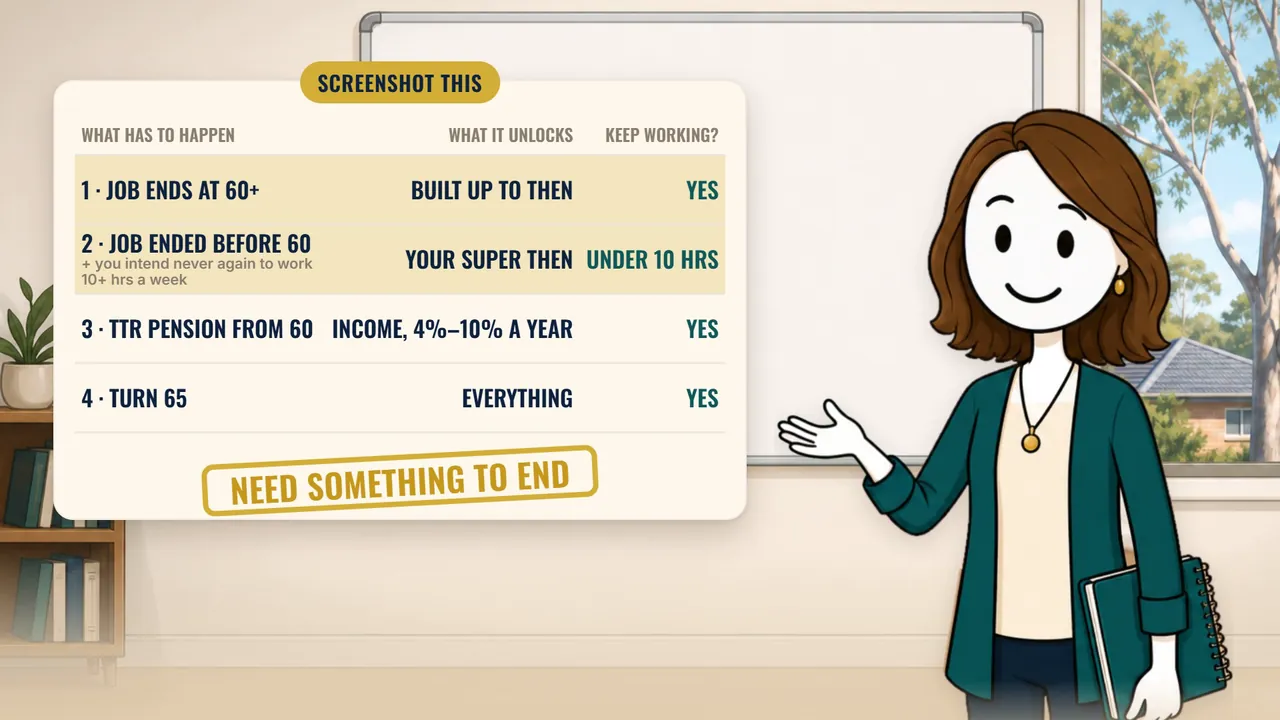
The rules list many conditions of release. From 60, four are the common ones. Two need something in your working life to end, and two don't.
| What has to happen | What it unlocks | Keep working? |
|---|---|---|
| 1. A job ends on or after you turn 60 | Everything built up to that day | Yes |
| 2. A job ended before 60, and you intend never again to work 10 hours a week or more | Everything built up to then | Under 10 hours a week |
| 3. A transition to retirement pension | An income of 4% to 10% of the balance a year | Yes |
| 4. You turn 65 | Everything | Yes |
Way one: a job ends on or after you turn 60
Once you're 60, leaving a job is enough. The ATO puts it simply: a member who is at least 60 "can access their preserved benefits when they leave a job". The regulations ask only whether the job - the "arrangement" you worked under - has come to an end, and that you were 60 or older when it did (SIS Regulations, regulation 6.01(7)). They don't ask why it ended, and they don't ask what you plan to do next. APRA, the prudential regulator, says that when the job ended after 60, your plans for future work "are not a consideration". (The ATO's general page on withdrawing super sums up both cases with the intention test; the regulations and APRA's guidance set out the difference.)
It doesn't have to be your only job. If you're 60 or over and leave one of two jobs, you can take everything you'd built up to that day. Anything that builds up after it - say from the job you keep, or a new one - stays locked until you meet another condition of release.
Unlocking your super doesn't mean you have to take it out. You can take a lump sum, start a pension, do both, or leave it where it is - subject to your fund's own rules.
Way two: a job ended before 60, and the 10-hour line
If a job ended before you turned 60, your fund also has to be satisfied of one thing: that you intend never again to be gainfully employed - working for pay or any other reward - for 10 hours a week or more.
The 10 hours comes straight from the regulations. Part-time work is defined as at least 10 hours, and less than 30 hours, a week. So once a job has ended, a few paid hours a week under 10 don't count against you.
Say you stopped work at 58. At 60, your super can unlock once your fund is satisfied you're done with that much paid work. Your fund may ask for evidence - APRA gives a statutory declaration as an example - and the test is what you intend at the time you claim.
Cutting back to fewer days in the same job isn't that job ending. That's the situation a transition to retirement pension is built for.
Way three: a transition to retirement pension
A transition to retirement (TTR) pension lets you keep working and draw an income from your super once you've reached preservation age. Nothing has to end. The trade-offs:
- Under 65, you draw between 4% and 10% of the balance each financial year.
- It pays an income. Lump sums are allowed only in limited cases.
- Its earnings are still taxed, because it isn't in the retirement phase - the tax-free pension stage. It moves there automatically at 65, or once you retire (or have a permanent incapacity or a terminal medical condition) and tell your fund.
- Whether you can start one depends on your fund's rules.
Our guide to super mistakes after 60 covers when a TTR costs more tax than it needs to.
Way four: turning 65
At 65, everything unlocks, whether you're still working or not. There are no cashing restrictions - you can take it as a lump sum or a pension. You don't have to take it out at all.
Is super tax-free after 60?
Mostly, for what you take out. But the tax on what your super earns depends on where it sits, not on your age.
Withdrawals. From 60, lump sums from a taxed super fund are tax-free. So are payments from an account-based pension, including a TTR. The exception is an untaxed element - money your fund hasn't paid tax on, which the ATO says is most commonly in a public sector fund. That part can still be taxed after 60. Your fund can tell you whether you have one.
Earnings. Super's investment earnings are taxed at 15% in an accumulation account - the account it builds up in while you work. Move it into a retirement phase pension and the earnings are tax-free. One exception for large balances: under Division 296, law from 1 July 2026, someone whose total super balance is over $3 million (the 2026-27 threshold) pays an extra 15% on the share of earnings relating to the balance above $3 million, and over $10 million a further 10%.
There's a lifetime limit on how much you can move into retirement phase - the transfer balance cap. The general cap is $2.1 million for 2026-27. A retirement phase pension also has a minimum you have to draw each year: 4% of the balance under 65, and 5% from 65 to 74.
What's the trap if you work for yourself?
Ways one and two both need something to end. And the rules count self-employment as work: gainfully employed means "employed or self-employed for gain or reward".
For most employees, the ending is easy to show. You resign, or you're let go, and your employer can confirm it. When you're your own boss, there's no one to resign to. And the regulations don't define what an "arrangement" is, or when one ends for a business.
There's no rule that fills the gap. One super specialist firm, Heffron, says ending a contract with a customer - even a big one - may not be enough for a sole trader, who may need to stop trading or sell the business. Two other paths can still work:
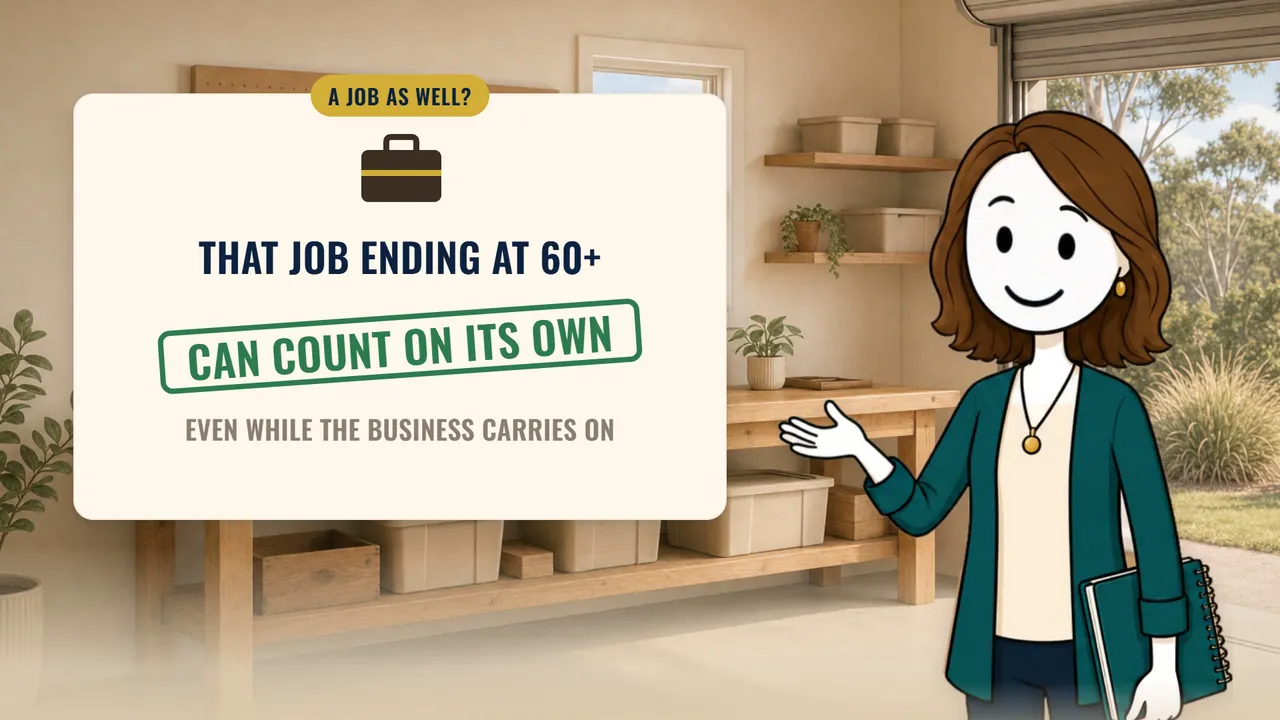
- A job as well as the business. If you also have a job, that job ending once you're 60 can count on its own, while the business carries on.
- A job that ended in the past. If a job ended at some point, way two may still work while the business carries on - but only if you genuinely intend never again to work 10 hours a week or more.
The ATO example: leaving the job isn't always enough
In a case study published in 2016, the ATO showed how hard this can be to prove. Charlie, 57, left his job in a smash repair business run by a family trust. He was a beneficiary of the trust, and had his leave paid out. But he kept doing much the same work there, and received distributions from the trust.
The ATO said it "cannot be certain" Charlie had retired. If the work was still earning him a reward, even without a wage, the arrangement may not have come to an end. It listed factors it may look at, including the hours he put in, whether a reward was expected, and whether the business could run without him - and said each case is decided on its own facts.
Charlie was under 60, so his fund also had to be satisfied of his intentions. But whether an arrangement has really ended matters under both tests.
Owning something that pays you isn't the problem. The ATO says passive income - rent, trust distributions or dividends - "would not normally affect the retirement definition". It's doing the work, for a reward, that counts.

An example: Greg, a plumber who works for himself
Greg is an illustration, not a real person. He's 61, a sole trader plumber, and has $400,000 in super. He wants to drop to two full days a week and top up his income from his super.
- Way two is closed. Two full days is more than 10 hours a week, so he can't honestly say he'll never work that much again.
- Way one is closed. His business hasn't ended.
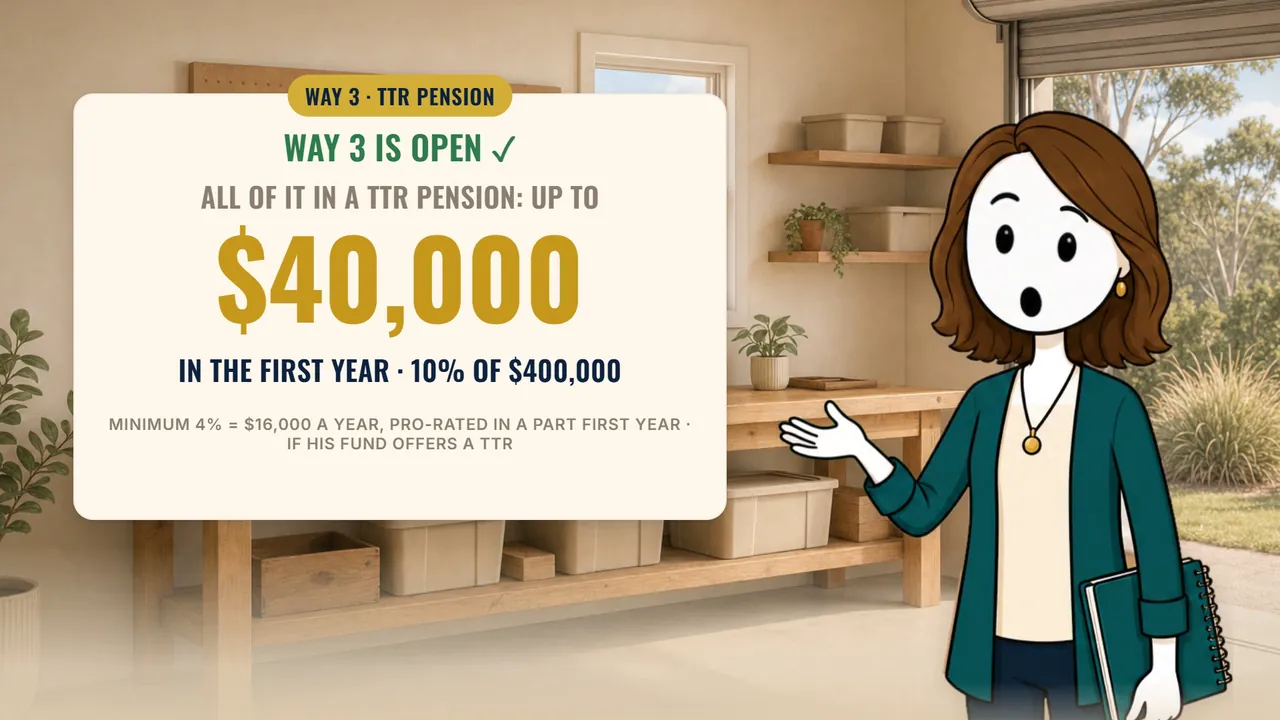
- Way three is open, if his fund offers it. With all of it in a TTR pension, he could draw up to $40,000 in the first year - 10% of $400,000. The minimum is 4%, or $16,000 for a full year.
- Tax. At 61, his TTR payments are generally tax-free. But the earnings inside it are still taxed until he turns 65, or retires and tells his fund.
- Or he sells, or winds up, the business. If he genuinely stops working in it, that ending comes after 60, so what he's built up can unlock. That rests on a specialist view of when a business arrangement ends.
- Or he waits for 65, four years away, when it all unlocks anyway.
As a sole trader, nobody has to pay super guarantee for Greg. Say he puts money in himself and wants to claim a tax deduction for it. To do that, he gives his fund a notice of intent - the form that tells it he'll claim. That notice isn't valid once his fund has started paying a pension using any of the contribution. So the notice goes in before the pension starts, and the fund's acknowledgment comes back before he claims the deduction. And if Greg had a partner on a Centrelink payment, his TTR would be counted - which is the next question.
How do you fund the seven years before the Age Pension?
The Age Pension starts at 67. Stop work at 60 and that's seven years funded by your own money: your super, once it's unlocked, savings outside super, and any work you keep.
Super and Centrelink before 67
Before Age Pension age, Centrelink doesn't count your super in the income and assets tests while your fund isn't paying you a pension. Two things change that:
- Start a pension - a TTR included - and it's assessed as an income stream.
- Take money out and put it in the bank, and that money counts.
Your partner's super is treated the same way while they're under Age Pension age. From their Age Pension age it counts, even if they aren't getting a payment.
That matters if you or your partner get a means-tested payment. If you're under 67 and get JobSeeker, Disability Support Pension or Carer Payment, starting a pension from your super counts for that payment. It matters for couples with an age gap, too. If the older partner already gets the Age Pension, the younger partner starting a pension adds that balance to the couple's means test. That can cut the older partner's pension. Our complete guide to retirement in Australia works through a couple with an age gap.
From 67
At Age Pension age, your super counts wherever it sits: in the assets test at the balance on your latest statement, and in the income test under deeming - the set rate of return Centrelink assumes your savings earn. Your principal home isn't counted. The assets test allows the full pension with up to $333,000 of assets for a single homeowner, and $499,000 combined for a homeowner couple. The full pension is $1,237.70 a fortnight for a single person - see how much the Age Pension pays for every household.
How much do you need to retire at 60?
The best-known benchmark is ASFA's Retirement Standard, from the Association of Superannuation Funds of Australia (ASFA Retirement Standard).
| ASFA comfortable lifestyle | Budget a year | Savings at retirement |
|---|---|---|
| Single homeowner | $56,166 | $630,000 |
| Homeowner couple | $78,998 | $730,000 |
Read the assumptions, because they matter here. ASFA's budgets are for retirees aged 65 to 84 who own their home outright and are relatively healthy. Its lump sums assume you draw down all your capital and receive a part Age Pension - and that pension can't start before 67.
Retire at 60 and three things change at once. You add seven years with no Age Pension at the front. Your contributions stop seven years earlier. And so does the growth they would have earned.
As a rough sum, seven years of the comfortable single budget comes to about $393,000 at today's prices. That's before any returns. Money still invested keeps earning, which lowers the amount needed on the day you stop - by how much depends on returns, which aren't guaranteed.
ASFA's figures are a benchmark, not a budget. Your own number starts with what you actually spend, less the costs that stop with work - the commute, work clothes, your own super contributions, and the mortgage if it's paid off by then.
The bottom line
Retiring at 60 is allowed, and the system is built for it - but not automatically. You need a genuine condition of release. For an employee, that can be as simple as a job ending on or after 60. For the self-employed, in Heffron's view, it can mean winding up or selling the business. If nothing is ending and you'll keep working 10 hours a week or more, the usual way in before 65 is a TTR pension (a few narrow grounds, such as severe financial hardship or compassionate grounds, are the exceptions); otherwise everything unlocks at 65. From 60, what you take out of a taxed fund is generally tax-free, but what your super earns is tax-free only in retirement phase. And the seven years to 67 are yours to fund.
This is the standard picture. Serious illness opens other conditions of release. If your super is in a defined benefit scheme, or your business runs through a company or a family trust, check the details with your fund.
Your fund can confirm which conditions of release you meet and what its own rules allow. For how a change would affect a Centrelink payment, Services Australia's Financial Information Service is free - call the Older Australians line on 132 300 and ask for a FIS officer.
Frequently asked questions
I stopped work at 55. What do I need to show my fund at 60?
Because your job ended before 60, your fund has to be satisfied that you intend never again to work 10 hours a week or more. Your fund may ask for evidence - APRA gives a statutory declaration as an example - and it has to be true when you make it. From 65, you don't need it: everything unlocks whether you're working or not.
I've been made redundant at 60. Does that count?
Yes, if you're 60 or older when the job ends. The rule asks only whether the arrangement you worked under has ended on or after your 60th birthday - not why - so a redundancy counts as well as a resignation. Everything you'd built up to that day unlocks, even if you take another job later. How a redundancy payout is treated if you claim a Centrelink payment is a separate question for Services Australia.
Can I leave a job after 60, start a pension, then go back as a contractor?
The ATO says a member who is 60 or over and leaves one job "may cash all benefits accumulated up to that time", even while working in another. Anything that builds up after that date stays locked until another condition of release, such as turning 65. The job has to have genuinely ended, and your fund's rules can be stricter than the law. The ATO's own example shows how it looks at someone who leaves but keeps doing much the same work.
Can I take all my super as a lump sum at 60?
Once you've met a condition of release with no cashing restrictions - such as retiring - you can generally take it as a lump sum, a pension or both, if your fund allows it. From 60, a lump sum from a taxed fund is tax-free. One thing to know if you're under 67: money taken out of super and put in the bank counts in Centrelink's income and assets tests, where super sitting in your fund doesn't.
Doesn't the seven-year figure ignore investment returns?
Yes - about $393,000 is a simple sum of seven years of ASFA's comfortable single budget, before returns. Money that stays invested keeps earning while you draw on it, which lowers the amount needed at 60. How much less depends on the returns you actually get, and the balance earns less each year as you draw it down. That's a question for your own numbers.
Sources
- ATO - When you can withdraw your super - preservation age 60 from 1 July 1964; the meaning of retirement (updated 10 July 2026)
- ATO - Conditions of release (for APRA-regulated funds) - leaving a job at 60 or over; one of two jobs; TTR rules; no cashing restrictions at 65 (updated 13 October 2025)
- Superannuation Industry (Supervision) Regulations 1994 - reg 1.03(1) gainfully employed and part-time (10 hours a week); reg 6.01(7) retirement; reg 6.12 and 6.15; Schedule 1 items 101, 106 and 110 (Compilation No. 159, in force 1 July 2026)
- APRA - SPG 280 Payment Standards - the two retirement definitions; evidence such as a statutory declaration
- ATO - Transition to retirement - a TTR isn't in retirement phase until 65, retirement, permanent incapacity or a terminal condition (updated 5 June 2026)
- ATO - Retirement withdrawal: lump sum or income stream - TTR draws of 4% to 10%; moves to retirement phase automatically at 65, otherwise when you notify your fund (updated 31 March 2026)
- ATO - Transition to retirement income streams (SMSF) - the 10% maximum isn't reduced in a part first year; payments over 60 generally tax-free (updated 2 April 2025)
- ATO - Tax on super benefits - earnings taxed at 15% in accumulation, tax-free in retirement phase; tax from 60; the untaxed element
- ATO - Payments from super - lump sum tax table; minimum drawdown 4% under 65, 5% from 65 to 74 (updated 16 September 2026)
- ATO - Division 296 tax thresholds (published 21 September 2026) and Be ready for new tax on large and very large super balances (7 July 2026) - $3 million and $10 million thresholds for 2026-27
- ATO - Transfer balance cap - $2.1 million for 2026-27 (updated 27 April 2026)
- ATO - SMSF case studies: Retirement - establishing whether gainful employment has ceased - the Crackle trust example (6 April 2016)
- ATO - Work out if you have to pay super - sole traders don't pay super guarantee for themselves (updated 15 July 2026)
- ATO - Personal super contributions - when a notice of intent is valid
- Heffron - Sole traders face super access challenges - specialist commentary on when a sole trader has retired
- Services Australia - Superannuation (Age Pension), (JobSeeker Payment), (Disability Support Pension) and (Carer Payment) - when super is counted, the same wording on each (updated 3 February 2025)
- Services Australia - Who can get Age Pension - Age Pension age 67
- Services Australia - Assets test for Age Pension - $333,000 and $499,000 full-pension limits (from 20 September 2026)
- Services Australia - Real estate assets and Deeming - the principal home; deeming
- Services Australia - How much Age Pension you can get - $1,237.70 a fortnight single (from 20 September 2026)
- ASFA Retirement Standard - June quarter 2026 budgets and summary with lump sums - $56,166 and $78,998 a year; $630,000 and $730,000; assumptions
- Services Australia - Financial Information Service and Phone us - the Older Australians line, 132 300
General information only. This article is general information only. It doesn't take into account your objectives, financial situation or needs, and it isn't personal financial advice. Speak with a licensed financial adviser about your own situation. Services Australia's Financial Information Service (132 300) is free. Figures are current from 20 September 2026 and change every March, July and September - check servicesaustralia.gov.au and ato.gov.au for the latest.
A note on how this is made: Every article starts with real research and is checked against current ATO and Services Australia figures - that part isn't automated. AI tools help draft the text and produce the video's narration and visuals. We write, verify and stand behind every word.
Keep reading
- Super Mistakes After 60: Five That Cost Australians Money
- Transition to Retirement Australia: The 15% Rule Most Miss (video)
- Average Super Balance at Retirement in Australia - and What the Age Pension Adds
New here? Start with the complete guide: Retirement in Australia, explained - every rule, every test and a countdown to your last working day.