
How to Boost Your Age Pension, Legally: Four Ways and the One That Backfires

Figures current from 20 September 2026. How this is made
Key takeaways
- Centrelink works out the Age Pension under an assets test and an income test and pays the lower result. Once the assets test sets your rate, every $1,000 over the limit costs $3 a fortnight ($78 a year) - for a couple, $3 off the two pensions combined, or $1.50 if only one partner is paid - so taking money out of the assets test is worth far more than taking it out of the income test.
- Super in an accumulation account owned by a partner under 67 isn't counted. In our illustration, a 68-year-old's pension rises from $526.50 to $900.02 a fortnight when his 64-year-old wife moves her account-based pension back into accumulation - until she turns 67, and with its earnings taxed at 15% there.
- Your home isn't counted, and Services Australia treats home improvements as a normal cost, not a gift. While the assets test sets the rate, $40,000 of savings spent on the home is worth $3,120 a year to a single pensioner.
- The Work Bonus keeps the first $300 a fortnight of work income out of the income test and banks unused amounts up to $11,800. The Commonwealth Seniors Health Card has no assets test - its income limit is $105,048 a year for a single person.
- Giving money away above $10,000 in a financial year, or $30,000 over five, doesn't lower your assessed assets: the excess keeps counting, and is deemed to earn income, for five years. A loan to family counts as yours while it's owed.
Can you boost your Age Pension without earning more or spending less? Sometimes - because of how Centrelink's two means tests treat different kinds of money. Super in a younger partner's name, money spent on the home, work income and a health card that has no assets test can all change what you get or what you pay. Giving money to family usually doesn't. This guide explains the mechanics of each, with a worked example for an age-gap couple at the rates from 20 September 2026. It's general information, not advice about your situation.

This video was published on 3 September 2026 using the rates that took effect on 20 September 2026 - the same rates as this article. The rules were checked again on 11 November 2026, and the article sets some of them out more precisely.
How does Centrelink work out your Age Pension?
It runs two tests. The assets test looks at what you own, and the income test looks at what you earn - or, for savings and super, what Centrelink assumes they earn. It works out a rate under each, and the assets test applies only if it produces the lower rate.
Your home isn't counted. For almost everything else, the assets test allows the full pension up to these limits:
| Household | Homeowner | Non-homeowner |
|---|---|---|
| Single | $333,000 | $600,000 |
| Couple, combined | $499,000 | $766,000 |
| Couple, only one partner eligible, combined | $499,000 | $766,000 |
Under the assets test, the pension falls by $3 a fortnight for every $1,000 of assets over the limit - for a couple, $3 off the two pensions combined. Over 26 fortnights, that's $78 a year, or 7.8% of every dollar over the limit. (Our guide to the Age Pension assets test covers what counts and where the pension stops.)
The income test is gentler. It uses deeming - the set rate of return Centrelink assumes your financial assets earn: 1.75% on the first $110,600 of a couple's combined savings (or $66,800 for a single person), and 3.75% on the rest. Above a free area - the income allowed before the pension starts to fall - of $396 a fortnight for a couple ($226 single), each partner's pension falls 25 cents for every dollar (50 cents for a single person). (Our guide to full Age Pension limits shows why that sets a lower limit for money in super and the bank.)
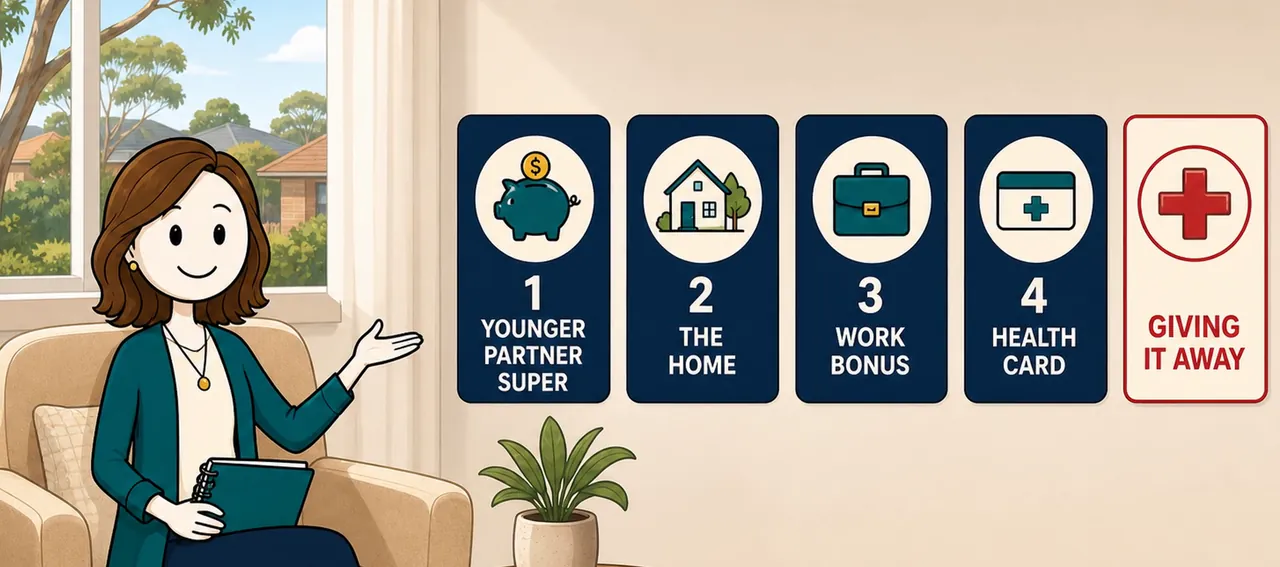
So the four levers work by moving money out of one test or the other, or by changing which income counts:
| Lever | What it changes | Who it can help |
|---|---|---|
| 1. A younger partner's super | Money in accumulation isn't counted in either test while that partner is under 67 | Couples where one partner is under Age Pension age |
| 2. Money spent on the home | The home isn't counted, so savings spent on it leave both tests | Homeowners |
| 3. The Work Bonus | Up to $300 a fortnight of work income isn't counted | Pensioners of Age Pension age who work, when the income test sets their rate |
| 4. The Commonwealth Seniors Health Card | No assets test - cheaper medicines without the pension | People of Age Pension age who don't get the pension |
Lever one: does a younger partner's super count for the Age Pension?
Not while it's sitting in an accumulation account. Services Australia says it doesn't count your or your partner's super in the income and assets tests while you're under Age Pension age, "if your fund isn't paying you a superannuation pension" (Services Australia: superannuation). An accumulation account is the ordinary kind of super account that builds up while you work and pays nothing out.
Two things make it count. If the fund pays a super pension from it - an account-based pension (a regular income paid from super), or a transition to retirement pension (one you can draw while still working) - it's assessed as an income stream. And from Age Pension age, 67, it counts wherever it sits.
That's what makes lever one possible for an age-gap couple. Only the partner aged 67 or over can be paid the Age Pension. But the couple's assets are added together and measured against the couple limit, and the couple income test uses their combined income.
Worked example: Ray and Wendy
Ray and Wendy are an illustration, not real people. Ray is 68 and gets the Age Pension. Wendy is 64, so she can't be paid it yet. They own their home. Both have retired and draw account-based pensions - a regular income paid from super - started after 1 January 2015, so Centrelink deems them like savings. Wendy has no wages and no payment of her own.
| What they have | Before | After move one | After move two |
|---|---|---|---|
| Car and contents | $35,000 | $35,000 | $35,000 |
| Ray's account-based pension | $380,000 | $380,000 | $288,000 |
| Wendy's super | $310,000, paying a pension - counted | $310,000 in accumulation - not counted | $402,000 in accumulation - not counted |
| Bank | $45,000 | $45,000 | $45,000 |
| Counted by the assets test | $770,000 | $460,000 | $368,000 |
| Ray's rate under the assets test | $526.50 | $933.00 | $933.00 |
| Ray's rate under the income test | about $788 | $900.02 | $933.00 |
| Ray is paid | $526.50 | $900.02 | $933.00 |
Before:
- Assets test. $770,000 is $271,000 over the $499,000 limit - the homeowner couple limit applies even though only Ray can be paid. The couple loses $3 a fortnight per $1,000 combined, and because only Ray is paid, his share is half: $1.50 per $1,000, or $406.50 off. His rate under the assets test is $933.00 less $406.50 = $526.50.
- Income test. Their financial assets - both pensions and the bank - are $735,000. Deeming: $110,600 at 1.75% is $1,935.50, and $624,400 at 3.75% is $23,415. That's $25,350.50 a year, or $975.02 a fortnight - $579.02 over the $396 free area. At 25 cents in the dollar, about $144.76 comes off, leaving about $788.
- Ray is paid the lower: $526.50. The assets test sets his rate.
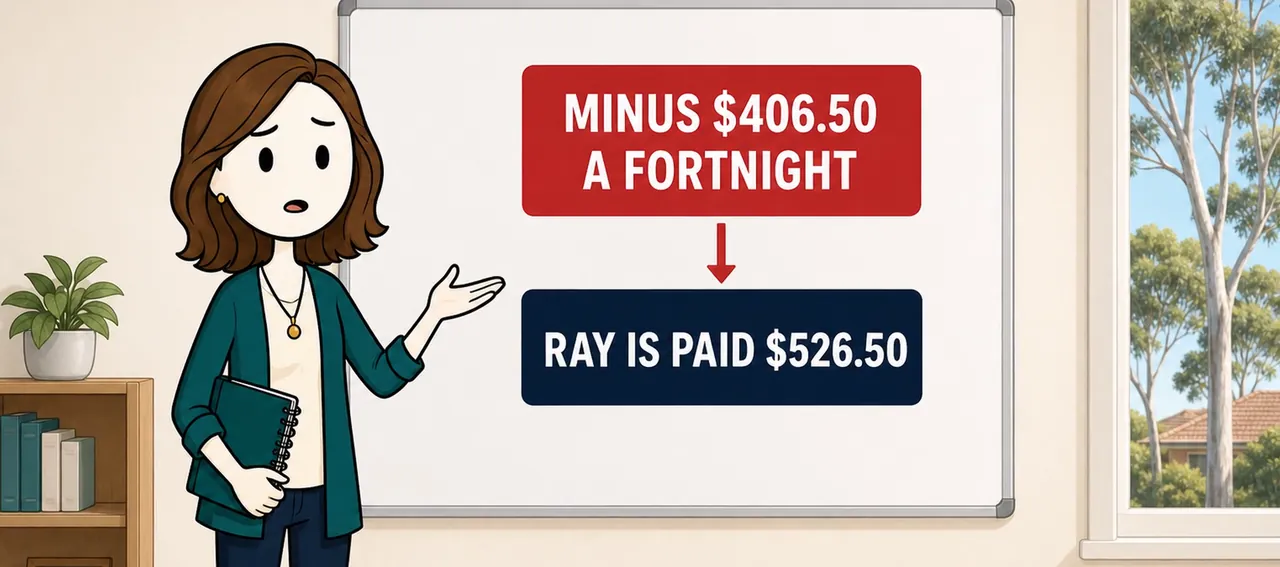
Move one: Wendy's pension goes back into accumulation. The ATO says that, if the income stream's rules and the provider allow, you can fully commute (stop) a super pension and roll the lump sum back into an accumulation account. Wendy is under 67 and her fund is no longer paying her a pension, so her $310,000 is no longer counted.
- Assets test. $460,000 is under the $499,000 limit, so the assets test allows the full rate, $933.00.
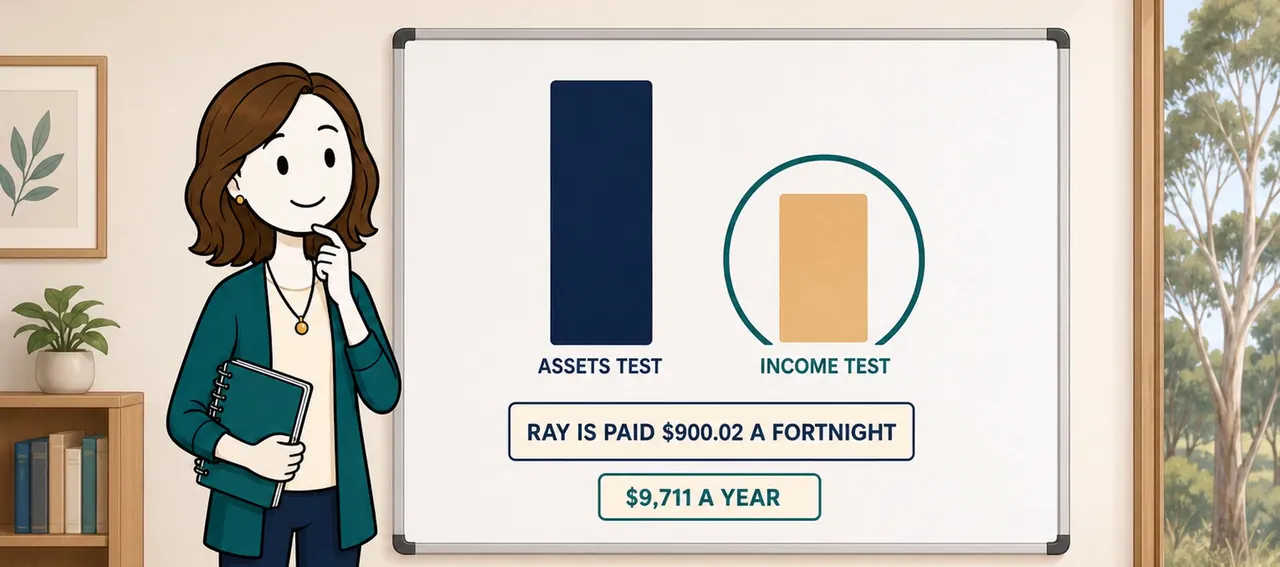
- Income test. Financial assets are now $425,000. Deemed income is $13,725.50 a year, or $527.90 a fortnight - $131.90 over the free area. A quarter of that, $32.98, comes off: $900.02.
- Ray is paid $900.02 - up $373.52 a fortnight, or $9,711.52 a year. The income test now sets his rate.
Move two: $92,000 more into Wendy's super. Ray takes $92,000 out of his account-based pension as a lump sum - tax-free at 68 from a taxed fund (one that has paid tax on what goes into it) - and Wendy pays it into her accumulation account as a personal contribution she doesn't claim a tax deduction for. That counts towards her non-concessional contributions cap (the yearly limit on after-tax contributions), which is $130,000 for 2026-27 (nil if her total super balance on the previous 30 June was at or above the general transfer balance cap - hers is far below it).
- Income test. Financial assets are now $333,000. Deemed income is $10,275.50 a year, or $395.21 a fortnight - just under the $396 free area. Nothing comes off.
- Ray is paid the full $933.00 - another $32.98 a fortnight, or $857.48 a year.
Together the two moves add $406.50 a fortnight, or $10,569 a year, before the 15% tax on earnings in accumulation (below). But move one did about 92% of that, and the reason is worth knowing.
Why does the second move add so much less?
Because it works on the income test, not the assets test. For Ray - the only partner paid - each $1,000 that leaves the assets test is worth $1.50 a fortnight: $39 a year, or 3.9% of the money. Each $1,000 that leaves the income test (above the deeming threshold) cuts deemed income by $37.50 a year, and a quarter of that comes back to him: about $9.38 a year, or under 1%.
And there's a cost on the other side. The ATO says super earnings are taxed at 15% in the accumulation phase and are tax-free in the retirement phase (a super pension such as an account-based pension). So money moved from a pension into accumulation pays 15% tax on whatever it earns.
Whether the extra pension outweighs that tax depends on what the money earns, and that's a question for your own numbers - and your fund's rules.
What are the limits of lever one?
- It ends at 67. The day Wendy reaches Age Pension age, her super counts in both tests, wherever it sits.
- It only lasts while it isn't paying her a pension. If her fund starts paying her a super pension - a transition to retirement pension included - it's assessed as an income stream.
- A minimum still applies. The ATO says the minimum annual payment rule applies, pro rata, to the pension payments before a full commutation.
- The money is now in Wendy's name. That includes the $92,000 that was Ray's.
- If the younger partner has a payment of their own, such as JobSeeker, Services Australia uses the same super rule for it: not counted under Age Pension age unless it's paying a pension.
- If the younger partner works, their wages count in the couple income test. The Work Bonus (lever three) covers only a pensioner's own work income - Services Australia says you can't use it for your partner's wages.
Lever two: is money spent on your home counted?
No. Your principal home - the home you live in, and the first 2 hectares of land it's on, on a single title - is the only real estate the assets test leaves out. Money spent on it stops being savings, so it leaves the assets test and is no longer deemed.
Spending on the home isn't a gift, either. Services Australia says it won't treat selling or reducing assets "to meet normal costs" as gifting, and its examples of normal costs include "buying a fridge, a holiday or home improvements".
Here's what $40,000 of savings spent on a new kitchen and bathroom does, where the counted assets are over the assets limit both before and after the spend:
- A single pensioner whose rate is set by the assets test: 40 x $3 x 26 = $3,120 a year more pension.
- A couple who are both paid: the same $3,120 a year, split between them.
- A couple where only one partner is paid, like Ray before move one: half - $1,560 a year.
- If the income test sets your rate instead, before and after: much less. For a single person with savings still above $66,800 after the spend, about $750 a year ($40,000 x 3.75% x 50 cents).
It's a one-way door. The money is in the house, not the bank, until you sell. And downsizing works the other way: proceeds that don't go into a new home are counted, and deemed at the regular rates.
What happens if you sell your home to buy another?
The part of the proceeds you plan to use to buy, build, rebuild, repair or renovate a new principal home may be exempt from the assets test. For homes sold from 1 January 2023, that exemption lasts up to 24 months, and depending on your circumstances you could get up to 12 months more - 36 at most. While it's exempt, that part is deemed at the lower rate only, currently 1.75%. Any extra proceeds held in a financial asset are deemed at the regular rates.
If you're building, the land is also exempt for up to 24 months, as long as it's worth less than you got for your old home.
Other spending the assets test leaves out
Paying for your funeral in advance is another one. Services Australia doesn't count a burial plot, whatever its value. It doesn't count the amount you prepay to a funeral director either, as long as your contract says the funeral is paid in full. And up to two funeral bonds aren't counted if you don't also have a prepaid funeral and the amount invested is under the allowable limit - $16,250 from 1 July 2026.
If you rent, lever two isn't open to you. The assets test allows a renter more before the pension starts to fall - $600,000 single, $766,000 for a couple - and levers one, three and four still apply.
Lever three: how does the Work Bonus work?
The Work Bonus keeps some of your pay out of the income test. Each fortnight, $300 of credit is added to your Work Bonus balance, and it's used to offset your work income before the income test is applied. Credit you don't use builds up, to a maximum of $11,800. When you claim an eligible payment for the first time, you start with a balance of $4,000 (Services Australia: how the Work Bonus works).
Who and what it covers:
- Who: people of Age Pension age getting the Age Pension, Carer Payment or Disability Support Pension. It isn't available on the transitional rate - a different rate kept for some people who were getting a pension in 2009.
- What: wages, salary, paid leave while still employed, director's fees, and self-employment that involves active participation - bookkeeping, lawn mowing or plumbing, say. Not investment income, super, or managing your own shares or rental properties.
- How: you don't apply. Services Australia applies it when you declare your income. It's worked out for each person and can't be shared by a couple.
A single pensioner with no other income can earn $526 a fortnight from work - the $226 free area plus the $300 - each fortnight, once any banked balance is used up, before the pension starts to fall.
It only lifts your payment if the income test sets your rate. Take Ray after move one, paid $900.02 under the income test. If he earned $300 a fortnight from work, the Work Bonus would offset all of it and he'd still get $900.02. Without it, he'd get $825.02 - $75 a fortnight less. Before move one, when the assets test set his rate, the same $300 wouldn't have changed his payment at all.
Lever four: what if you don't get the Age Pension at all?
Then the Commonwealth Seniors Health Card (CSHC) may be open to you. It has no assets test. To get it you must be Age Pension age, meet the residence rules, and not be getting an income support payment from Centrelink or the Department of Veterans' Affairs.
Its income test looks at your adjusted taxable income - your taxable income plus certain other amounts Services Australia adds back - and your partner's, plus deemed income from account-based pensions. One bought or changed from 1 January 2015 is deemed; an older one is deemed too if it's yours and your card was granted after 2014, or if it's your partner's and they're 60 or older. The limits, reviewed every 20 September:
| Household | Income limit a year |
|---|---|
| Single | $105,048 |
| Couple, combined | $168,076 |
It's the alternative to the pension, not an extra: anyone getting the Age Pension is sent a Pensioner Concession Card automatically instead.
One clear saving is on medicines. With the card, Pharmaceutical Benefits Scheme (PBS) medicines cost less, and you reach the safety net sooner:
| PBS medicines in 2026 | Without a concession card | With a concession card |
|---|---|---|
| Each script costs up to | $25.00 | $7.70 |
| PBS Safety Net threshold for the year | $1,748.20 | $277.20 |
| After the threshold, with a Safety Net card | up to $7.70 | free |
Five regular medicines filled monthly is 60 scripts a year. Without a card, that's up to $1,500 - short of the general safety net. With the card, it would be $462, but the safety net caps it at $277.20 - up to about $1,223 a year less. (The $7.70 is fixed until the end of 2029; the other amounts can change each 1 January.) The card can also mean bulk-billed doctor visits (that's up to your doctor), and some states, territories and councils offer extra concessions.
Why does giving money away backfire?
Because Centrelink can keep counting the money after it's gone. The gifting free areas are $10,000 in a financial year and $30,000 over five financial years (with no more than $10,000 of it in any one year). They're the same for a single person or a couple. Anything over them is counted in the assets test and deemed under the income test for five years from the date of the gift (Services Australia: how much you can gift).
So you no longer have the money or what it earns, and your pension is worked out as if you still had most of it. Say Ray and Wendy, before either move and with no other gifts in the past five years, gave their daughter $80,000 in one financial year, from their savings and super:
- $10,000 is inside the free area. The other $70,000 still counts.
- Their counted assets fall only from $770,000 to $760,000.
- Ray's pension rises by $15 a fortnight, to $541.50 - $390 a year more, for giving away $80,000.
- The $70,000 keeps counting for five years from the date of the gift.
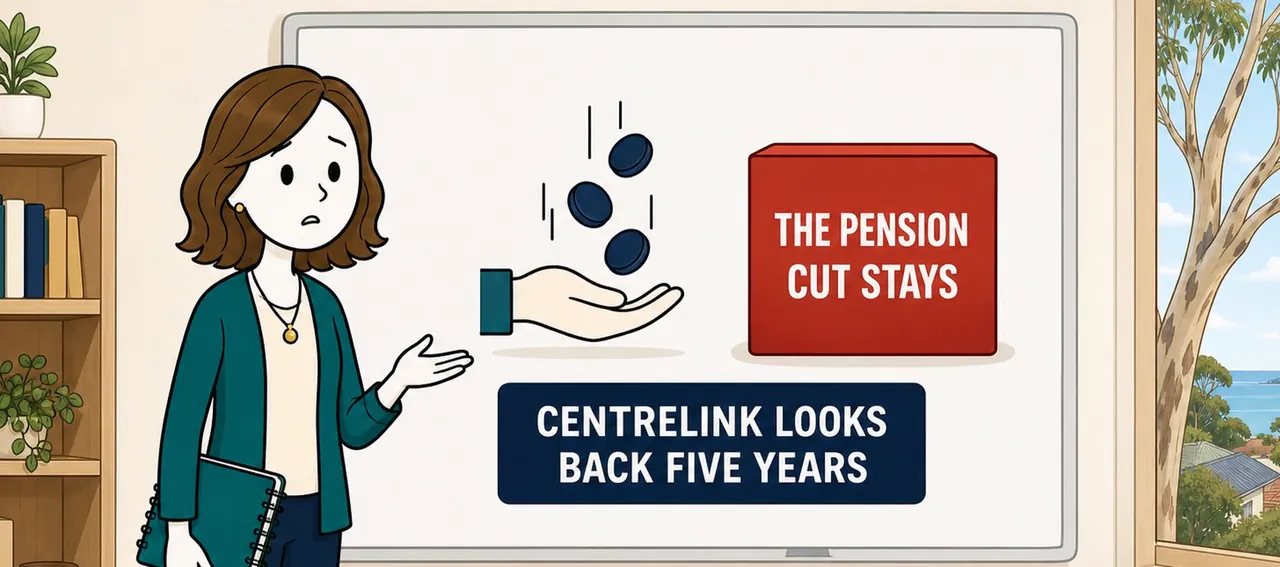
It reaches back, too. Gifts made in the past five years may be included - even ones made before you claimed. There's one exception for a first claim: if you can show you didn't expect to need a payment when you made the gift, Services Australia may not count it, and it decides case by case. Services Australia suggests contacting it before you or your partner make a gift, to check whether it will change your payment.
Does a loan to family get around it?
No. A loan isn't a gift, but money loaned is one of the financial investments Centrelink counts - in the assets test, and deemed under the income test - for as long as it's owed. Lend your daughter the $80,000 instead, and Ray's pension stays at $526.50. If you later forgive the loan, Services Australia may count that as a gift.
Who don't these levers help?
- People who are legally blind. Services Australia says that if you're legally blind and not claiming Rent Assistance, you may be able to get the Age Pension without being assessed against the income and assets tests. Levers that work through those tests won't change your rate.
- Renters, for lever two.
- Anyone whose rate is set by the other test. A lever pays most through the test that sets your rate. When the income test sets it, money out of the assets test is worth only the pension its deemed income was costing - about $18.75 a year per $1,000 for a single person with savings above the $66,800 deeming threshold. The Work Bonus matters only when, without it, the income test would set your rate.
For what each household gets at the full rate, see how much the Age Pension pays.
The bottom line
When the assets test sets your rate, the levers that move the Age Pension most are the ones that take money out of it, because there every $1,000 costs $78 a year ($39 where only one partner of a couple is paid). A younger partner's accumulation account does that until they turn 67. Money spent on the home does it for as long as you own the home. The Work Bonus protects work income when the income test sets your rate, and the Commonwealth Seniors Health Card helps when the pension is out of reach. Giving money away above the free areas leaves the excess counted for five years.
Each of these has costs and trade-offs that depend on your whole situation - tax inside super, who owns the money, and how long you'll need it. Services Australia's Financial Information Service can explain how a change would be assessed. It's free - call the Older Australians line on 132 300 and ask for a FIS officer.
Frequently asked questions
Why does the second move add so little?
Because it only works on the income test. For a couple where only one partner is paid, each $1,000 moved out of the income test adds about $9.38 a year to the pension, against $39 a year for each $1,000 moved out of the assets test. In the illustration, Ray is already under the assets limit after move one, so the extra $92,000 adds $857.48 a year to Ray's pension. Its earnings in accumulation are taxed at 15%; whether that trade suits a household depends on its own numbers.
Does my partner's super count once they turn 67?
Yes. From Age Pension age, Services Australia counts super in the assets test at the balance on the latest statement and deems it under the income test - wherever it sits, and even if your partner isn't getting a payment. Lever one only works while the younger partner is under 67.
Can I give my children $10,000 every year without it counting?
Not every year. The free areas are $10,000 in a financial year and $30,000 over five financial years. Give $10,000 in each of five years and the gifts in years four and five go over the five-year limit, so $20,000 counts in all - assessed as an asset and deemed - each for five years from when it was given. A couple shares the same limits as a single person.
Does the Work Bonus cover rent or dividends?
No. Services Australia applies it to employment income and self-employment that involves active participation. Income from investments and super isn't covered, and neither is managing your own share portfolio or rental properties.
Can I have the Commonwealth Seniors Health Card and the Age Pension?
No. The card is for people of Age Pension age who aren't getting an income support payment. If you get the Age Pension, Services Australia sends you a Pensioner Concession Card automatically instead.
Sources
- Services Australia - How much Age Pension you can get - $933.00 a fortnight each for a couple, $1,237.70 single (from 20 September 2026; page updated 20 September 2026)
- Services Australia - Assets test for Age Pension - full-pension limits, including a couple with one partner eligible: $499,000 homeowner, $766,000 non-homeowner; cut-off $1,121,000 (page updated 20 September 2026)
- Services Australia - Income test for Age Pension - free areas $226 single / $396 couple combined; 50c single, 25c each partner; permanently blind pensioners
- Services Australia - Deeming - 1.75% / 3.75%; thresholds $66,800 single, $110,600 couple combined; home sale proceeds deemed at the lower rate (page updated 20 September 2026)
- Services Australia - A guide to Australian Government payments, 20 September to 31 December 2026 - the test giving the lower rate applies; $3 a fortnight per $1,000 over the assets free area; Work Bonus $300, $11,800, new recipients start on $4,000, not shared by a couple; gifting; deeming table
- Services Australia - Superannuation (Age Pension) and (JobSeeker Payment) - super not counted under Age Pension age unless the fund pays a pension; counted from Age Pension age (updated 3 February 2025)
- Services Australia - Income streams - account-based pensions started from 1 January 2015 are deemed (updated 26 May 2026)
- Services Australia - Asset types - money loaned is a financial investment; market value (updated 16 July 2026)
- Services Australia - Real estate assets - the principal home and 2 hectares; sale proceeds exempt up to 24 months plus up to 12 (updated 5 June 2026)
- Services Australia - Funeral bonds and prepaid funerals - burial plots and fully prepaid funerals not counted; funeral bond allowable limit $16,250 from 1 July 2026
- Services Australia - How the Work Bonus works, Work Bonus balance, Who can get it, Types of income and Your partner's income - $300 a fortnight, balance to $11,800, $4,000 starting balance (updated 21 July 2026); eligibility; income covered; not for a partner's wages
- Services Australia - Who can get a Commonwealth Seniors Health Card, Income test and Benefits - eligibility; $105,048 single, $168,076 couple, no assets test (updated 20 September 2026); benefits
- Services Australia - Who can get a Pensioner Concession Card - sent automatically with the Age Pension
- Services Australia - PBS Safety Net thresholds, PBS - Fees, patient contributions and safety net thresholds and PBS explanatory notes 1.4 - $25.00 and $7.70 a script; safety nets $1,748.20 and $277.20 (from 1 January 2026); $7.70 fixed to 2029
- Services Australia - How much you can gift, What gifts we include, How gifting can affect your payment and When gifting exceptions apply - $10,000 a financial year, $30,000 over five; excess counted and deemed for five years; home improvements are normal costs; forgiven loans; the past five years; unforeseen circumstances
- Services Australia - Who can get Age Pension - Age Pension age 67; legally blind claimants
- ATO - Retirement withdrawal: lump sum or income stream - commuting a super pension and rolling it back to accumulation; the pro-rata minimum before a full commutation (updated 31 March 2026)
- ATO - Tax on super benefits - earnings taxed at 15% in accumulation, tax-free in retirement phase
- ATO - Payments from super - lump sums of a taxed element at 60 or over: nil tax (updated 16 September 2026)
- ATO - Contributions caps - non-concessional cap $130,000 for 2026-27 (updated 11 September 2026)
- Services Australia - Financial Information Service
General information only. This article is general information only. It doesn't take into account your objectives, financial situation or needs, and it isn't personal financial advice. Speak with a licensed financial adviser about your own situation. Services Australia's Financial Information Service (132 300) is free. Figures are current from 20 September 2026 and change every March, July and September - check servicesaustralia.gov.au and ato.gov.au for the latest.
A note on how this is made: Every article starts with real research and is checked against current ATO and Services Australia figures - that part isn't automated. AI tools help draft the text and produce the video's narration and visuals. We write, verify and stand behind every word.
Keep reading
- The Age Pension Assets Test: What Counts, Where the Pension Stops, and Whether Losing It Matters
- How Much Can You Have and Still Get the Full Age Pension? The Income Test and Deeming
- How Much Is the Age Pension? Rates for Singles and Couples, Homeowners and Renters
New here? Start with the complete guide: Retirement in Australia, explained - every rule, every test and a countdown to your last working day.
More Age Pension
- When Only One Partner Is Eligible for the Age Pension: What an Age-Gap Couple Gets
- How Much Can You Have and Still Get the Full Age Pension? The Income Test and Deeming
- The Age Pension Assets Test: What Counts, Where the Pension Stops, and Whether Losing It Matters
- How Much Is the Age Pension? Rates for Singles and Couples, Homeowners and Renters