
Average Super Balance by Age in Australia: 55, 60, 65 and 70 - and What the Age Pension Adds

Figures current from 20 September 2026. How this is made
Key takeaways
- The median super balance is about $185,000 at 55 to 59, $203,000 at 60 to 64, $219,000 at 65 to 69 and $228,000 at 70 to 74 (ATO data at June 2024, analysed by ASFA).
- The average is much higher - almost $493,000 at 70 to 74 - because a small number of very large balances pull it up. The median is the better guide to what's typical.
- These figures count only people who have super. By 70 to 74, about four in ten Australians have none. Some never had super; ASFA says the fall in numbers with age is mainly people taking their money out, not deaths.
- The Age Pension starts at 67, not 65. At 55, 60 and 65 it pays nothing.
- At pension age, every one of the eight balances in the table - median and average, at all four ages - gives a single homeowner between about $41,400 and $45,400 a year, pension and super together. The pension fills the gap.
The average super balance by age in Australia climbs from about $301,000 in the late fifties to almost $493,000 in the early seventies. But the typical person - the median - has far less: about $228,000 at 70 to 74. Here are both figures at 55, 60, 65 and 70, what they leave out, and what the Age Pension adds once it starts.

What is the average super balance by age?
The latest figures are the Tax Office's data at June 2024, analysed by ASFA, the super funds' industry body, in its 2026 report on super account balances. They count only people who have super.
| Age | Median balance | Average balance | Average is this many times the median |
|---|---|---|---|
| 55 to 59 | $185,120 | $301,151 | 1.6 |
| 60 to 64 | $203,326 | $371,379 | 1.8 |
| 65 to 69 | $218,631 | $437,422 | 2.0 |
| 70 to 74 | $227,982 | $492,903 | 2.2 |
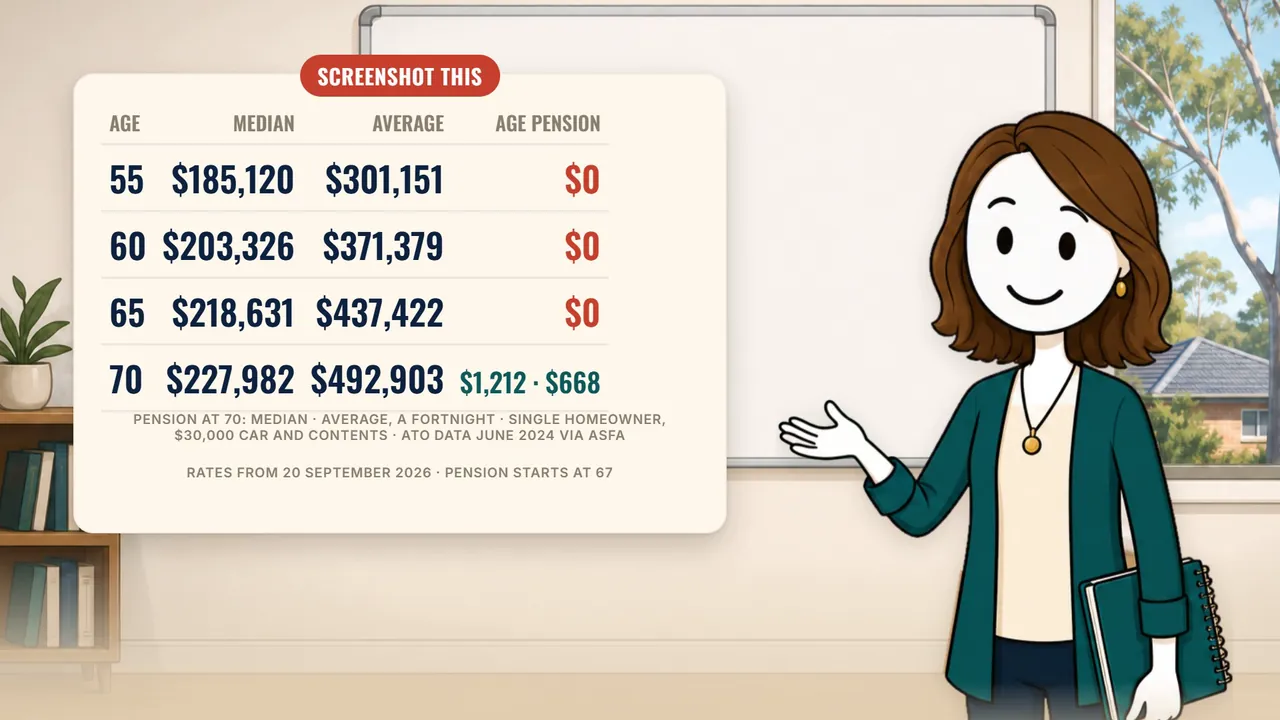
Median vs average: which one should you compare yourself with?
The median is the person in the middle of the queue: half have more, half have less. The average adds everyone up and divides, so a small number of very large balances drag it up.
The gap widens with age. At 55 to 59, the average is about 1.6 times the median. By 65 to 69 it's twice the median. The biggest balances pull further ahead while the middle moves slowly. So if you're checking where you stand, the median is the better guide - and at every age in the table, most people are below the average.
Men and women
| Age | Men's median | Women's median |
|---|---|---|
| 55 to 59 | $220,560 | $154,732 |
| 60 to 64 | $236,126 | $174,655 |
| 65 to 69 | $230,766 | $207,187 |
| 70 to 74 | $227,027 | $228,978 |
At 55 to 59, women's median is almost 30% lower than men's. By 70 to 74, the two are level - but that's among people who still have super.
Average super balance at 55
The median for Australians aged 55 to 59 is $185,120, and the average is $301,151.
At 55, the Age Pension is still 12 years away. And your super is generally locked until your preservation age - the age you can take it once you retire: for anyone born on or after 1 July 1964 - everyone in their fifties now - preservation age is 60. Before then, it can only come out in limited circumstances.
If you're out of work before then, one rule is worth knowing. Before Age Pension age, Centrelink doesn't count super that's still in the fund and isn't paying you a pension. It counts once your fund starts paying you a pension from it.
Average super balance at 60
In the early sixties, the median is $203,326 and the average $371,379. ASFA describes people aged 60 to 64 as at or approaching retirement. (We look at what that typical balance pays, with the Age Pension on top, in what the average Australian retires with.)
From 60, you can generally take your super once you've retired. For super, retirement has a specific meaning: in the ATO's words, your paid employment ended on or after 60 (no further test applies), or it ended before 60 once you'd reached your preservation age and your fund is satisfied you don't intend to work again. Your fund can confirm whether you meet it.
The Age Pension, though, is still seven years away. The full single pension is worth about $32,180 a year, so seven years of it comes to about $225,000 - more than the median balance at 60. That's not a verdict on anyone's plan: plenty of people keep working, have savings outside super, or a partner's income. But for anyone planning to stop at 60, those seven years are a stretch the plan has to cover.
Average super balance at 65
In the late sixties, the median is $218,631 and the average $437,422 - twice the median.
At 65, your super opens up whether you've retired or not. The Age Pension still pays nothing until 67. From 67, Centrelink counts your super in both of its means tests - the assets test (what you own) and the income test (what you earn, or are assumed to earn) - even if you've never touched it.
The pension isn't automatic. You can claim it in the 13 weeks before you turn 67.
Average super balance at 70
In the early seventies, the median is $227,982 and the average $492,903.
But only about six in ten Australians aged 70 to 74 have any super (58.5%). Some people that age never had super: ABS data quoted by ASFA put it at around 27% of retirees over 70. And between the early sixties and the early seventies, the number of people with super roughly halves - from about 1.32 million to 687,000.
ASFA says the drop is mainly people closing their accounts by taking their money out, not deaths. People with smaller balances often take the lot - to pay off debts, fix the house or replace the car.
| Age | Share with super |
|---|---|
| 55 to 59 | 93.3% |
| 60 to 64 | 86.2% |
| 65 to 69 | 74.1% |
| 70 to 74 | 58.5% |
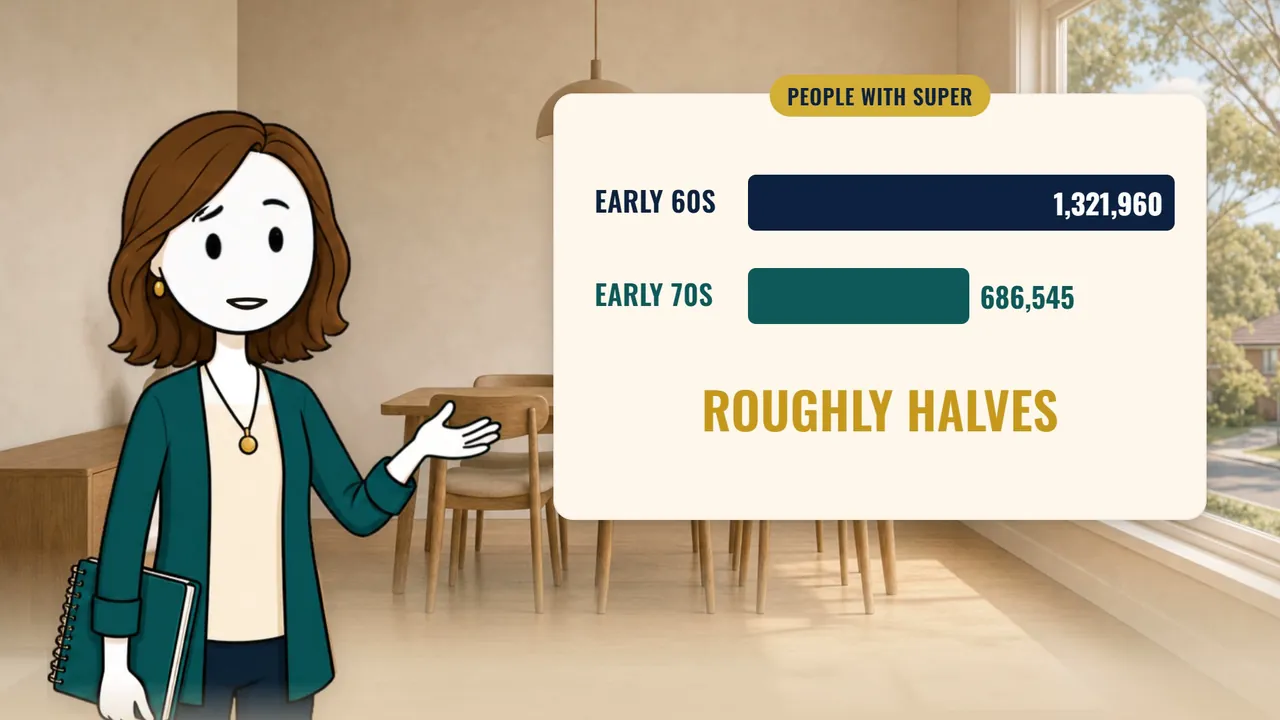
So the figures at 70 describe only the people who still have super. If you're 70 and your balance looks low next to them, remember who you're being compared with.
Taking super out doesn't change the pension on its own. But if the money sits in the bank, Centrelink still counts it.
What does the Age Pension add at each balance?
Take each balance in the table as if it were yours at pension age: a single homeowner aged 67 to 74, drawing the minimum drawdown - the least the law says an account-based pension (a super pension that pays you a regular income) must pay each year, 5% at that age - with $30,000 of car and contents and no other income. Pension rates are from 20 September 2026; the assets and income tests are explained in our guide to how much the Age Pension pays.
| Balance | Age Pension a year | Plus 5% minimum drawdown | Total a year |
|---|---|---|---|
| $185,120 (median, 55 to 59) | $32,180 (full rate) | $9,256 | $41,436 |
| $203,326 (median, 60 to 64) | $31,974 | $10,166 | $42,140 |
| $218,631 (median, 65 to 69) | $31,687 | $10,932 | $42,619 |
| $227,982 (median, 70 to 74) | $31,511 | $11,399 | $42,911 |
| $301,151 (average, 55 to 59) | $30,140 | $15,058 | $45,197 |
| $371,379 (average, 60 to 64) | $26,857 | $18,569 | $45,426 |
| $437,422 (average, 65 to 69) | $21,709 | $21,871 | $43,580 |
| $492,903 (average, 70 to 74) | $17,380 | $24,645 | $42,025 |
Every one of them lands between about $41,400 and $45,400 a year - from $185,000 in super to almost $493,000, barely $4,000 apart.
The pension fills the gap. Less super, more pension; more super, less pension. The median balances are close to the full rate: the income test, which assumes your savings earn a set rate (called deeming), only trims them a little. Three of the four averages - from 60 to 74 - are over the full-pension assets limit of $333,000, so the assets test takes $3 a fortnight for every $1,000 over. That's why the average at 70 comes out slightly behind the median.
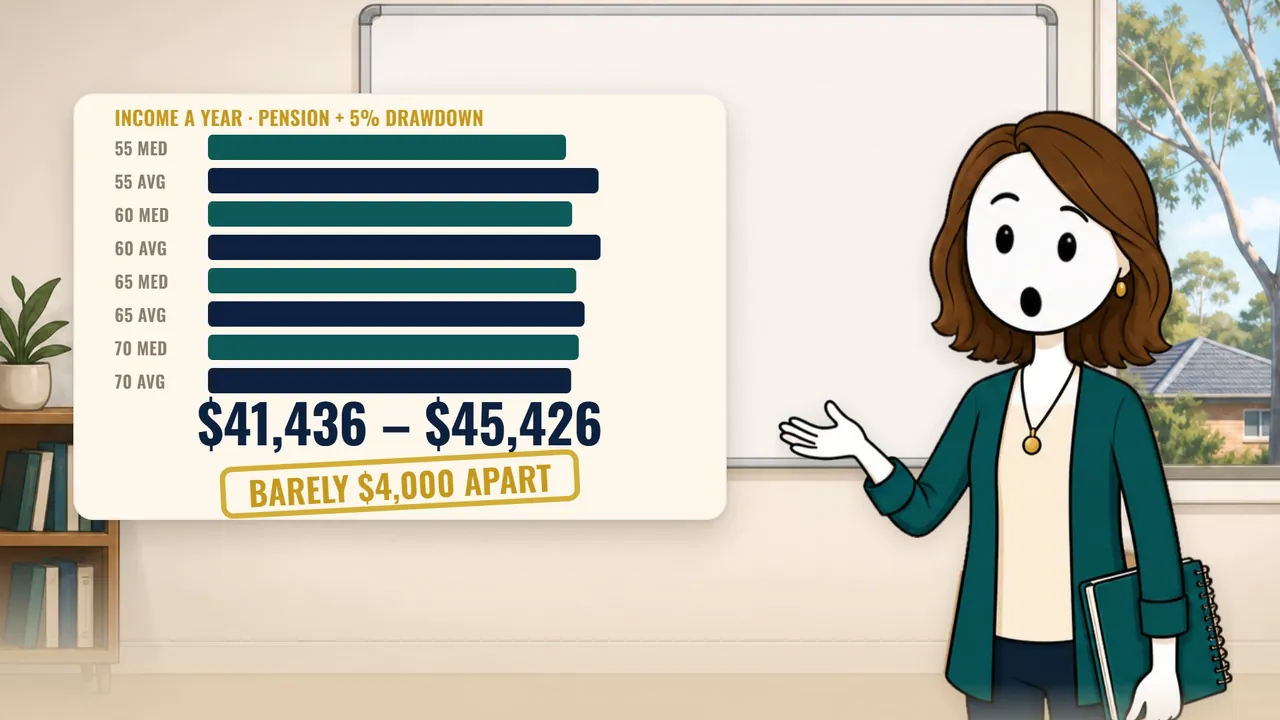
Every one of these totals sits above ASFA's modest budget for a single homeowner ($36,548 a year) and below comfortable ($56,166), June quarter 2026.
What the bigger balances still buy
None of this makes the bigger balance worse. The money is still theirs: a buffer for big bills and bad years, a new car, help for family, or the cost of care later on. They can draw more than the minimum, and as the balance runs down, the pension rises back. So this isn't a reason to save less - and being below the average is normal. (For how far the assets test reaches, see our guide to the Age Pension assets test.)
One more thing: all of this is a single homeowner with nothing else. Couples have their own limits and rates, and renters get more room on assets and may get Rent Assistance.
The bottom line
At 55, 60 and 65, the Age Pension pays nothing and your super does the work. From 67, the pension arrives, and it gives the most to the people with the least. And the number to measure yourself against is the median, not the average.
For your own position, Services Australia's Financial Information Service is free - call the Older Australians line on 132 300 and ask for a FIS officer - and the complete guide to retirement in Australia walks through the whole system in order.
Frequently asked questions
Are these balances for individuals or couples?
Individuals. The figures are per person with a super account, not per household. For the Age Pension, Centrelink adds a couple's assets together and measures them against the couple limits.
I'm below the average for my age. Should I be worried?
More than half of people at every age in the table are below the average, because the average is pulled up by a small number of very large balances. The median is the fairer comparison. And from 67, the Age Pension fills more of the gap for smaller balances.
Can I take my super out at 60 if I've stopped working?
Generally, yes, once you've met a condition of release. Retirement is one: the ATO describes it as your paid employment ending on or after 60 (no further test applies), or ending before 60 once you'd reached your preservation age with your fund satisfied you don't intend to work again. Your fund can confirm your position. At 65, you can access your super whether you've retired or not.
If I take my super out, does Centrelink stop counting it?
Not if you keep the money. Taking money out of super doesn't by itself change your payment, but if you put it in the bank or buy an income stream, it's still counted. Before Age Pension age, though, super left in the fund and not paying you a pension isn't counted at all.
Why does the median balance go up at 70 if people are spending their super?
Each age group in the table is a different group of people, not the same people getting older. ASFA says the fall in account numbers with age is mainly people closing their accounts by taking their benefits, not deaths - and people with relatively low balances often close their account completely. It also links rising balances among older Australians to the super system maturing.
Sources
- ASFA - An update on superannuation account balances (2026 edition) - Tables 1, 2 and 6: medians, averages, account numbers and incidence by age, ATO data at June 2024
- ATO - Super withdrawal options - conditions of release, preservation age (updated 10 July 2026)
- Services Australia - Superannuation - when super is and isn't counted
- Services Australia - Who can get Age Pension and How to prepare to claim - age 67; claim in the 13 weeks before
- Services Australia - How much Age Pension you can get - $1,237.70 a fortnight single from 20 September 2026
- Services Australia - Assets test for Age Pension - $333,000 single homeowner full-pension limit
- Services Australia - Income test and Deeming - $226 free area; 1.75% / 3.75%
- DSS Social Security Guide 4.2.3 - the $3-per-$1,000 taper
- ATO - Payments from super - 5% minimum drawdown at 65 to 74
- ASFA Retirement Standard - June quarter 2026 budgets (checked 3 November 2026)
General information only. This article is general information only. It doesn't take into account your objectives, financial situation or needs, and it isn't personal financial advice. Speak with a licensed financial adviser about your own situation. Services Australia's Financial Information Service (132 300) is free. Figures are current from 20 September 2026 and change every March, July and September - check servicesaustralia.gov.au and ato.gov.au for the latest.
A note on how this is made: Every article starts with real research and is checked against current ATO and Services Australia figures - that part isn't automated. AI tools help draft the text and produce the video's narration and visuals. We write, verify and stand behind every word.
Keep reading
- Average Super Balance at Retirement in Australia - and What the Age Pension Adds
- How Much Is the Age Pension? Rates for Singles and Couples, Homeowners and Renters
- The Age Pension Assets Test: What Counts, Where the Pension Stops, and Whether Losing It Matters
New here? Start with the complete guide: Retirement in Australia, explained - every rule, every test and a countdown to your last working day.