

Figures current from 20 September 2026. How this is made
Key takeaways
- Australia has no single retirement age. 60 is when you can take your super once you retire, 65 is when it opens regardless, and 67 is Age Pension age.
- Under 67, super that's just sitting in the fund (in accumulation) is invisible to Centrelink. The day it starts paying you a pension, it's counted.
- The Age Pension runs two tests - assets and income - and pays whichever gives the lower rate. While the assets test is the one that applies, every $1,000 you own above its free area costs $78 a year of pension.
- The pension is a floor that rises as your super falls, which is why a modest balance can last longer than simple division suggests.
- For a couple with an age gap, moving the younger partner's super into pension phase too early can cost the older partner thousands a year of pension - almost $8,000 a year in our worked example.

Retirement planning in Australia is less about a single date and more about doing things in the right order. This guide covers the whole system in the order you'll need it: when your money opens up, what retirement really costs, how both Age Pension tests work, the trap in the years before 67, and a countdown to your last working day.
Age Pension and JobSeeker figures are current from 20 September 2026 (free areas, deeming thresholds and the 2026-27 tax and super caps from 1 July 2026; ASFA budgets for the June quarter 2026). The worked examples use two illustrative households - Robyn, and Graham and Lyn - who aren't real people.
1. When can you access your super? The three ages that matter
If you were born on or after 1 July 1964, there are three birthdays that decide when your money opens up. None of them is called retirement.
Age 60: preservation age
From 60, you can take your super once you retire. For super, retiring has a specific meaning:
- If you stop paid work after turning 60, that generally counts as retiring.
- If you stopped work before 60, your fund also has to be satisfied that you don't intend to work again.
- If you want to keep working past 60, you can still draw some super through a transition to retirement pension (see number 7).
Anyone born before July 1964 had a slightly younger preservation age and has already reached it.
Age 65: super opens completely
At 65, your super opens up whether you've retired or not. You can keep working full-time and still take a lump sum or start a pension. The retirement test no longer applies.
Age 67: Age Pension age
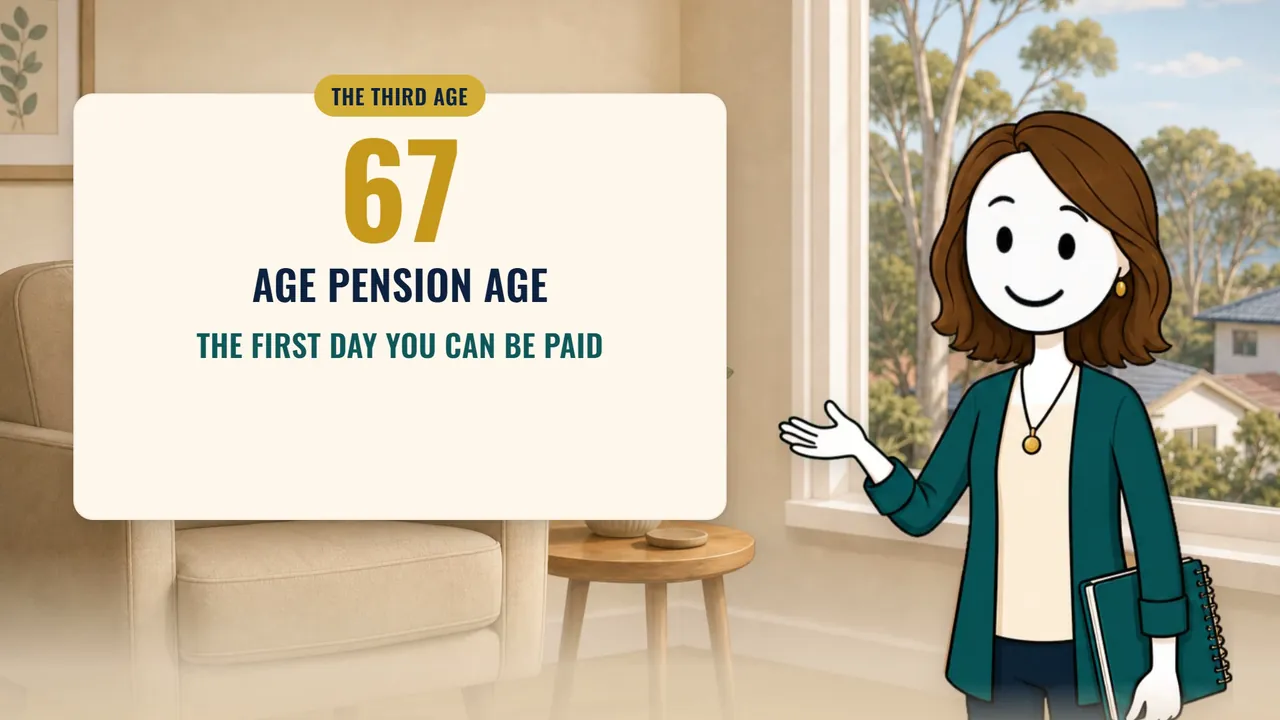
67 is the first day you can be paid the Age Pension. It's also the day your super becomes visible to Centrelink, even if you've never touched it.
Before 67, super sitting in the fund isn't counted for the Age Pension, JobSeeker, the Disability Support Pension or Carer Payment. The moment the fund pays you a pension from it, it is.
| Age | What it opens |
|---|---|
| 60 | Super, once you've retired (or a transition to retirement pension while working) |
| 65 | All your super, whether you've retired or not |
| 67 | The Age Pension - and Centrelink starts counting your super |
So none of these is a retirement age. You can stop work at 58 and live on savings, or work until 75. The ages only decide which doors are open. Retirement isn't a date the government sets - it's a sequence of doors, and planning is about which one you walk through, and when.
One quieter age: the Commonwealth Seniors Health Card also starts at Age Pension age, for people who don't qualify for the pension itself. It has an income test, and you have to claim it.
2. How much will you spend in retirement?
Ask someone what they'll spend in retirement and the answer is usually their regular bills - groceries, power, insurance, rates, the phone. That's the number that leaves out the expensive years.
The lumpy spending
What gets missed is the spending that doesn't come every year: a car that needs replacing, a hot water system, a roof, a kitchen, dental work, a trip to see family, helping a child with a deposit. None of those lands every year, so they don't feel like a cost. But over 20 or more years of retirement, they're real money.
The fix is simple:
- List the big items.
- Guess how often each comes up - a car every 10 years, a kitchen every 20, a roof once.
- Divide each cost by the years, so it becomes a yearly figure.
- Add that to your regular bills. That's your number - and it's often bigger than expected, which is the point of doing it.
Do it for the household you'll actually be. A couple's budget isn't double a single's, because the house, the car and the power bill are shared. But a couple that becomes a single later on doesn't halve its costs either. Plan for both.
The ASFA Retirement Standard
If you want a benchmark, the super industry body ASFA publishes one every quarter: the ASFA Retirement Standard. For people aged 65 to 84 (June quarter 2026):
| A year | Single | Couple |
|---|---|---|
| Comfortable (homeowner) | $56,166 | $78,998 |
| Modest (homeowner) | $36,548 | $52,690 |
| Modest (renting privately) | $51,418 | $69,376 |
| Full Age Pension, for comparison | $32,180 | $48,516 |
ASFA's budgets assume you own your home outright, and its lump-sum targets also assume you receive a part Age Pension and draw down all your savings. A comfortable retirement includes a reasonable car, private health cover and an overseas trip every seven years. The modest budget means basic health cover, an older car and a limited budget for home repairs.
On its own, the full Age Pension sits below even the modest budget. The gap, and everything above it, is what your super and savings are for - and at the typical super balance, the pension still does most of the work, as what the average Australian retires with shows. And if you rent, look at the renters' figure: rent doesn't stop at retirement.
Meet Robyn
Robyn is 68, single, and owns her home.
| Robyn's assets | Amount |
|---|---|
| Super, in an account-based pension (a regular income paid from her super balance) | $420,000 |
| Money in the bank | $35,000 |
| Car | $18,000 |
| Furniture and contents | $10,000 |
She's done the spending exercise above, lumpy costs included, and spends about $45,000 a year - between the modest and comfortable benchmarks, and more than the full Age Pension pays. So the questions are how much pension she gets (numbers 4 and 5) and how long her super lasts filling the gap (number 6).
3. Your super on one page
Before any of the rules can help you, you need one page with every super account on it.
Find every account
The fastest way is your myGov account, linked to the ATO. Under super, it lists every fund that reported an account in your name. It also shows lost super - accounts a fund couldn't keep in touch with you about - and any super the ATO is holding for you.
Before you consolidate, check two things
Two accounts can mean two sets of fees, and rolling them into one is a common tidy-up. But first:
- Insurance. Most funds give you life and disability cover by default, and the premiums come out of your balance. Disability (TPD) cover in super usually ends at 65 and life cover at 70, though it depends on the fund. A fund also cancels cover on an account that hasn't had a contribution for 16 months, unless you've told it you want to keep it. Check whether you still need the cover, whether you're paying for it twice, and whether closing an account would switch off cover you want.
- The type of account. Most are accumulation accounts, where your balance rides the ups and downs of the market. An older public sector or corporate fund might be a defined benefit - a set income, usually for life, worked out from a formula rather than an investment balance. Choices around a defined benefit are often one-way. That one deserves advice before you touch it.
While you're there, note the fees and the investment option on each account - not to pick one, but so you can compare what you've written down.
Check your nomination
Super doesn't automatically follow your will. Unless you've made a binding nomination, the fund's trustee decides who receives it. Some nominations expire, so check the date on yours.
The one page
For every account, write down:
- the fund, the balance, and the date of the statement
- whether it's accumulation, pension phase or a defined benefit
- what insurance is attached
- who you've nominated to receive it
The statement date matters because from 67, Centrelink counts the balance on your latest statement. If you're part of a couple, write it for both of you side by side, with your ages next to each account - numbers 4 to 7 show why the ages matter as much as the balances.
Everything else in this guide runs off that page. There's a ready-made version in the workbook at the end of this guide, but a sheet of paper works just as well.
4. The Age Pension assets test: why the pension counts your car
The Age Pension doesn't start by asking what you earn. It asks what you own - including things you'd never think of as wealth, like the car in the driveway. (That's unusual: of four countries' state pensions, ours is the only one that shrinks as your savings grow.) There are two tests, assets and income, and you're paid on whichever gives you less. This is the assets test.
What counts and what doesn't
Counted: your super once you're 67; bank accounts, term deposits, shares and managed funds; your car, caravan or boat; your furniture and contents, at what they'd fetch second-hand (not what you paid or the insured value); and any property other than the home you live in.
Not counted: the home you live in, on up to 2 hectares on the same title; and a partner's super while they're under 67 and it isn't paying them a pension.
The free areas and the taper
Own up to the free area and the assets test takes nothing off. Services Australia publishes the current limits on its assets test page. Above it, the pension drops by $3 a fortnight for every $1,000 over - that's $78 a year per $1,000. It's a slope, not a cliff: the pension keeps shrinking until it reaches zero at the cut-off.
| Assets test | Full pension up to | Part pension stops at |
|---|---|---|
| Single, homeowner | $333,000 | $745,750 |
| Single, non-homeowner | $600,000 | $1,012,750 |
| Couple (combined), homeowner | $499,000 | $1,121,000 |
| Couple (combined), non-homeowner | $766,000 | $1,388,000 |
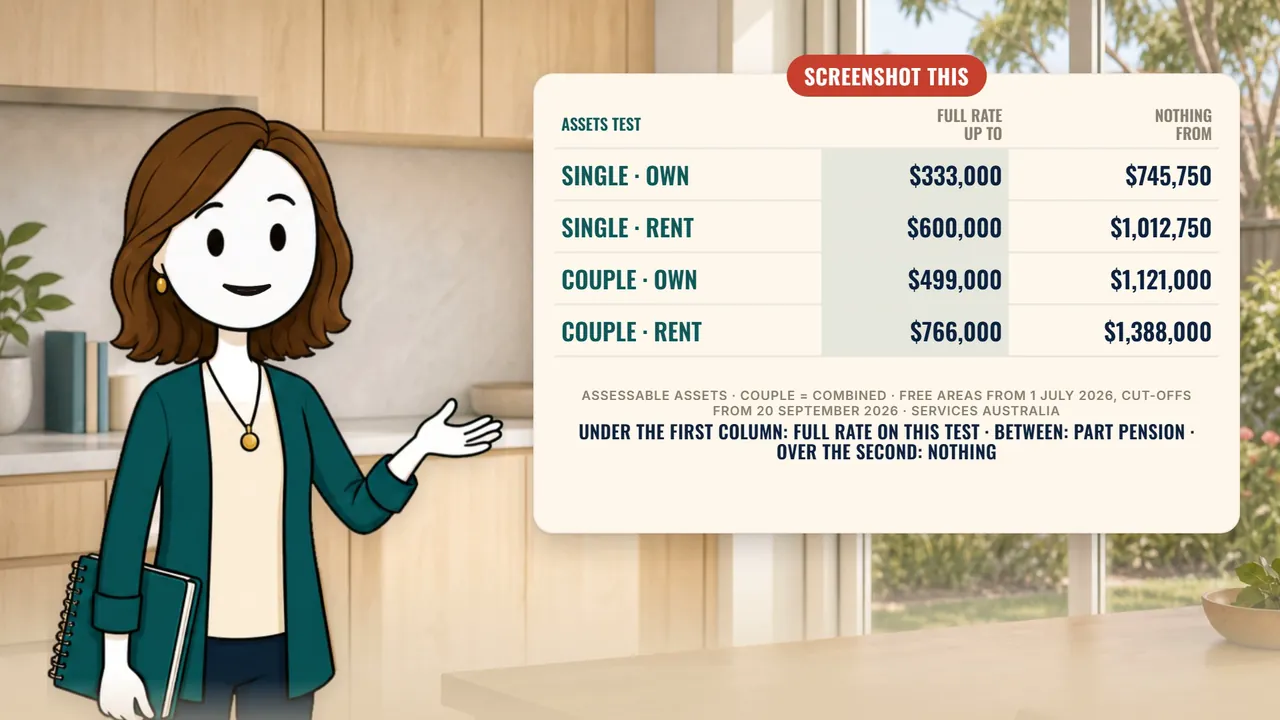
A renter's free area is higher because a renter doesn't have a home that's been left out. A couple's free area is for everything the two of you own together, not each - and a couple where only one partner is old enough still uses the couple free area, against both partners' assets.
Worked example: Robyn's assets test
- Add up her assessable assets (the home is left out): $420,000 + $35,000 + $18,000 + $10,000 = $483,000.
- Take off the single homeowner free area: $483,000 - $333,000 = $150,000 over.
- $3 for every $1,000 over: 150 x $3 = $450 a fortnight off.
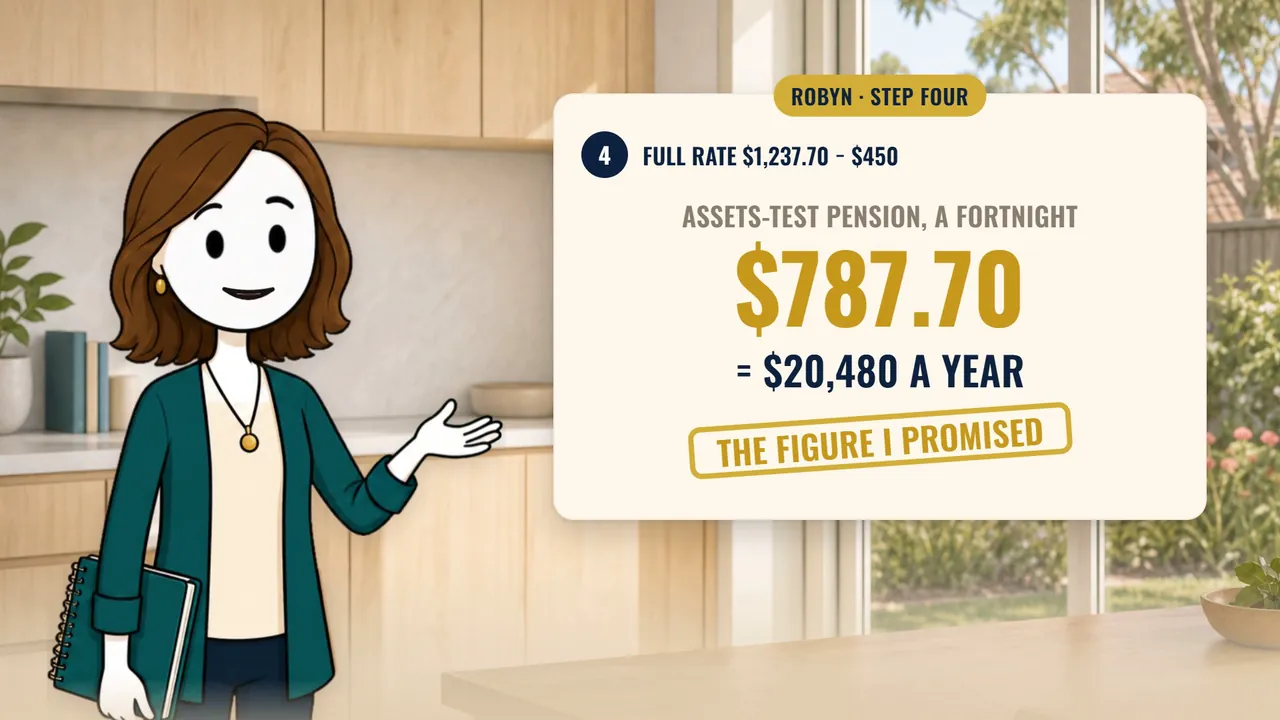
- Take that off the full rate of $1,237.70: $787.70 a fortnight - about $20,480 a year.
The income test (number 5) would pay her more, so the assets test is the one that applies. Robyn gets a bit under two-thirds of the full pension on top of her own super, and every extra $1,000 she owns above the free area costs her $78 a year.
Two practical notes. Value your car and contents at what they'd fetch second-hand. And Centrelink revalues pension accounts and shares automatically twice a year - but if your balance drops, you can ask for a reassessment at any time.
Graham and Lyn: a couple with an age gap
Graham is 68 and retired, with his super in an account-based pension. Lyn is 62 and works part-time, with her super in accumulation.
| Graham and Lyn | Amount |
|---|---|
| Graham's account-based pension | $350,000 |
| Lyn's super (accumulation) | $280,000 - not counted |
| Savings | $60,000 |
| Cars and contents | $30,000 |
| Lyn's part-time wages (assumed) | $1,500 a fortnight |
Lyn's super isn't counted at all: she's under 67 and the fund isn't paying her anything. So their assessable assets are $350,000 + $60,000 + $30,000 = $440,000 - under the couple homeowner free area of $499,000. On the assets test, Graham gets the full partnered rate of $933.00 a fortnight.
It's Graham who's paid, not the couple: only a partner who has reached 67 can get the Age Pension. But the test looks at everything both of them own - except, for now, Lyn's super. At number 7, one decision of Lyn's makes that balance visible overnight.
If your assets are over the cut-off, it isn't necessarily the end. There's a hardship provision for people in severe financial hardship, and the Home Equity Access Scheme lets a homeowner of pension age borrow against the home - a loan, repaid later.
5. The income test: deeming and the Work Bonus
Centrelink doesn't use what your savings actually earn. It decides for you instead. That rule is called deeming, and it's why a term deposit and a share portfolio are treated exactly the same way.
How deeming works
Deeming assumes your financial assets - bank accounts, shares, managed funds, and super once you're 67 - earn a set rate:
| Deeming (rates from 20 September 2026, thresholds from 1 July 2026) | Single | Couple (combined, at least one on a pension) |
|---|---|---|
| 1.75% on the first | $66,800 | $110,600 |
| 3.75% on the rest | above $66,800 | above $110,600 |
If your money earns more than that, the extra isn't counted. If it earns less, Centrelink still assumes the set rate. So you can chase a better return without being penalised, but a term deposit paying less than the deemed rate is still deemed at the full rate. An account-based pension started since 1 January 2015 is deemed too - Centrelink looks at the balance, not what the pension pays you. (Robyn's and Graham's pensions in these examples started after that date.)
The income free area and taper
| Income test | Free area (a fortnight) | Above it |
|---|---|---|
| Single | $226 | the pension drops 50c per $1 |
| Couple (combined income) | $396 | each partner's pension drops 25c per $1 |
Worked example: Robyn's income test
- Her financial assets are the pension account and the bank: $455,000 (the car and furniture drop out here).
- Deemed income: $66,800 x 1.75% + $388,200 x 3.75% = $15,726.50 a year - $604.87 a fortnight.
- Over the free area: $604.87 - $226 = $378.87.
- Halve it (50 cents in the dollar): $189.43.
- Income-test pension: $1,237.70 - $189.43 = $1,048.27 a fortnight.
That's more than the assets test gave her ($787.70), so she's paid under the assets test. Lower wins. Robyn's problem isn't her income - it's what she owns.
Which test bites depends on your mix of assets and income, so both always have to be run. Change one thing - sell a car, start a pension, take a part-time job - and the test that applies can flip. Centrelink does the flip automatically.
Worked example: Graham's income test while Lyn works
- Their financial assets are Graham's $350,000 and their $60,000 of savings: $410,000. Deemed at the couple rates: $13,163 a year - $506.27 a fortnight.
- Lyn's wages count in full: $506.27 + $1,500 = $2,006.27 a fortnight.
- Over the couple free area: $2,006.27 - $396 = $1,610.27.
- Graham's pension drops 25c per dollar: $402.57.
- Graham's pension: $933.00 - $402.57 = $530.43 a fortnight - a bit over half the partnered rate. The income test is lower than the assets test here, so that's what he's paid.
When Lyn stops work, her wages leave the test. Deemed income of $506.27 is $110.27 over the free area, which costs $27.57, so Graham's pension rises to $905.43 a fortnight - $375 a fortnight more. Lyn's part-time work is worth her wages minus about a quarter of them in Graham's lost pension: still well ahead, but a real cost to know about.
The Work Bonus
If you're on the Age Pension and you work, the first $300 a fortnight of your own employment or self-employment income is ignored by the income test. Unused amounts build up as a credit, up to $11,800, that you can use later - for example if you pick up a casual job. It's also available on Carer Payment and the Disability Support Pension once you're Age Pension age. Some people still on the old transitional rate of pension from 2009 have different income-test rules and don't get the Work Bonus.
It doesn't help Lyn. She's under 67 and not on a pension, so her wages count in full. That's the age-gap effect in one sentence.
Two more things on income. Rent from an investment property counts as income, and the property counts as an asset - both tests at once. And the Age Pension is a taxable payment: Centrelink doesn't take tax out automatically, but it will if you ask.
6. How long will your super last?
The usual question is whether the super will run out. The better question is what the pension does while the super is falling - because it isn't standing still.
Minimum drawdowns
Once your super pays you an account-based pension, you must draw at least a minimum each year, as a percentage of the balance (the ATO's table):
| Age | Under 65 | 65-74 | 75-79 | 80-84 | 85-89 | 90-94 | 95+ |
|---|---|---|---|---|---|---|---|
| Minimum a year | 4% | 5% | 6% | 7% | 9% | 11% | 14% |
There's no maximum - you can draw more whenever you need to. The minimum is worked out on your balance at 1 July each year, and pro-rated in the year you start; your fund does the sum. From 60, payments from a taxed super fund are generally tax-free. Some public sector schemes work differently - your fund can tell you which kind it is.
Robyn spends $45,000 a year and her pension covers about $20,480 of it. So she draws about $24,500 a year from her super - a bit above her 5% minimum of $21,000.
The Age Pension is a floor
Suppose Robyn's balance falls, because she's drawing more than it earns or because markets have a bad run. While she's above the free area, every $1,000 her assets fall puts $78 a year back on her pension.
- If her super is $100,000 lower, her assets are $383,000 and her pension is $1,087.70 a fortnight - about $7,800 a year more.
- Once she's back at the free area, the assets test pays the full rate and the income test takes a small slice for her deemed income: about $1,156 a fortnight, close to the full rate.
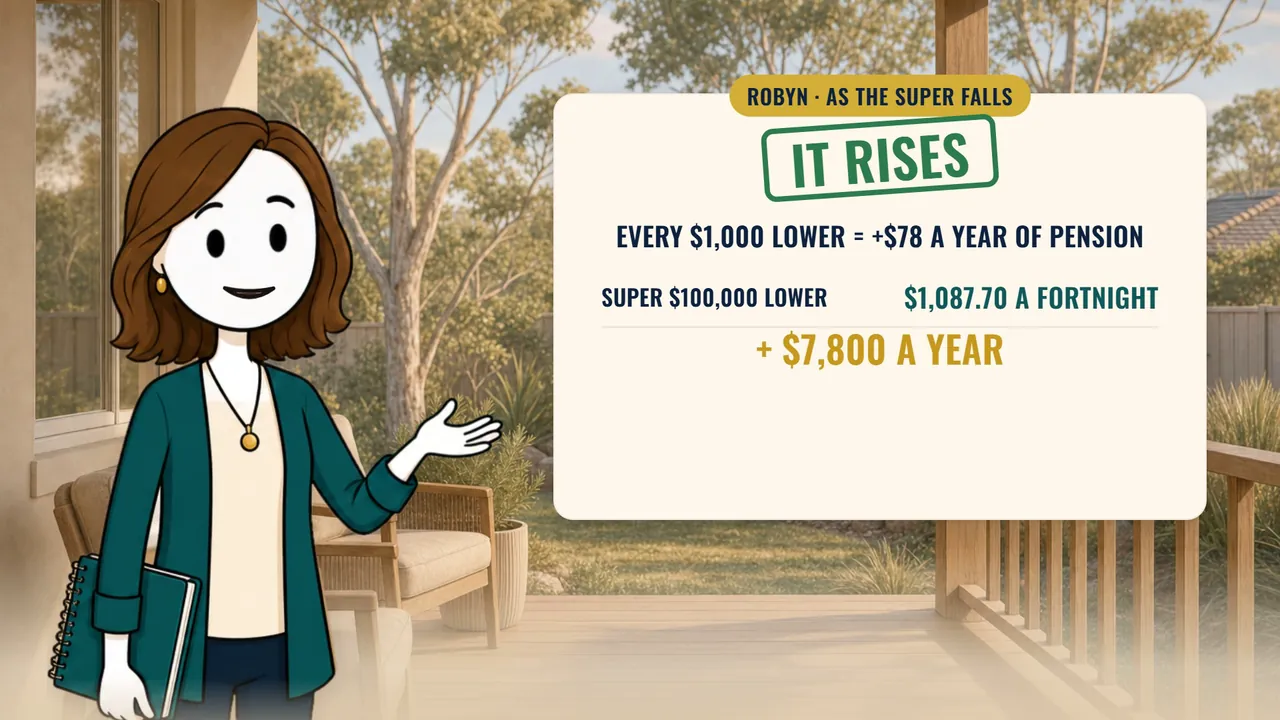
So the Age Pension is a floor that rises as the super falls. The super isn't carrying the whole load, and the load gets lighter as it goes. Spending $45,000 with a pension that rises toward about $30,000 still means drawing on the balance - but the gap she has to fill shrinks over time instead of staying fixed.
What this can't tell you is what her super will earn, or how many years it lasts. That depends on markets, and on the order good and bad years arrive in - a real risk called sequencing risk, and a personal one for an adviser.
One exception. If you're under 67 and on a means-tested payment - the Disability Support Pension, Carer Payment or JobSeeker - or your partner is on the Age Pension, starting an account-based pension makes that balance assessable. Check before you start one.
7. The gap before 67 - and the trap inside it
Stop work at 62 and there are five years before the Age Pension. There are four ways to fund the gap, and many people use a mix.
Door 1: your super
From 60, once you've retired, you can take lump sums or start an account-based pension, tax-free from a taxed fund. The catch: super in accumulation is invisible to Centrelink, but the day it pays you a pension, it's an asset and deemed income - for any means-tested payment in the household.
Door 2: a transition to retirement pension
From preservation age, while you're still working, you can draw part of your super each year as a pension without retiring - at least 4% and at most 10% of the balance a year. You can't take lump sums from it until you retire or turn 65. Centrelink treats it like any other super pension: visible.
Door 3: part-time work
Wages are wages. There's no Work Bonus until you're Age Pension age and on a pension. If you're on JobSeeker, wages reduce it under its own income test.
Door 4: JobSeeker
JobSeeker is an income support payment for people under 67 who are looking for work. From 20 September 2026 the base rate is $824.90 a fortnight for a single person with no children, $883.30 for a single person aged 55 or over after nine continuous months on an income support payment, and $755.10 each for partners, plus the Energy Supplement (a small extra amount paid with the rate).
- Its income test is steeper than the pension's: income over $150 a fortnight reduces it by 50c per dollar up to $256, then 60c above that. A partner's income over $1,440 a fortnight also reduces it.
- It has an assets test, and it's a cliff, not a slope: go over $333,000 (single homeowner; $600,000 non-homeowner, $499,000 or $766,000 for a couple combined) and JobSeeker stops altogether. Super in accumulation still doesn't count.
- Savings and payouts can delay the first payment. Liquid assets over certain limits can mean a wait of 1 to 13 weeks, and a leave or redundancy payout when you finish work can delay it further.
- It has mutual obligations - the activities you must do to keep the payment. From 60, 30 hours a fortnight of approved volunteering can fully meet them. Between 55 and 59 the rules are different for the first 12 months on a payment.
So under 67, JobSeeker can be the floor instead of the Age Pension for someone under those asset limits, with its own conditions. Across all four doors, notice what each does to Centrelink's view of you: wages are visible, a super pension is visible, super in accumulation isn't.
The age-gap trap: moving super into pension phase too early
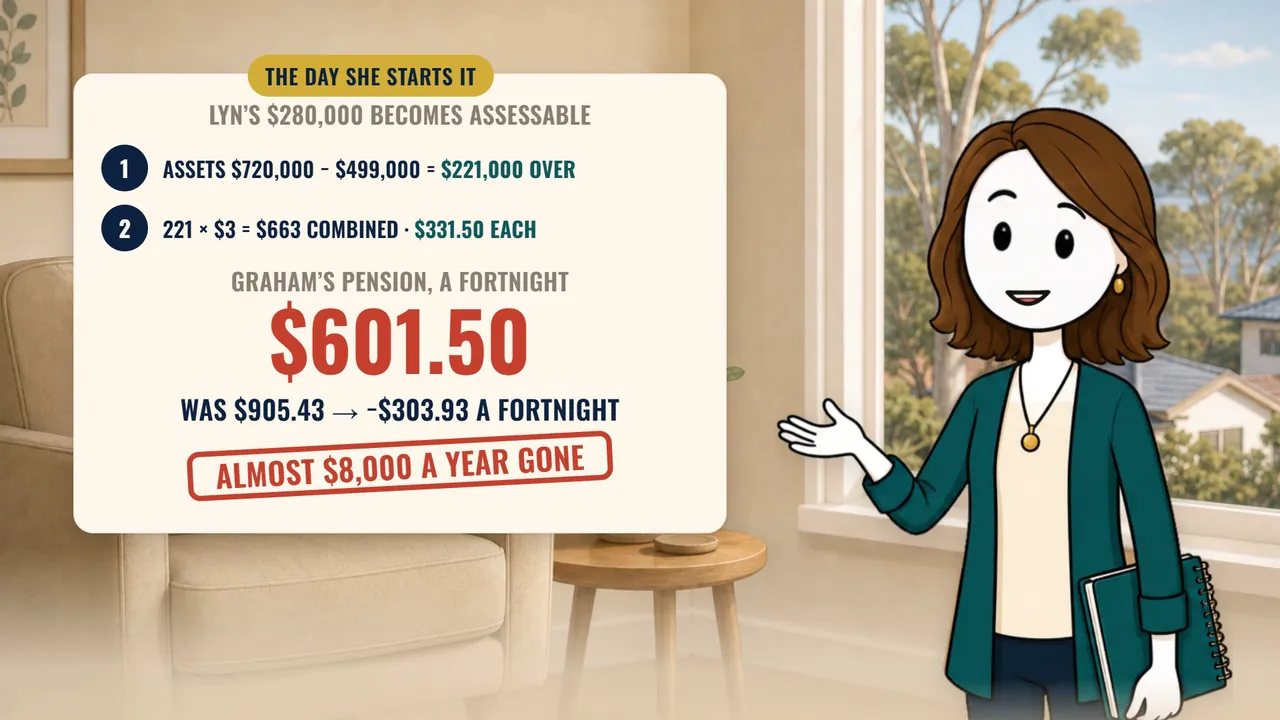
Back to Graham and Lyn. Lyn is 62 and has just stopped work, so Graham is on about $905 a fortnight. Lyn has reached preservation age and retired, so she can move her $280,000 into an account-based pension. It looks sensible - lower tax on earnings, a regular income. Here's what it does:
- The day she starts it, her balance becomes assessable. Their assets jump from $440,000 to $720,000.
- That's $221,000 over the couple free area: 221 x $3 = $663 a fortnight off the couple, $331.50 each.
- Graham's pension falls to $933.00 - $331.50 = $601.50 a fortnight.
- That's $303.93 a fortnight less - almost $8,000 a year of pension gone.
Not because they have more money - because the same money moved from an invisible box to a visible one. The same thing happens, on a smaller scale, if she starts a transition to retirement pension while still working: Graham's pension drops to $429.47 a fortnight, about $2,600 a year less. And it isn't only super: if Lyn took a lump sum out and put it in the bank, that's a financial asset too, counted and deemed from the day it lands.
When Lyn turns 67 her super becomes visible anyway - but by then she's paid too. With the same balances, they'd each get $601.50 a fortnight: two part pensions instead of one.
None of that says Lyn shouldn't start a pension. It says the pension Graham gives up is part of the price, and it belongs in the comparison. The same mechanic applies to anyone on the Disability Support Pension, Carer Payment or JobSeeker.
8. Your home, gifts, and why spending for a bigger pension can cost you
Your home
The home you live in is exempt from the assets test, on up to 2 hectares on the same title, whatever it's worth. That's why a homeowner's free area is lower than a renter's.
Selling it: if you sell your home, the money you plan to put into your next home stays exempt from the assets test for up to 24 months (up to 36 in some circumstances), and is deemed at the lower rate. Anything beyond the cost of the next home is just money in the bank - counted and deemed.
Downsizer contributions: if you're 55 or over and you and/or your spouse have owned the home for at least 10 years, up to $300,000 per person of the sale proceeds can go into super outside the normal caps, within 90 days of receiving the proceeds (usually at settlement). In accumulation, that money is invisible until 67, then counted. Downsizing can change your pension either way, which is why Services Australia suggests talking to its Financial Information Service before you decide.
A retirement village has its own rules: whether Centrelink treats you as a homeowner depends on the entry contribution you paid. Ask before you sign.
Gifting
You can give away anything you like, but Centrelink only treats a gift as gone up to a limit: $10,000 a financial year, and $30,000 over five financial years. Anything above that is still counted as your asset, and deemed, for five years - and that applies to other Centrelink payments too.
If Robyn gives a grandchild $30,000 in one go (and has made no other gifts in the last five years), the first $10,000 counts as gone and the other $20,000 stays on her books. Her pension rises to $817.70 a fortnight - exactly the same as if she'd given $10,000. The gift is real; the pension effect is capped.
The spending trap
Robyn is $150,000 over the free area, and every $1,000 she spends puts $78 a year back on her pension. So wouldn't it pay to spend?
Say she spends $20,000 on a new kitchen. Her assets fall to $463,000 and her pension rises to $847.70 a fortnight - about $1,560 a year more. At that rate it takes almost 13 years to get the $20,000 back, before counting what the money would have earned.
Spending to get more pension rarely pays: it takes almost 13 years to get the money back, and the extra pension stops anyway once your assets would have fallen to the free area. Spending because you want the kitchen is a different, perfectly good question - but the pension on its own isn't a reason. The same logic covers paying down the mortgage on your home, prepaying a funeral or putting money into the house: each can lift the pension, and each means the money is no longer in your hands.
9. Your last working year, and the tax deduction you can lose for good
Leave payouts and redundancy
When you retire, unused annual leave and long service leave are paid out as a lump sum. For leave built up since the early 1990s, that's taxed as ordinary income, at your marginal rate, in the year you receive it.
A genuine redundancy is different. If it happens before Age Pension age, part of the redundancy payment is tax-free: in 2026-27, $13,598 plus $6,801 for each complete year of service. The leave payout itself is still taxed.
Which side of 30 June
A leave payout lands in whichever tax year it's paid. Finish in late June and it stacks on top of a full year of wages; finish in early July and it lands in a year where it might be most of your income. Same payout, different marginal rate - whether it's worth moving a finish date is a question for your accountant.
Contribution caps run by financial year too, and what counts is the day the fund receives the money.
Contribution caps (2026-27)
- Concessional cap: $32,500. It covers employer contributions, salary sacrifice and personal contributions you claim a deduction for, all added together. If your total super balance (everything you hold in super) was under $500,000 at the previous 30 June, unused cap from the previous five years can be carried forward.
- Non-concessional cap: $130,000 of after-tax money a year. If you're under 75, you may be able to bring forward up to three years ($390,000) in one go, depending on your total super balance.
Go over either cap and the ATO assesses extra tax. The caps are a ceiling, not a target, and the ceiling is lower than it looks once employer contributions are counted.
The notice-of-intent trap
To claim a tax deduction for a personal super contribution, you must give your fund a notice of intent and get its acknowledgment back. And the order matters: the notice isn't valid once the fund has started paying a pension using any of that contribution, or after you've rolled it to another fund. It also has to be in before you lodge your tax return for that year, or by the end of the following financial year if that's earlier. Start the pension first, and the deduction on that contribution is lost - not reduced, lost. And from 67 to 74, you must also meet the work test - at least 40 hours of work in a consecutive 30-day period that year - or qualify for its one-off exemption, to claim the deduction.
In order: contribute, lodge the notice, wait for the acknowledgment, then start the pension.
10. The countdown to your last working day
Here's everything above as a timeline.
Three years out
- Write the one page from number 3: every account, balance, type, insurance and nomination.
- Check your insurance against what you actually need.
- Do the spending exercise from number 2, lumpy costs included.
- Book a free session with the Financial Information Service at Services Australia - call 132 300 (or your usual Centrelink line if you're already on a payment) and ask for FIS.
One year out
- Work out which of the three ages applies to you, and when.
- Check the contribution caps and any carry-forward you have.
- Decide, with advice if you need it, whether your super will pay a pension or stay in accumulation - and if anyone in the household is on a means-tested payment, run the age-gap check from number 7 before anything moves.
- If you're approaching 67, you can submit your Age Pension claim in the 13 weeks before you reach Age Pension age. Start early - it asks for a lot of paperwork.
90 days out
- Settle your finish date, and which side of 30 June it falls.
- Lodge any notice of intent and wait for the acknowledgment before a pension starts.
- If you've sold a home, remember the downsizer window runs from when you receive the proceeds.
- Make sure your myGov account is linked to both the ATO and Centrelink.
Little of this is complicated. Nearly all of it is about doing things in the right order. And after you've retired, tell Centrelink when things change, check your pension rate each March and September, and look at the one page once a year. The rules here change rarely; the figures move during the year - rates in March and September, free areas and caps in July.
Putting your own numbers through it
The hard part isn't understanding the rules. It's putting your own numbers through them, in the right order. You can do that with a pen and this guide - everything you need is here.
If you'd rather have it laid out for you, there's a workbook version that follows the same ten steps in the same order. It doesn't tell you what to do. It gets your own numbers onto paper, so a conversation with the Financial Information Service or an adviser starts in the right place.

The Retirement Countdown Workbook
Everything in this guide, laid out for your own numbers - for anyone within a few years of stopping work, or helping a parent who is.
- The one page for every super account
- The lumpy-spending worksheet
- Both Age Pension tests, set out step by step
- The countdown as tick-box lists: three years, one year, 90 days
A$27 incl. GST - free updates every time the rates change - 30-day money-back guarantee.
Frequently asked questions
What is the retirement age in Australia?
There isn't one. You can stop work whenever you like. What matters are three ages: 60 (preservation age, when you can take your super once you retire, if you were born on or after 1 July 1964), 65 (when super opens regardless of work) and 67 (Age Pension age).
Is my super counted for the Age Pension before I turn 67?
Not while it stays in accumulation and isn't paying you a pension. Once your fund pays you a pension from it - or once you reach Age Pension age - it's counted in the assets test and in the income test. An account-based pension started since 1 January 2015 is deemed; other types of pension are assessed differently. The same applies to a partner's super.
How much do I need to retire in Australia?
It depends on what you'll spend, and whether you own your home. ASFA's comfortable budget for a single homeowner is $56,166 a year (June quarter 2026), and the full Age Pension pays $32,180. ASFA's lump-sum targets assume you own your home, receive a part Age Pension and draw down all your savings. Work out your own spending - lumpy costs included - and then how much of it the Age Pension covers at your level of assets and income.
When can I apply for the Age Pension?
You can submit your claim in the 13 weeks before you reach Age Pension age (67). Start early, because the claim asks for a lot of paperwork.
Can I get a part Age Pension if I own a home and have savings?
Often, yes. A single homeowner can have assets up to $745,750 and a couple homeowner up to $1,121,000 before the assets test stops the pension entirely (from 20 September 2026), though the income test can stop it earlier.
Sources
- Services Australia - How much Age Pension you can get - single $1,237.70, couple $933.00 each from 20 September 2026; Age Pension is a taxable payment
- Services Australia - Assets test for Age Pension - free areas (1 July 2026) and cut-offs (20 September 2026)
- Services Australia - Income test for Age Pension - $226 / $396 free areas, 50c / 25c tapers
- Services Australia - Deeming - 1.75% / 3.75% (from 20 September 2026), $66,800 / $110,600; home-sale proceeds at the lower rate
- Services Australia - Superannuation - when super is and isn't counted
- Services Australia - How Work Bonus works - $300 a fortnight, $11,800 maximum balance
- Services Australia - How much you can gift - $10,000 a year, $30,000 over 5 years
- Services Australia - Real estate assets and Asset types - the home, 2 hectares, 24-month exemption on sale proceeds
- Services Australia - How much JobSeeker Payment you can get, income test, income and assets tests, when your first payment comes and mutual obligations if you're 55 or older - rates from 20 September 2026
- Services Australia - Commonwealth Seniors Health Card and How to prepare to claim Age Pension - claiming in the 13 weeks before Age Pension age
- Services Australia - Financial Information Service
- ATO - Payments from super - minimum annual payment rates
- ATO - Contributions caps - 2026-27: $32,500 concessional, $130,000 non-concessional, carry-forward under $500,000
- ATO - Employment termination payments - genuine redundancy tax-free amounts 2026-27
- ATO - Downsizer super contributions - $300,000, age 55, 90 days
- ATO - Personal super contributions - the notice of intent and the work test from 67 to 74
- ATO - Transition to retirement
- Moneysmart - Insurance through super - when cover usually ends; the 16-month rule
- ASFA Retirement Standard - June quarter 2026 budgets
General information only. This article is general information only. It doesn't take into account your objectives, financial situation or needs, and it isn't personal financial advice. Speak with a licensed financial adviser about your own situation. Services Australia's Financial Information Service (132 300) is free. Figures are current from 20 September 2026 and change every March, July and September - check servicesaustralia.gov.au and ato.gov.au for the latest.
A note on how this is made: Every article starts with real research and is checked against current ATO and Services Australia figures - that part isn't automated. AI tools help draft the text and produce the video's narration and visuals. We write, verify and stand behind every word.
Keep reading
- Age Pension vs UK State Pension, US Social Security and NZ Super: Who Pays More?
- Average Super Balance at Retirement in Australia - and What the Age Pension Adds
- The Deeming Rate Trap: Why Your Age Pension Rise Is Smaller Than the Headline (video)
- Transition to Retirement Australia: The 15% Rule Most Miss (video)
- Can You Get JobSeeker Before Your Super Unlocks? (Australia 2026) (video)